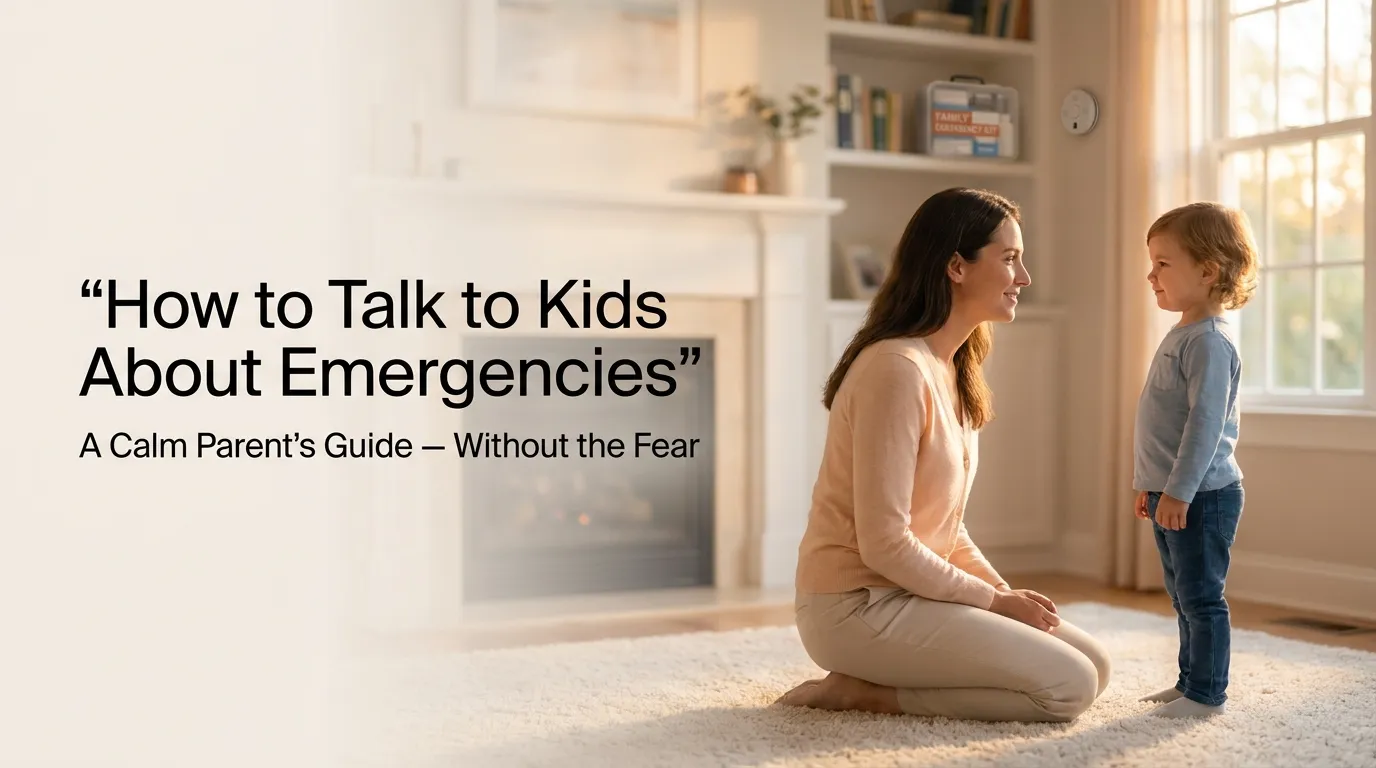
I still remember the exact moment I realized I had no idea how to do this.
My youngest was five. We had just watched a short news clip about a storm, and that night he tugged my sleeve at bedtime and whispered, “Mom, can our house break too?”
My heart dropped. I froze.
I wanted to say the right thing, but instead I mumbled something like, “Don’t worry about it, go to sleep.” I felt like a fraud. I had spent years telling people about safety, yet I couldn’t calm my own child.
That little question stayed with me for weeks. It made me dig into how parents can prepare kids for real emergencies without handing them a suitcase full of worry.
Why This Conversation Feels So Heavy on Parents
If you have ever felt stuck between “I need to protect my child” and “I don’t want to scare them,” you are not alone. This is one of the hardest tightropes parents walk.
We live with a quiet fear in the back of our minds. What if there is a fire? What if I’m not there when something happens? What if my child freezes instead of acting?
So many of us end up doing one of two things. We either avoid the topic completely, hoping nothing bad ever happens. Or we overload our kids with warnings until they start seeing danger everywhere.
Both paths steal something from us. Avoidance leaves kids unprepared and confused when a real event happens. Overwarning creates anxious children who cry at fire drills or refuse to sleep alone.
And it wears on you too. You lie awake replaying “what if” scenarios. You feel guilty when you snap at your kids for being scared. You wonder if you are somehow doing this parenting thing wrong.
Here is the truth I learned the hard way. A child who understands what to do feels safer, not more scared. Fear grows in the dark spaces of the unknown. When kids know the plan, that unknown shrinks.
The goal is not to hide the world from your child. The goal is to hand them a small flashlight so the dark feels less scary.
Start With Calm, Because Kids Read You First
Before you say a single word about emergencies, your child is already reading your face and your voice.
Kids are tiny emotion detectors. If you talk about a house fire with a shaky voice and wide eyes, they will match your panic. If you talk about it the same way you explain crossing the street, they will treat it as normal and manageable.
So the first move is you. Take a breath. Get your own nerves settled before the talk.
I learned this myself when I tried to teach my kids our fire escape plan. My voice was tight and rushed, and my daughter started tearing up before I even finished. I realized the fear was coming from me, not the topic. The next day I tried again with a calm, steady tone, and it went completely differently.
Experts back this up. The idea of a parent staying calm to reduce a child’s stress is central to guidance from the American Red Cross on preparing families for emergencies. Your calm becomes their calm.
A Quick Word Swap That Changes Everything
The words you pick matter more than you think. Small changes turn scary talks into steady ones.
- Instead of “Someone might break in,” try “We lock our doors to keep our home cozy and safe.”
- Instead of “The house could burn down,” try “If we ever smell smoke, here is our smart plan to get outside fast.”
- Instead of “You could get lost and never find us,” try “If we get separated, here is exactly how we find each other again.”
See the shift? You are still teaching the same safety skill. You are just framing it around the plan, not the disaster.
Match the Talk to Your Child’s Age
One reason these talks go sideways is that we give five-year-olds information meant for twelve-year-olds. Age-matched talks keep fear low and understanding high.
A toddler does not need to know statistics about house fires. They need to know how to hold your hand and walk to the “safe meeting tree” outside.
An older child can handle more. They can learn how to call for help, how to check if a door is hot, and how to help a younger sibling.
Guidance from public safety offices, like this county guide on helping children cope with disaster, stresses giving simple, honest, age-right facts. Say what is true, but only as much as their age can handle.
Here is a simple way I think about it:
| Age Group | What They Can Handle | Keep the Focus On |
|---|---|---|
| Ages 2–5 | Very simple ideas, short talks | Holding hands, meeting spots, “helpers” |
| Ages 6–9 | Basic plans, simple actions | Calling 911, escape routes, staying together |
| Ages 10+ | Full family plan, small responsibilities | Helping siblings, checking exits, backup contacts |
The beauty of matching the talk to the age is that your child never feels like the world is too big to handle. Each stage builds on the last.
If you want a deeper breakdown of readiness by age, our full family safety blueprint walks through it step by step.
Turn the Plan Into Play, Not a Lecture
Kids do not learn safety from long serious talks. They learn it through repetition and play.
This is where the magic happens. When you turn practice into a game, kids feel powerful instead of scared. They stop seeing emergencies as monsters and start seeing them as puzzles they already know how to solve.
We practiced our fire drill like it was a race. “Let’s see how fast we can get to the mailbox and count to ten together!” My kids laughed the whole time. But guess what stuck? The exact route out of the house.
Practicing your escape route until it feels boring is the best gift you can give your child. Boring means their body knows what to do even when their mind panics. You can make it fun with these fire escape drills for kids that we use at home.
Play-based practice works for more than fires. Practice the “what if a stranger talks to you” scenario as a role-play. Practice “what if you get lost at the store.” Practice “what if you are home and someone knocks.”
Watch this simple demo of a calm family emergency drill that kids actually enjoy — it shows exactly how to keep the mood light while teaching real skills, and the rest of this guide builds right on top of it.
Teaching the 911 Call Without the Fear
One skill every child should own is calling for help. But this is where parents often scare kids by accident.
Do not frame it as “call 911 when something terrible happens.” Frame it as “911 is a special phone number that connects you to a helper who wants to keep you safe.”
Practice it. Let your child say their full name, your name, and your home address out loud. Turn it into a memory game so it sticks.
Teach them the difference between a real emergency and a small problem. A skinned knee is not a 911 call. A parent who won’t wake up is. Kids feel proud when they understand that difference.
Help Anxious Kids Feel Steady
Some children carry more worry than others. If your child is anxious by nature, these talks need extra gentleness.
For anxious kids, focus heavily on control and helpers. Remind them that firefighters, police, teachers, and doctors are all trained to help. Even when you are not there, other helpers will be.
A calming tool many families use is the 3-3-3 rule for children. When your child feels panicked, they name 3 things they see, 3 things they hear, and move 3 parts of their body. It pulls their mind back to the present moment and out of the fear spiral.
This kind of grounding trick works because anxiety lives in “what might happen.” The 3-3-3 rule drags attention back to “what is happening right now,” which is almost always safe.
Child mental health guidance, including resources from the American Academy of Pediatrics on helping children after a crisis, points to routine, reassurance, and steady adult presence as the strongest comfort tools you have.
Keep normal routines going. Bedtime stories, family dinners, and hugs tell an anxious brain, “See? Life is still okay.”
Don’t Forget the Everyday Dangers Right at Home
We often picture emergencies as big dramatic events. But most childhood scares happen quietly inside our own homes.
Talking about everyday home dangers is part of the same calm conversation. And these talks are easier because you can point to real objects in real time.
Walk your child through the house like a friendly detective mission. Point out the things that need care, without making them terrifying.
- Certain houseplants can be poisonous if chewed, so we admire them with our eyes, not our mouths.
- Electrical cords stay in the wall, not in little hands.
- Some foods are choking risks for younger siblings, so we cut them small.
- Cleaning supplies and medicine live up high because they are only for grown-ups.
For a full room-by-room rundown, our guide on common household poison hazards and prevention makes this simple. Pairing it with a proper child-proofing home safety checklist covers the gaps most parents miss.
Myth vs Reality: Many parents think “my kid is old enough now, I don’t need to child-proof.” Reality? Curiosity outpaces judgment for years. A calm walk-through beats a scary lesson learned the hard way.
Even outdoor spaces deserve a mention. A quick review of backyard safety for kids covers pools, gates, and play areas that often get overlooked.
When Kids Are Home Without You
At some point, your child will be home alone or with a sibling. This is where all your calm practice pays off.
The key is confidence, not fear. A child who knows the plan for “who to call” and “what door to answer” feels grown-up and capable, not nervous.
Talk through simple rules together. Which visitors are okay. What to do if the phone rings. Where the emergency contact list lives.
Our home alone safety readiness guide breaks this into small steps, and pairing it with tips on managing visitors when kids are home alone covers the door-answering worry that stresses so many parents.
The message you want your child to carry is simple and steady. “You know what to do, and I trust you.” That single sentence builds more safety than a hundred warnings ever could.
Because in the end, this whole thing is not about scaring kids into being careful. It is about handing them quiet confidence, one calm talk at a time — so that when life gets bumpy, they feel ready instead of afraid.
Smart Habits That Keep Your Child Ready for Life, Not Just for Today
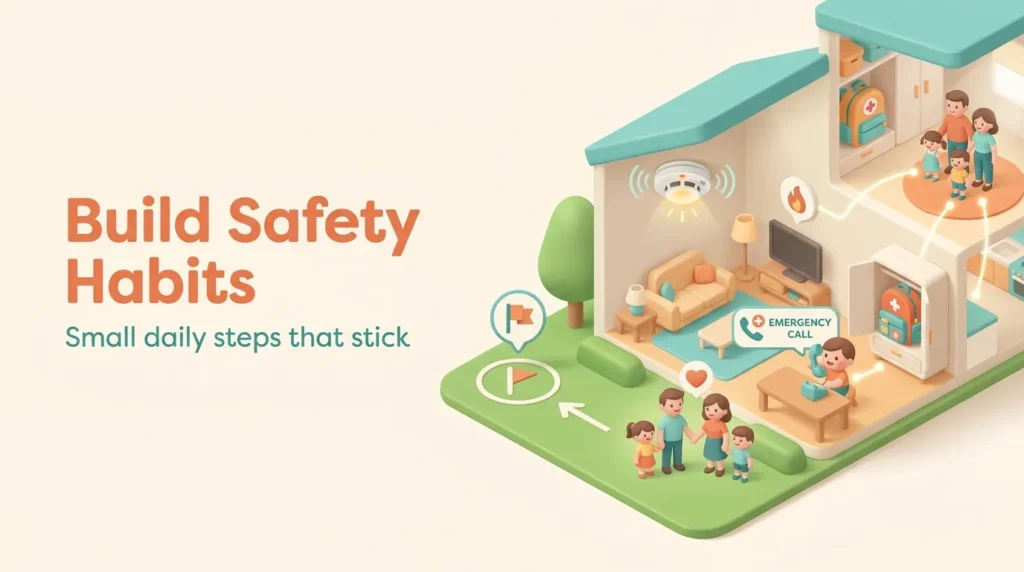
Having one good talk with your child is a great start. But real safety comes from small habits you repeat over time.
Think of it like brushing teeth. One brush does not keep cavities away. It is the daily habit that protects them.
The same goes for emergency confidence. You want these skills baked so deep that your child acts on instinct, even when they feel scared.
Make Safety a Normal Part of Everyday Life
The best trick I ever learned was to stop treating safety as a “big serious talk.” Instead, I fold it into normal moments.
When we buckle up in the car, I might say, “This is how we stay safe on bumpy roads.” When we pass a fire truck, we wave and remember our helpers.
These tiny moments add up. Your child stops seeing safety as scary and starts seeing it as simply part of how your family lives. Reinforcing habits like proper car seat safety and restraint use during daily drives keeps the lessons alive without a single scary word.
Keep Practicing in Short, Playful Bursts
You do not need long drills that bore everyone. Quick five-minute refreshers work far better.
Once a month, we do a surprise “safety quiz” over dinner. I ask silly questions like, “What is our meeting spot?” or “What do you say if you call 911?” Whoever answers first gets to pick dessert.
The goal is repetition without pressure. When practice feels like a game, kids remember it. When it feels like a test, they tense up and forget.
Update the Plan as Your Child Grows
A plan that fits a five-year-old will not fit a ten-year-old. Your family plan should grow right along with your child.
As they get older, hand over more responsibility. Let them help pack the emergency kit. Let them learn where the water shutoff is. Let them memorize a second contact number.
This slow handover builds real independence. According to preparedness guidance from Ready.gov’s resources for kids and families, involving children directly in planning helps them feel capable and lowers their anxiety about the unknown.
Watch for Their Emotional Cues
Every child processes fear differently. Some ask a hundred questions. Others go quiet and pretend they do not care.
Pay attention to changes. A child who suddenly clings, wets the bed, or has nightmares may be carrying worry they cannot name.
When that happens, slow down. Offer extra hugs and reassurance. Remind them that feelings are okay and that you are always there. This is the same steady care you would use when helping a child through any tough moment, much like the calm approach in our modern stranger danger tips.
Build a Support Circle Beyond Just You
Your child should know that safety is a whole team, not just Mom or Dad. This takes pressure off you and gives them more comfort.
Introduce them to their “trusted adults.” A grandparent, a neighbor, a teacher, or a family friend. Make sure your child knows who they can run to if you are not around.
If you use babysitters or caregivers, make sure they know your plan too. Taking time to properly vet a babysitter means your safety habits stay strong even when you step out.

The Well-Meaning Mistakes That Quietly Backfire
Even the most loving parents slip up here. I know I did. These missteps do not come from carelessness. They come from fear and love getting tangled up.
The problem is that some of these mistakes can undo all your good work. Worse, a few can leave your child more scared or less prepared. Let me walk you through the ones I see most.
Dumping too much information at once. When we finally get brave enough to talk, we sometimes unload everything in one sitting. Fires, floods, strangers, and break-ins all in ten minutes.
This overwhelms a child fast. Their brain cannot sort it all, so it just files everything under “scary.” Small, spaced-out talks always beat one giant fear session.
Waiting for the “perfect” moment that never comes. So many parents keep pushing this off. They tell themselves they will do it when the child is older, calmer, or less busy.
But emergencies do not wait for perfect timing. The child who never got the talk is the one who freezes when it counts. A “good enough” talk today beats a “perfect” talk that never happens.
Making promises you cannot keep. I did this myself with that “nothing bad will ever happen” line. It feels comforting in the moment, but it can break trust.
Kids are smart. When something does go wrong, they remember you said it would not. Instead, promise what is true: “I will always do everything I can to keep you safe, and we have a plan.”
Letting your own panic lead the talk. If you are terrified of storms, your child will learn to be terrified too. Our fears pass to our kids more easily than we think.
Work on your own calm first. If a topic makes you shake, practice talking about it out loud alone before you bring it to your child.
Forgetting to revisit the plan. A one-time talk fades fast. Kids forget details, and plans go stale as life changes.
Homes get remodeled. New siblings arrive. Phone numbers change. If you never review, your child may be practicing an outdated plan when the real moment hits.
Skipping the everyday home risks. We get so focused on big dramatic events that we forget the daily dangers. Yet falls, poisons, and choking send far more kids to the ER than storms do.
Do not overlook simple steps. Even something like preventing senior falls at home matters if grandparents live with you, since kids and elders often share the same spaces.
The heart of all these mistakes is the same. We let fear either freeze us into silence or push us into overload. The sweet spot is steady, small, and honest.
Common Questions Parents Ask About These Safety Talks
What is the 3-3-3 rule for children?
The 3-3-3 rule is a simple calming trick for anxious kids. When they feel panicked, they name 3 things they see, 3 sounds they hear, and move 3 body parts. It pulls their focus back to the present and quiets the fear fast.
At what age should I start talking to my child about emergencies?
You can start as early as age two or three with very simple ideas, like holding hands and knowing a meeting spot. As your child grows, you add more detail. The key is to match the message to their age so it never feels too heavy.
How do I talk about emergencies without scaring my child?
Stay calm, use simple words, and focus on the plan instead of the danger. Frame everything around helpers and what your family does to stay safe. When kids feel they have a job and a team, fear shrinks on its own.
How can I help my anxious child feel safe at home?
Keep routines steady and remind them of all the helpers around them. Use grounding tricks like the 3-3-3 rule when worry spikes. Extra hugs, honest answers, and a predictable daily rhythm do more than any lecture ever could.
How do I teach my child to call 911?
Practice it like a game with a toy or switched-off phone. Teach them to say their name, what is wrong, and their address. Make sure they know it is a brave, smart thing to do, never something they will get in trouble for.
Should I tell my child about scary news events?
Only share what fits their age, and keep it simple and honest. Turn off nonstop news coverage, since repeated images can frighten young minds. Focus on the helpers and remind them your family is safe and prepared.
Your Calm, Confident Next Step Starts Today
Here is the beautiful truth I want you to hold onto. Preparing your child for emergencies does not have to scare them, and it does not have to scare you either.
When you lead with calm, use simple honest words, and turn practice into play, you give your child something powerful. You give them confidence.
A prepared child is not a fearful child. A prepared child is a brave one. They walk through the world knowing they have a plan, a team, and a parent who trusts them.
So do not aim for perfect. Aim for started. One short talk this week is worth more than a flawless plan you keep putting off.
A Simple Action Plan for This Week
- Today: Pick one calm moment and name your family meeting spot together.
- This week: Practice the 911 call as a fun game with a toy phone.
- Weekend: Do a five-minute, playful escape drill and celebrate afterward.
- Ongoing: Fold tiny safety reminders into normal daily life, like buckling up or waving at helpers.
Keep it light. Keep it steady. Keep it going.
From my own home to yours, I promise this gets easier every single time you do it. That scared little question my son asked me years ago turned into one of the best things that ever happened to our family, because it pushed me to teach him calm confidence. Start your first small talk today, and watch your child grow braver right before your eyes.
Disclaimer: This article is for general informational and educational purposes only and does not replace professional medical, psychological, or emergency guidance. Every child is different, and if your child shows ongoing anxiety, distress, or trauma, please consult a licensed pediatrician, child psychologist, or qualified mental health professional. In any real emergency, always contact your local emergency services immediately.