A delivery truck once backed all the way up to my garage door, and I never heard the engine. My dog didn’t lift her head. Nothing physical stood between my house and the street, so anyone could pull in, turn around, or sit there for a minute, and I’d have no way of knowing.
Once I noticed that gap, I couldn’t stop noticing it. Packages go missing off porches because nothing slows anyone down before they reach the door. Cars use open driveways to turn around, and once in a while, one lingers longer than a turnaround should take. Kids and pets can wander toward the street with no real boundary stopping them.
I looked into hiring someone to close that gap, and the quotes made my decision for me. A contractor-built driveway gate can run well into the thousands once you add labor. A cheap DIY driveway gate gets you almost the same result for a fraction of that, as long as you get a few key details right. Here’s exactly how I did it, from the first phone call to the final coat of sealant.
What You Need Before You Start
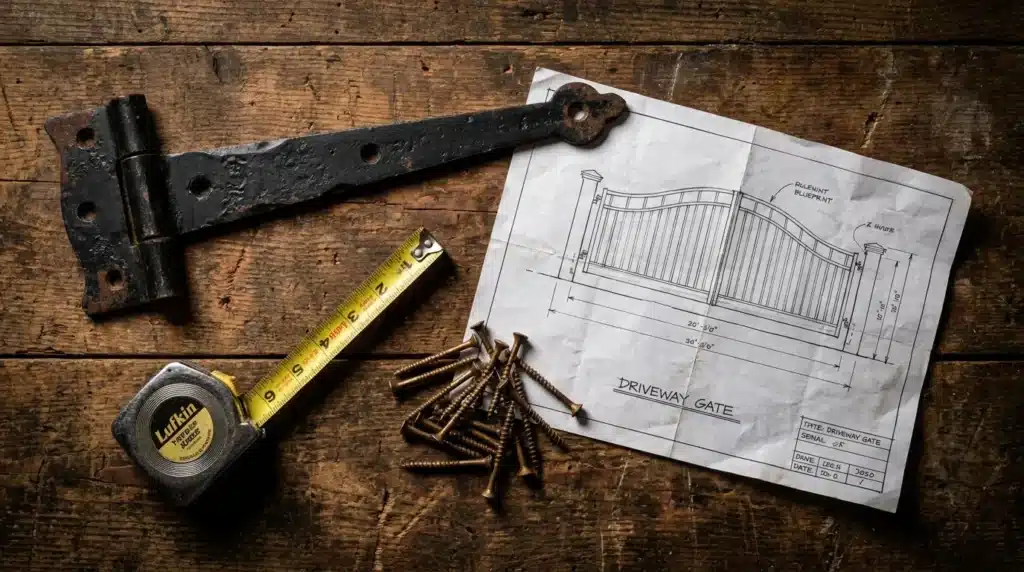
I didn’t buy a single board until I wrote out a full list and priced it against what I already had in the garage. Sticking to a real list is most of what keeps a budget driveway gate build actually cheap, since one impulse trip to the hardware store can blow the whole plan.
Tools and Materials Checklist:
- Tape measure and string line, for a straight, square layout
- Post hole digger, or a rented power auger if your soil pushes back
- Quick-set concrete mix (a 50-pound bag runs about $6 at most hardware stores)
- Pressure-treated lumber or steel tubing, depending on your chosen style
- Exterior wood screws or a welder, plus a heavy-duty hinge set (around $12 a pair)
- A slide bolt, chain-and-padlock kit, or a keypad lock
- Level, drill, and whatever saw you already own
Choosing a Material That Keeps It Cheap Without Cutting Corners
Most budget builds go wrong right here, when someone grabs whatever lumber looks cheapest without asking what six months of rain and sun will do to it.
| Material | Approximate Cost | Best For | Watch Out For |
|---|---|---|---|
| Pressure-treated wood | Low ($6–9 per 2×4) | Single swing gates, wood-fence homes | Warping if not sealed yearly |
| Steel tubing (2-inch) | Medium | Wide driveways, automated gates | Needs rust-proof paint or coating |
| Aluminum slat kits | Medium-High | Coastal or humid climates | Can flex on very wide spans |
For a first build on a tight budget, pressure-treated 2x4s and 4×4 posts are still the cheapest and most forgiving choice among cheap DIY driveway security gate ideas. Plan on a coat of weatherproof sealant every year so the wood doesn’t cup or crack.
Setting Posts That Actually Hold
Dig your post holes at least 36 inches deep, and go deeper if your winters bring hard freezes. Frost heave is the single biggest reason DIY gate posts start leaning within their first year. Cornell Cooperative Extension publishes region-by-region frost-depth guidance that’s worth checking before you dig, since it varies more than most people expect.
Pour the concrete, then walk away for at least 48 hours before hanging anything heavy. Rushing this step is how a post ends up tilted just enough to throw the whole gate out of square within a week, which usually means redoing work you already paid for once.
Bracing So the Gate Doesn’t Sag by Spring
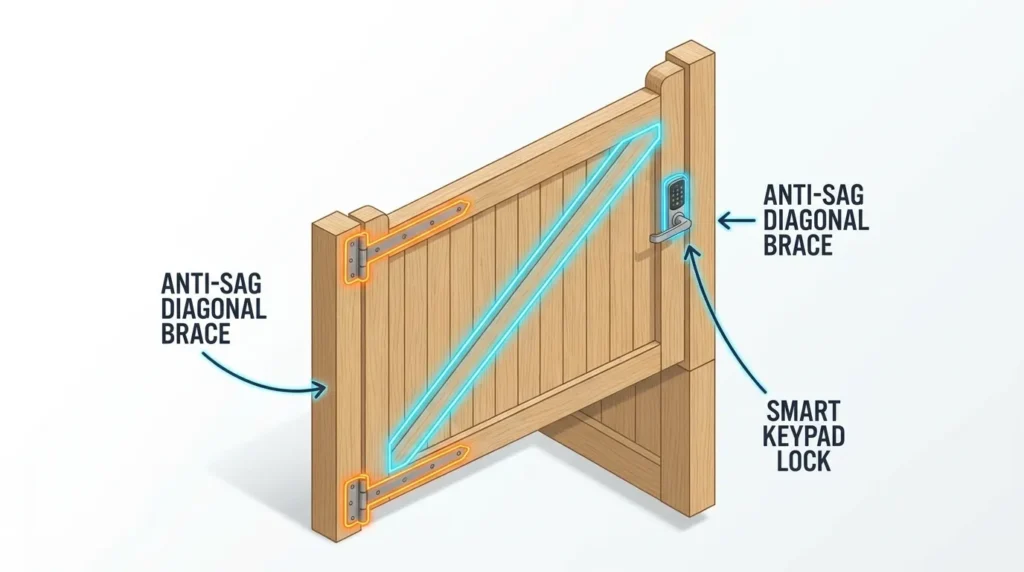
A driveway gate carries most of its weight on one unsupported edge, which is exactly where sagging starts. One diagonal brace, running from the bottom hinge-side corner up to the top opposite corner, does more against sag than a fistful of extra screws ever could, and it barely adds to the material cost.
Skip that brace, and within a few months you can watch the far corner drop a visible half-inch. Running the brace in the correct direction fixes it for good.
Watching someone frame and brace a gate in real time clears up a few details that measurements on paper can’t. This short video walkthrough covers the process before you start cutting:
Here’s a quick video that walks through framing and bracing a driveway gate before you pick up a saw.
Picking a Lock Worth Trusting
A gate without a real lock is just a fence panel on hinges, no matter how cheap or expensive the build was. A basic slide bolt with a weatherproof padlock runs under $20 total, and it’s still one of the best cheap driveway gate lock ideas out there. A keypad lock costs more upfront, but you never have to carry a key, and you can change the code any time you want.
If you’re rethinking the rest of your entry points at the same time, motion sensor lighting near the driveway pairs naturally with a gate, since motion sensor lights work as a deterrent after dark while the gate handles the barrier itself. Plenty of homeowners also add a camera pointed at the gate, though it’s worth knowing that not every camera setup deters intruders the way people assume.
The National Crime Prevention Council notes that visible barriers and controlled entry points are among the physical changes most likely to make a property look like a poor target, since many opportunistic intruders are simply looking for the fastest, quietest way in.
Before You Dig: Call About Permits
Some cities require a permit for anything over a certain height, or anything that could swing into a public right-of-way, and the rules shift block by block. The International Code Council keeps general reference material on residential fence and gate height rules, which is a reasonable starting point if you’ve never dealt with a permit office before.
One phone call now beats a fine, or a forced teardown, after a weekend of work, and a fine will erase your entire budget savings in one shot.
Finishing It So It Looks Like It Belongs
A gate that looks bolted on as an afterthought can drag a whole property down instead of lifting it up. Matching the finish to your fence or trim color fixes most of that instantly, and it’s the one step in a cheap DIY driveway gate build where a can of paint does more than money would. Curb appeal research from the National Association of REALTORS® consistently points to a defined, well-kept entry as a strong first impression, and that same clear boundary works quietly as a deterrent too.
Two gates into building these on my own property, the lesson that stuck with me most is simple: post depth, bracing, and the lock matter more than the finish ever will. Get those three right, and the paint job is the easy afternoon.
A driveway gate rarely works alone, and it pairs well with a few other habits around the property.
Related reads:
- Burglar-Proof Your Yard
- Nighttime Home Security Checklist
- Fake Presence Tricks to Deter Burglars While Away
Upkeep That Keeps a Cheap Build From Turning Expensive
Once the gate is standing and locked, the real work shifts to keeping it that way for years, not just weeks. Skipping upkeep is the single fastest way to turn a budget driveway gate into an expensive rebuild.
Start with the hinges. A cheap hinge set is usually the first thing to fail on a heavy gate. Swap in heavy-duty carriage bolts where the hinge meets the post instead of standard wood screws, since screws back out slowly from the constant swinging motion and bolts don’t.
If you built with wood, reseal it once a year, ideally right before your area’s wettest season. Skip that for a couple of seasons and the edges start cupping, and once wood cups, it never lays flat again.
Change your keypad code every few months if you added one. It’s the same logic as rotating a Wi-Fi password. A code shared with a dog walker, a contractor, or a house-sitting neighbor shouldn’t stay live forever, which is also worth remembering if you ever hand off a full checklist to someone watching your house while you’re away.
A solar motion light mounted directly on the gate post is one of the cheapest upgrades worth adding, often under $25 online. It needs no wiring, it charges itself during the day, and it lights up exactly the spot where someone has to stand to open the gate.
If your driveway is wide enough for a double-swing gate, add a drop rod on whichever panel gets opened less often. It locks that side straight into the ground, so the gate can’t be forced open from one panel even if the main lock fails.
Walk your gate once a season and check for wobble at the hinge post by hand. Catch it early and you’re tightening a bolt. Catch it late and you’re re-pouring concrete in the middle of winter, and that bill erases every dollar the cheap build saved you.
None of this makes a gate unbeatable, but it does make it slower, louder, and a lot less appealing to bother with, and for most opportunistic situations, that’s the whole point. The same logic applies to other entry points around the property, including anywhere packages tend to pile up near the street and any side or service door near the garage that gets overlooked.
Where Most Cheap Driveway Gate Builds Quietly Go Wrong
I’ve made a few of these mistakes myself, and none of them announced themselves on day one. They showed up months later, right when I was counting on the gate most, and every one of them turned a cheap build into a costly redo.
Skipping the permit call feels harmless when you’re eager to start building. It stops feeling harmless the day it shows up during a home sale or an insurance inspection.
Letting wood sit directly on bare soil is another one. Even pressure-treated lumber breaks down faster in dirt than it does resting on a concrete footing or a post base. My first post base was visibly soft within two years of skipping that step.
Mixing metals without thinking it through causes trouble too. Steel hardware against an aluminum gate, or the wrong screws in treated lumber, sets up corrosion right where the two metals touch. It looks fine at first, then one day the hinge is crumbling from the inside out.
Hanging the gate before the concrete cures is tempting when you want to finish in one weekend. It’s also one of the fastest routes to a gate that leans by the following season.
A shiny padlock on a thin hasp looks secure and isn’t. A lock is only as strong as what it’s screwed into, so a heavy-duty lock on a flimsy mount doesn’t do you many favors.
Don’t overlook swing direction, either. A gate swinging out into the street can be a real liability issue in some areas if it ever blocks a sidewalk or road, permit or no permit.
Look, none of these are dealbreakers. Catch them early and you’re looking at a few extra minutes of work, not a full rebuild.
Questions People Ask Before They Start Digging
What are some cheap DIY driveway security gate ideas?
Simple wood-frame swing gates, cattle-panel gates, and aluminum slat kits are the three easiest and cheapest builds for a first-timer. Wood gives you the most control over cost, while aluminum kits save time since a lot of the cutting is already done.
Do I need a permit for a driveway gate?
It depends on your city, county, and sometimes your homeowners’ association. A quick call to the local building department before any post holes get dug is the safer route.
Do driveway gates actually stop thieves?
A visible, locked gate makes a property look less like an easy target and makes it much harder for someone to approach unnoticed. It won’t stop someone determined, but it adds a real obstacle and a few extra seconds most opportunistic intruders aren’t willing to spend.
What’s the cheapest way to build a driveway gate?
A single-panel pressure-treated wood swing gate with a basic slide bolt is usually the cheapest route, especially if you already own basic tools. Costs climb fast once automation, welding, or a wide double-swing span gets added.
Can I install my own driveway gate?
Yes, plenty of homeowners hang their own gate over a weekend or two with basic tools. The trickiest parts are getting the posts perfectly plumb and giving the concrete enough time to cure before hanging anything heavy.
Before You Start
Let’s be real: a gate won’t turn your house into a fortress, and no brace, lock, or post depth ever will. But it makes a lazy burglar think twice, and for most driveways, that’s really the whole point.
If you’re still weighing whether to start, dig the first two post holes this weekend. Once those are set in concrete, the rest of the build tends to move faster than the planning did. A gate is just one piece of the puzzle, so it’s worth pairing it with the rest of your setup.
Related read:
Disclaimer: I’m a homeowner sharing what worked on my own property, not a licensed contractor. Before digging post holes or adding smart locks, double-check your local town codes or talk with a local fence professional to make sure you’re covered.