Why My Backyard Was Never As Safe As I Thought
I used to believe my backyard was the safest part of my house. My front door had a deadbolt. My windows locked. My alarm system covered every entry point I could think of.
Then one morning I walked outside and noticed my side gate had been left open all night. Nobody broke in. Nothing was stolen. But that one moment shook me.
I realized I had spent months worrying about my front door and almost zero time thinking about my yard. My bushes were overgrown enough to hide a person. My side gate had a flimsy latch a kid could pop open. My motion light hadn’t worked in weeks and I never noticed.
That was my wake-up call. I wasn’t dealing with one mistake. I was dealing with a whole list of small gaps I had never bothered to check.
If you’re reading this, you might be in the same spot I was. You feel good about your locks and your alarm, but you’ve never really walked your own yard the way a stranger would.
Here’s the hard truth: most break-ins don’t start at the front door. They start in the yard, where nobody’s watching, where the fence is low, and where a burglar can test a window or a gate without anyone seeing a thing.
That quiet, unseen part of your property is doing more to keep your family safe (or unsafe) than you probably realize.
Living with this kind of blind spot wears on you more than people admit. You start double-checking the gate before bed. You hear a noise outside and your mind jumps straight to the worst case. You stop letting your kids play in the backyard alone once it gets dark, even though it used to be their favorite spot.
It’s not just about stuff getting stolen. It’s about that nagging feeling that your own backyard, the place that should feel the safest, is actually the one part of your home you never really checked.
Some homeowners tell me they’ve caught themselves peeking out the window every time the dog barks at night. Others say they’ve started avoiding their own yard after dark, treating it like unfamiliar territory instead of their own property.
That’s not how it should feel. Your yard should be the place where your kids ride bikes and you grill on a Saturday, not a source of quiet stress.
The good news is that fixing this doesn’t require a huge budget or a complicated security system. Most of the fixes below cost very little, and some cost nothing at all.
The Step-by-Step Way to Lock Down Every Weak Spot in Your Yard
Building a Home That Looks Occupied, Even When It Isn’t
Burglars don’t like guessing games. They want a quick, quiet target, and an empty-looking house is exactly that.
A yard that looks lived-in is one of the strongest, cheapest deterrents you have. Keep a bike leaned against the porch. Leave a pair of gardening gloves and a watering can out near the flower bed. Small, everyday clutter signals that someone is home and active.
If you travel often, this matters even more. I learned this the hard way after a week-long trip left my yard looking untouched, with the same leaves piled in the same spot for seven straight days. If you want a full breakdown of how to keep your place looking occupied while you’re away, I put together a step-by-step guide on faking a lived-in presence that walks through timers, lighting patterns, and small daily habits.
You can also ask a neighbor to park in your driveway once or twice while you’re gone, or set porch lights on a rotating timer instead of a fixed on/off schedule. Predictable patterns are almost as easy to spot as an empty house.
Let There Be Light: Motion Sensors That Actually Work
Darkness is a burglar’s best friend. It gives them cover, time, and the ability to test a door or window without being seen.
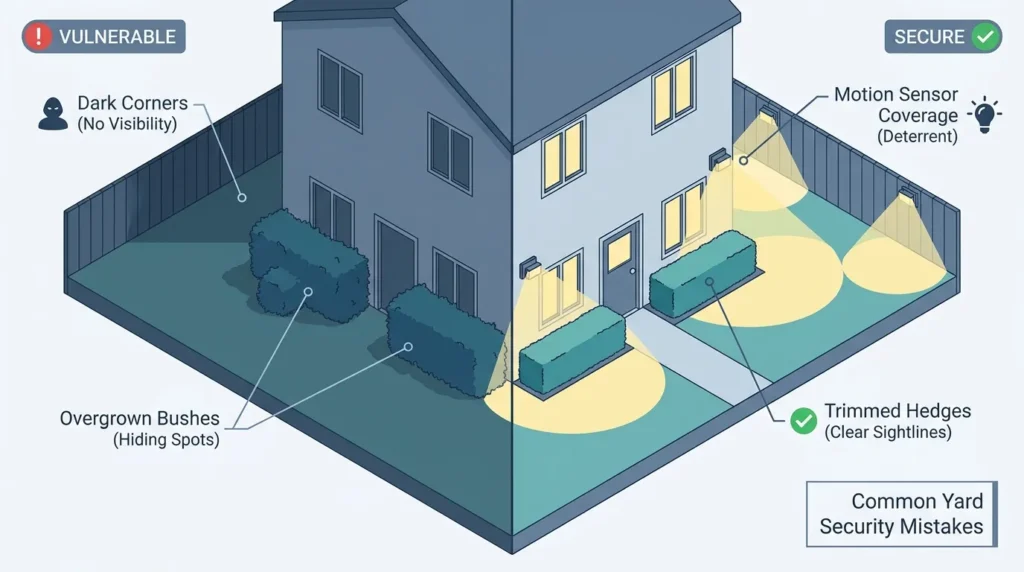
Motion-activated lighting removes that cover instantly. A sudden burst of light near a fence line or side gate is enough to make most people turn around and leave, simply because they no longer feel hidden.
Place your lights at the corners of your house, near gates, and along any path that leads to a back door or window. Avoid pointing them straight at the house, since that creates glare and actually makes it harder for your own cameras to pick up detail.
I made this mistake myself when I first installed motion lights. I aimed one directly at my back door, thinking it would light up anyone approaching. Instead, it washed out my camera footage every single time it triggered, and I couldn’t make out a single clear frame. Now I angle every light outward, toward the yard, not inward toward the house.
If you’re weighing options, government energy guidance on motion-activated outdoor lighting is worth a quick read, since the right sensor range and bulb type can cut your electricity use while still keeping the coverage you need.
Watch This Before You Buy a Single Motion Light
Before you spend a dollar on lighting, this short video breaks down exactly where most homeowners place their sensors wrong and how to fix it in ten minutes.
Clearing Out the Hiding Spots Burglars Love
Tall bushes, overgrown hedges, and thick shrubs near windows aren’t just a landscaping issue. They’re a built-in hiding spot.
Anything taller than waist height near a window or door gives someone a place to crouch, unseen, for as long as they need. Trim hedges below window level and keep at least a few feet of open space between plants and your walls.
This idea isn’t just common sense, it’s backed by actual crime research. Law enforcement researchers studying environmental design and crime prevention have found that clear sightlines around a home genuinely reduce the odds of a break-in, because visibility removes the cover a burglar depends on.
If privacy is your main reason for those tall bushes, you don’t have to choose between privacy and safety. A local extension office guide on landscaping for home security covers thorny, low-growing plants under windows that block a person’s view into your yard while still keeping the ground-level sightline clear for you.
Locking Down Gates, Fences, and Side Entrances
Your side gate is often the single weakest point in your whole security setup, weaker than your front door, weaker than your windows, weaker than almost anything else on your property.
A cheap latch or a gate that doesn’t fully close is basically an open invitation. Upgrade to a locking gate latch, and check that your fence has no gaps large enough for a hand to reach through and unlock it from the outside.
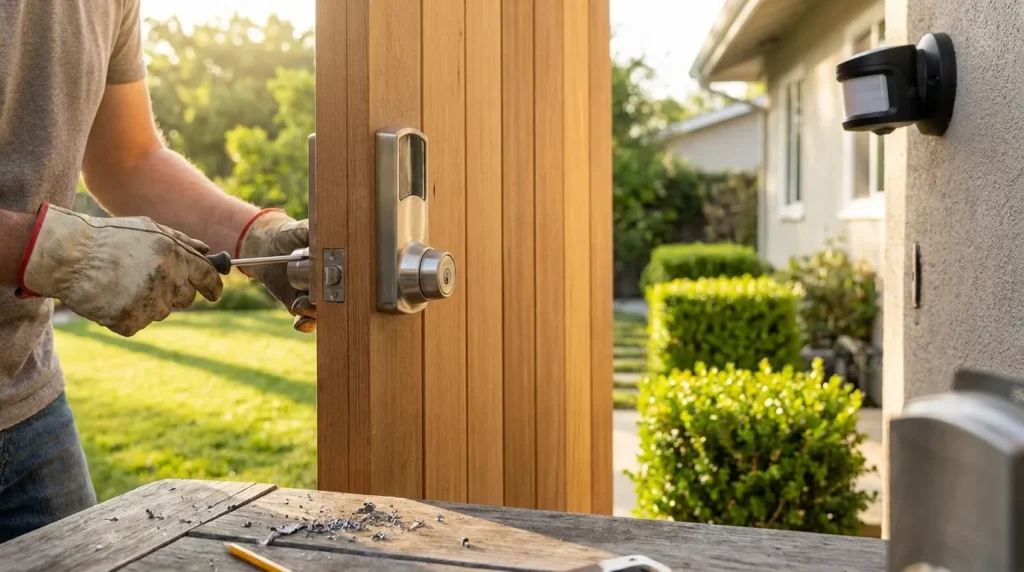
If you’re also rethinking the locks on your gate or shed, it’s worth comparing your options first. I broke down the real differences in smart locks versus traditional deadbolts, including which one actually holds up better against forced entry.
Sliding glass doors that open onto the backyard deserve their own attention too. They’re a common target because standard sliding locks are easier to force than a deadbolt. My guide on securing sliding glass doors covers a simple bar and pin trick that takes ten minutes to set up.
Smart Cameras: Where to Point Them for Maximum Coverage
A camera pointed at the wrong angle is almost as useless as no camera at all.
Cover your gates, your back door, and any blind corners created by fences or sheds. Overlapping coverage between two cameras removes the single blind spot that a lone camera always has.
Wi-Fi stability matters here more than people expect. A weak signal to your backyard camera means dropped footage right when you need it most. My guide on securing your home Wi-Fi for smart cameras walks through boosting your signal range so your outdoor cameras never lose connection.
If your yard connects to a garage or side entrance, don’t forget that access point either. I put together a separate checklist for overnight garage door security that pairs well with whatever camera setup you choose for the yard.
Checking Your Wi-Fi Range Before You Buy Anything Else
Here’s something most guides skip entirely. None of your cameras, smart locks, or lighting apps work well if your Wi-Fi signal dies out halfway across your backyard.
Test your signal strength before you spend money on new devices. Stand at your farthest gate or shed with your phone and check how many bars you have. A weak signal there means a weak connection for any camera you install in that same spot.
A cheap Wi-Fi extender or a mesh router node aimed at your backyard can solve this in an afternoon, and it’s far cheaper than replacing a camera you assume is broken when the real problem was signal strength all along.
Walking Your Yard Like a Stranger Would
Once every fix on this list is done, do one last thing. Step outside your fence line and actually look at your house from the street, the same way someone scouting it would.
Notice what’s visible through your windows. Notice which spots stay dark even with your new lights installed. Notice whether your gate looks locked from ten feet away or only up close.
I do this walk myself every few months now, usually right after sunset when the lighting tells the real story. It’s the single fastest way to catch a gap before someone else does.
None of these steps require a huge budget. A locking latch costs less than dinner out. A motion light is a weekend project. Trimming a hedge takes an afternoon. The real cost has always been not knowing where to look, and now you do.
Pro-Level Secrets to Keep Burglars Guessing
Once the basics are covered, a few advanced habits can push your backyard from “decent” to genuinely hard to target.
Layer your defenses instead of relying on one thing. A single camera can fail, a single light bulb can burn out, but a yard with lighting, cameras, a locked gate, and clear sightlines working together doesn’t have a single point of failure.
Rotate your routines. If your motion lights always trigger the same way at the same time, a patient person watching your house can learn the pattern. Change the timer schedule every few weeks so nothing about your yard feels predictable.
Talk to your neighbors. A quick text saying “I’ll be gone this weekend, can you glance at my backyard once or twice” costs nothing and adds a second set of eyes you don’t have to pay for. Neighborhood watch groups exist for exactly this reason, and most homeowners underestimate how much a simple heads-up to the person next door actually helps.
Think about sound, not just sight. Gravel paths near gates and fences make quiet approaches almost impossible, since every step crunches. It’s a small, old-school trick that still works because it adds friction without costing much.
Keep your tools locked away. Ladders, crowbars, or anything that could help someone break a window or reach a second floor should never sit out in the open. I once left a ladder against my shed for a whole summer without thinking twice, until a neighbor pointed out it was basically a free tool for anyone looking to reach my upstairs window.
If you leave town for more than a day or two, treat your backyard the same way you’d treat your front door. My guide on securing your home during vacation covers the exact checklist I run through before every trip, including who gets a spare key and how to handle mail and packages so nothing piles up outside.
Consider a smart plug for your outdoor lights instead of a basic timer. Smart plugs let you control lighting from your phone, which means you can react in real time if your camera catches something unusual instead of waiting for a fixed schedule to kick in.
Test your setup at night, from outside your own fence. Walk your property line after dark and look at your house the way a stranger would. You’ll notice gaps you’d never catch from inside, like a window that’s fully visible from the street or a gate light that doesn’t quite reach the latch.
Think about your storage sheds the same way you think about your house. A shed with a flimsy padlock often holds the exact tools someone would need to break into your home, ladders, crowbars, bolt cutters. Treat your shed lock with the same seriousness as your back door lock.
Rethink your fence height and material too, if you’re due for a replacement anyway. A solid privacy fence blocks a stranger’s view into your yard, but it also blocks your neighbors’ view of anything happening in it. A mix of solid fencing with a few see-through sections near entry points often works better than one extreme or the other.
The Mistakes That Quietly Undo All Your Hard Work
Even homeowners who genuinely try to stay safe fall into a few traps that quietly cancel out everything else they’ve done right.
The biggest one is treating security as a one-time project. You install a camera, trim the hedges, add a light, and then forget about all of it for a year. Bushes grow back. Bulbs burn out. Batteries in cameras die without warning. A backyard that was secure six months ago isn’t automatically secure today.
Another common mistake is focusing all your attention on the front of the house while treating the backyard like an afterthought. Burglars know this pattern too, which is exactly why so many break-ins happen through a back window, a side gate, or a sliding door instead of the front entrance everyone obsesses over.
Leaving valuable items visible is another quiet failure. A grill cover left open showing an expensive smoker, bikes leaned against a shed, patio furniture with obvious price tags still on it, all of it signals to a passing stranger that there’s something worth coming back for.
Weak Wi-Fi is a mistake people don’t even realize they’re making. A camera that drops its connection the moment it starts raining, or one that lags for a few seconds right when motion is detected, isn’t actually protecting anything. It’s giving you a false sense of security while quietly failing at the one moment you need it.
Skipping the small stuff adds up too. A latch that’s slightly bent, a light sensor angled a few degrees off, a hedge that’s grown two inches past where it should be trimmed. None of these feel urgent on their own. Together, they rebuild every gap you thought you’d already closed.
The fix isn’t complicated. Walk your yard once a season. Test your lights. Check your gate latches. Look at your camera footage during the day, not just when something goes wrong. A twenty-minute check every few months is enough to catch most of these before they become a real problem.
One more trap worth mentioning: assuming a security sticker or a fake camera box does all the work by itself. These can help as a small extra layer, but they shouldn’t replace an actual working light, a real lock, or a genuine camera. A sticker alone won’t stop someone who’s already decided your yard looks worth the risk.
Quick Answers to Your Backyard Security Questions
How can I make my backyard more secure without spending a lot of money?
Start with the free stuff first. Trim bushes below window height, close and latch your gate every single time, and keep tools and ladders out of sight. These three changes cost nothing and close some of the biggest gaps.
What do burglars hate the most when scouting a home?
Visibility and noise. A yard with clear sightlines, motion lighting, and a gravel path near entry points removes the cover and quiet that most burglars rely on to feel safe testing your property.
What can I plant or install for extra backyard privacy without hurting security?
Look for low, thorny plants under windows instead of tall, dense hedges. You get a natural barrier against anyone getting close to the glass while keeping the ground-level view open for you and your neighbors.
Which hidden spots in a yard do burglars use most often?
Overgrown corners, the space behind a shed, and any area blocked by a fence or tall plant are the usual spots. Anywhere a person can crouch and stay out of view from the street or your windows is worth checking.
Do fake presence tricks, like leaving lights or a bike out, actually work?
Yes, more than most people expect. Burglars are looking for a fast, low-risk target, and any sign that someone might be home, or might come home any minute, is often enough to send them looking somewhere else.
How often should I check my backyard security setup?
Once a season is a good baseline, or right before and after any major weather change. Bulbs burn out, batteries die, and hedges grow back faster than most people expect, so a quick seasonal check catches problems before they become real gaps.
Your Yard, Your Safe Space Starting Today
You don’t need a huge budget or a weekend of hard labor to fix most of what we covered here. A trimmed hedge, a locked latch, and one well-placed motion light can change how your entire property looks to someone scouting it from the sidewalk.
Start with just one thing today. Walk outside, look at your gate, check your bushes, glance at where your lights actually point. Small, consistent changes are what actually keep a home safe, not one big purchase.
I still walk my own yard every few months now, the same way I wish I’d started doing years ago. It takes me fifteen minutes, and every single time, I catch something small before it becomes something bigger. My hope is that you start doing the same thing this week, not someday.
My own backyard finally feels like mine again, not like a blind spot I was quietly worried about. Yours can feel that way too, and it usually only takes one weekend to get there.
Disclaimer: This article is intended for general educational and informational purposes only and does not replace advice from a licensed security professional, locksmith, or local law enforcement. Security needs vary by home, neighborhood, and local regulations, so please consult a qualified professional or your local police department’s crime prevention unit before making significant changes to your property’s security setup.