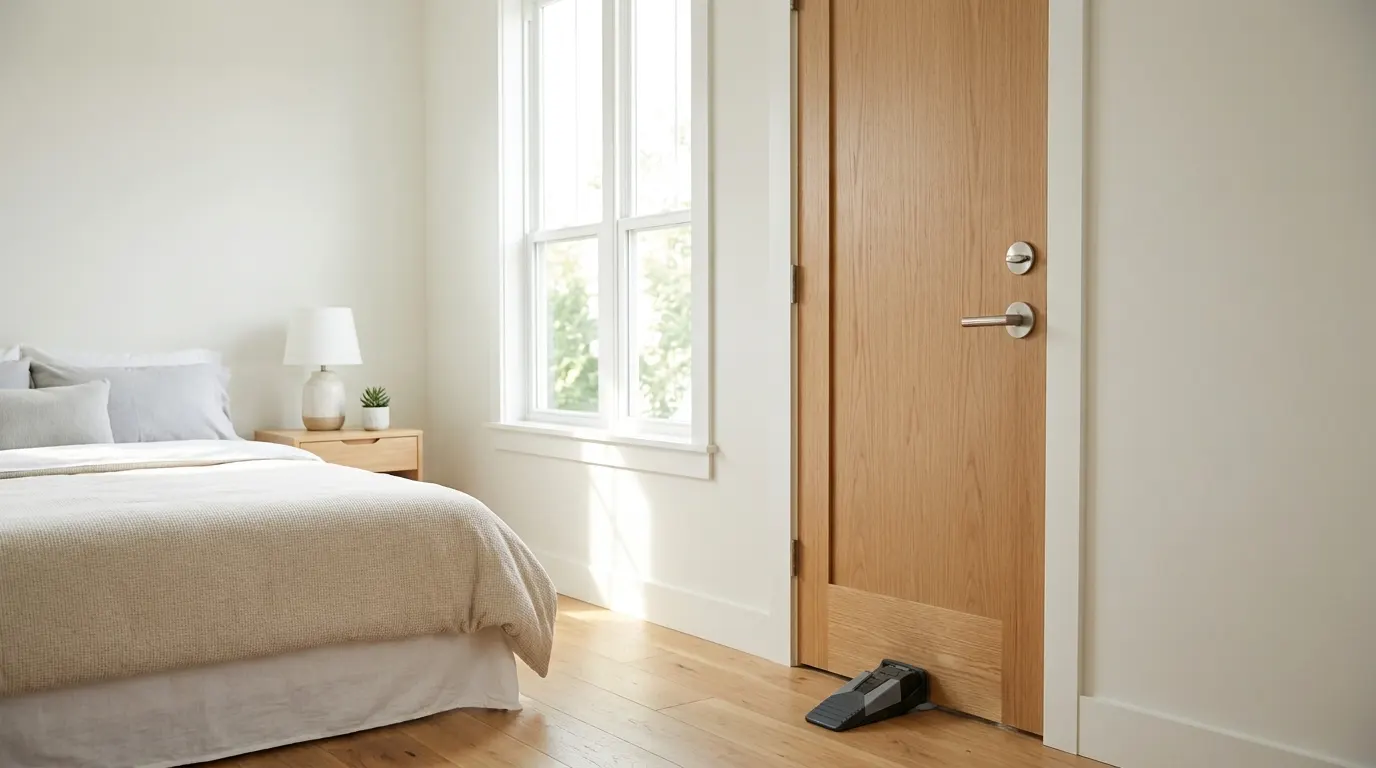
My Butter Knife Took Eight Seconds. That’s All It Took to Wreck My Sense of Safety
Eight seconds. That’s how long it took me to pop open my own bedroom door with a butter knife, standing in my socks at 1 a.m., testing a lock I’d trusted for two years.
I lived in a shared house at the time. Nothing dangerous was happening. But that eight-second test changed how I looked at every door in my home.
Quick answer: A privacy knob alone won’t stop a determined push. Real bedroom door security comes from three layers working together — a reinforced strike plate with long screws, a portable lock or door brace, and a habit of checking your hardware every few months. None of it requires drilling into a rental’s frame.
My roommate wasn’t the problem. My assumptions were. I’d assumed a locked door meant a secure door, and those two things turned out to be very different.
What a Flimsy Door Actually Costs You
A weak bedroom door doesn’t just fail during a break-in. It costs you sleep every single night before that ever happens.
Here’s what that looks like for a lot of people:
- Lying awake and listening for footsteps in the hallway
- Feeling on edge when you’re home alone
- Not trusting the standard knob that came with your rental
- Worrying about a roommate, guest, or landlord walking in unannounced
- Feeling stuck because drilling into a rental door risks your deposit
That last one is real. You shouldn’t have to choose between your security deposit and actually feeling safe in your own room. Most of the fixes below take under an hour and leave zero marks when you move out.
Why Your Current Lock Probably Isn’t Doing What You Think
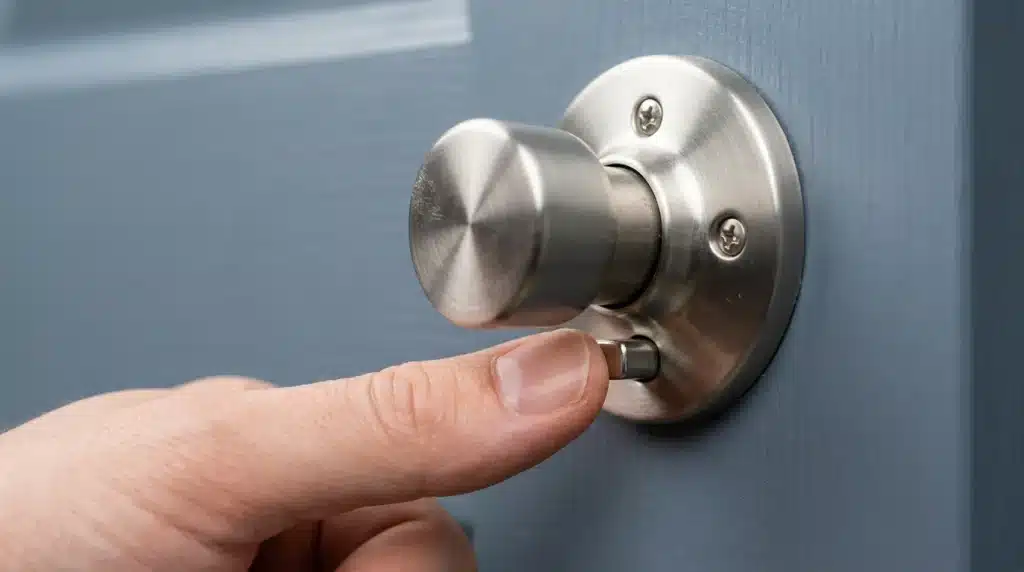
What’s the difference between a privacy lock and a real security lock?
A privacy lock — the small button on a standard interior doorknob — is built to stop a sibling from barging in, not to resist force. It has no strike plate reinforcement and no real resistance rating, so a firm shoulder or a thin tool defeats it in seconds.
Most interior doors ship with this exact hardware. It’s fine for privacy. It was never designed for security, and treating the two as the same thing is where most people go wrong first.
How does a reinforced strike plate actually stop a break-in?
A reinforced strike plate spreads the force of a kick or shove across a wider metal plate anchored with long screws, instead of concentrating it on the thin one-inch screws that ship standard. That single swap makes a bigger difference than almost any lock upgrade you could buy.
Most interior door frames use screws that barely bite into the stud behind the trim. Replace them with three-inch screws on both the strike plate and the hinges, and the frame itself becomes the strong point instead of the weak one.
- Remove one short screw from the strike plate
- Drive in a three-inch wood screw at the same angle
- Repeat for the remaining strike plate screws
- Do the same for each hinge, one screw at a time
This same principle carries over to your front entry too — if you haven’t looked at that door’s frame in a while, a forced-entry reinforcement plan walks through the same fix on a bigger scale.
What does an ANSI security grade actually tell you?
An ANSI/BHMA grade measures how many strike-force blows and cycles a lock can survive in lab testing, with Grade 1 built for commercial use and Grade 2 or 3 typical for residential doors. A high grade number on the lock itself still won’t save you if the screws behind it are an inch long.
I made this exact mistake early on. I bought a nicer lock, felt good about it, and never once checked the screws holding the strike plate — a strong lock in a weak frame is like a great engine bolted to a car with no brakes.
Building an Actual Layer of Protection on Your Door
Are portable door locks or door braces worth it?
Yes, for renters especially — a portable door lock or floor-mounted door brace installs in minutes with reversible screws and adds real resistance without touching the door frame permanently. These sit alongside your existing lock rather than replacing it.
Before you buy one, run through this quick checklist:
- Measure the gap between the door and the floor
- Confirm it matches your door’s swing direction, in or out
- Make sure it releases in under three seconds from the inside, no tools
- Pick an adjustable model if you move or travel often
If you’re renting and want a broader list of no-drill options, apartment security without drilling holes covers a few more devices that work the same way.
Watching a side-by-side comparison of these devices helped me pick the right one for my own door.
This short comparison shows exactly how much force each type of device can actually take before it fails:
Comparing Your Realistic Options
| Option | Cost | Renter-Friendly | Setup Time |
|---|---|---|---|
| Reinforced strike plate | Low | Yes (reversible screws) | 15 minutes |
| Portable door lock | Low–Medium | Yes | 5 minutes |
| Floor-mounted door brace | Low | Yes | 2 minutes |
| Smart lock (interior) | Medium–High | Depends on model | 30–45 minutes |
Should a bedroom door ever be harder to open than a fire exit?
No — any device you install must open in under three seconds from the inside, with no key and no searching in the dark, because a closed door that saves your life in a fire is worthless if you can’t get through it fast. Security and fire safety have to work together, not against each other.
Independent fire testing backs this up in a way that surprised me. Fire Safety Research Institute testing found that a room with an open door reached temperatures over 1,000°F during a house fire, while a closed door dramatically slowed the spread of the blaze in side-by-side comparisons. That protection only counts if the door opens instantly for you when you need out.
A Note If Kids Are in the House
Any lock meant to keep people out should never be able to trap someone in, especially a child. The Consumer Product Safety Commission publishes voluntary safety standards for household locking devices specifically because a device that’s hard to defeat from outside also needs to open instantly from inside in an emergency.
If you’re thinking beyond one door and want a fully hardened space for the whole family, a low-budget safe room setup pairs well with everything covered here.
Making Your Security Habit Actually Stick
Myth vs. Reality
Myth: A locked bedroom door is automatically a secure one. Reality: Standard privacy locks resist curiosity, not force. The frame and reinforcement hardware around the lock matter more than the lock itself.
Myth: Renters can’t do anything real about door security. Reality: Reversible, no-drill devices — door braces, portable locks, longer strike-plate screws in the original holes — install and remove without leaving a mark, so your lease stays intact.
Myth: A stronger lock is always the safest choice. Reality: Layered security matters as much as any single device. The National Crime Prevention Council points to habits and awareness working alongside hardware, not instead of it.
Should You Consider a Smart Lock for an Interior Door?
A smart lock built for interior use adds keypad entry, auto-locking after a set number of seconds, and a log of who opened the door and when. It’s not just front-door hardware anymore, and battery life is the main trade-off to plan around.
If a dead battery worries you, weigh that against a standard deadbolt before you commit. This comparison of smart locks versus traditional deadbolts lays out the real trade-offs instead of marketing claims.
Don’t Stop at the Door
A secured door with an unsecured window is only half a job. If your bedroom has a window, securing it from the inside closes that second entry point using the same no-drill approach.
Building the Habit That Actually Keeps You Safe
I installed my first door brace with a lot of enthusiasm, then stopped using it within a month because it felt like one extra step at bedtime. A random 2 a.m. noise reminded me exactly why I’d bought it.
Tie your door check to something you already do every night — plugging in your phone, turning off the lamp, whatever’s already automatic. Small habits stick when they ride along with routines you never skip.
Set a reminder every few months to physically test the door again. Push on it, wiggle the handle, and check that the screws haven’t loosened, because hardware wears down quietly and a two-minute check catches it before it becomes a real weakness. This same seasonal habit is worth extending past one room — a nighttime home security checklist is a solid next step once your door feels solid.
Where People Usually Go Wrong
A door brace that bends the first time you actually lean on it during testing gives you false confidence, which is worse than having nothing. Test any device with real pressure before you trust it.
A lock that takes fifteen seconds to release from the inside sounds fine until you imagine escaping a room filling with smoke. Every device you choose has to open fast, every time, without fumbling for anything.
Sarah, a reader who shared her experience, installed a portable door lock the week she moved in and it worked perfectly for months. The screws loosened just enough that a firm push popped it open one night, and she hadn’t checked it once since installation day
The Small Adjustments That Separate a Decent Door From a Genuinely Secure One
Most people stop after installing one device and call it done. That’s where a decent setup and a genuinely hard-to-crack door start to separate.
Screw length is the detail almost everyone skips. Standard strike plate screws run about three-quarters of an inch, which only bites into the door jamb itself, not the framing stud behind it. Swapping in three-inch screws lets the screw pass through the jamb and sink into the stud, turning a cosmetic fix into a structural one.
Hinge screws matter just as much as strike plate screws, and almost nobody touches them. Replace at least the top hinge screw on each hinge with a three-inch version, since a kicked-in door often fails at the hinge side first, not the lock side.
Gap size tells you a lot before you buy anything. Measure the space between your door’s edge and the frame with a tape measure. A gap wider than an eighth of an inch gives a pry bar room to work, and a simple adjustable strike plate can close that gap without replacing the door.
Federal crime data backs up where to focus your effort first. FBI Uniform Crime Reporting data shows that forcible entry accounts for the majority of burglary offenses, which means the door and its frame — not the window, not the wall — are usually the actual point of failure. That’s exactly why the frame upgrades matter more than a fancier knob.
Cycle testing is another number worth knowing before you shop. Hardware rated for Grade 2 residential use is built to survive 400,000 open-close cycles in lab testing, roughly a decade of daily use on a bedroom door, so a lock failing within a year or two usually points to a bad screw job rather than a bad lock.
Pro tip from my own trial and error: the first door brace I bought looked identical in photos to a much sturdier model, and I only found out the steel gauge was thinner once I tried leaning my full weight against it. Read the material specs, not just the star rating, before you buy.
For a bedroom that shares a wall with a garage or basement stairwell, treat that connecting door with the same seriousness as your bedroom door. Most people never think to check it. Walk through how to secure a garage side door this weekend so that weaker link doesn’t undo everything you just fixed.
Your bedroom door is one piece of a bigger picture, so don’t stop there. Run through a full new home security checklist room by room to catch anything you might have missed on your own.
Do this once a season, not once ever:
- Test the strike plate and hinge screws with a screwdriver, not just a glance
- Check that any battery-powered device still has at least 50% charge
- Confirm the release mechanism still opens in under three seconds
- Walk the perimeter of the room and note anything that’s shifted or loosened
The Slip-Ups That Quietly Undo a Good Security Setup
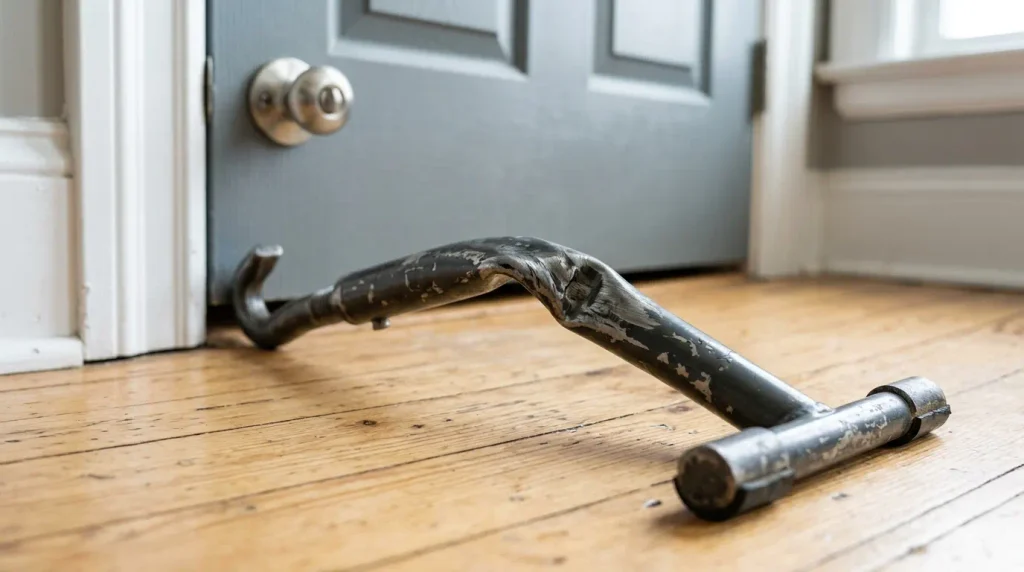
A door brace sitting in a drawer because it “felt like a hassle at bedtime” protects nobody. This is the single most common failure, and it has nothing to do with the hardware itself.
Buying based on the lowest price tag is a close second. A five-dollar brace that flexes under light pressure creates a false sense of security, which puts you in a worse position than having no device at all, since you stop being cautious once you think the problem is solved.
Ignoring the frame while upgrading only the lock is a mistake I made myself. A Grade 2 deadbolt bolted into a jamb held together with half-inch screws barely improves your situation, because the weak point simply moves from the lock to the wood around it.
Here’s a trap that catches renters especially: assuming a device is renter-safe just because the packaging says “no drill.” Some “no-drill” brackets use adhesive strips that pull paint off the door frame on removal, which can cost more at move-out than a few small screw holes would have.
A few more habits worth breaking:
- Treating a security upgrade as a one-time project instead of something to recheck
- Choosing a lock that needs a key to exit from the inside
- Letting a smart lock’s battery run down without a backup plan
- Skipping the fire-safety test on any new device before trusting it at night
None of these fixes make a room impossible to enter — no lock, brace, or reinforced frame does that. What they do is significantly reduce how fast or how quietly someone could get through that door, and that difference in time and noise is usually what matters most.
Common Questions About Bedroom Door Security
Can a landlord legally stop me from adding a door brace?
Most leases allow non-permanent security devices, but a few restrict any hardware attached to doors or frames, so check your lease terms first. Devices that use existing screw holes or pressure-fit designs are the safest bet if your lease is silent on the topic.
Do door braces work on outward-swinging doors?
Most floor-mounted braces are built for inward-swinging doors and won’t work the same way on a door that opens outward. For outward-swinging doors, a strike-side reinforcement kit or a portable lock designed for that swing direction is the better fit.
How often should I replace a portable door lock?
There’s no fixed replacement schedule, but check the screws and moving parts every three to four months and replace the unit if you notice bending, rust, or a looser fit than when you bought it. Most metal portable locks last several years under normal use if the screws stay tight.
Is a chain lock enough security on its own?
No — a standard chain lock is one of the weakest devices you can rely on, since a firm shove can snap the screws holding the chain plate to the frame. Use it as a secondary layer alongside a reinforced strike plate, never as your main line of defense.
What should I do if I hear someone at my door at night?
Stay where you are, avoid opening the door, and call for help immediately using a phone kept within reach of your bed. Confirm your device’s release mechanism ahead of time so you’re not fumbling with it if you ever need to leave the room quickly.
Your Door, Your Room, Your Peace of Mind
Every fix in this guide costs less than a night out and takes less time than a load of laundry. None of it requires a landlord’s sign-off or a contractor’s invoice.
Pick one thing from this guide and do it this week. The screws, the brace, or the seasonal check-in — any single step moves you from “hoping the door holds” to actually knowing it will.
My own start was one uneasy night and a butter knife test that scared me straight. I still do the seasonal screw check every few months, and that two-minute habit is the reason I stopped lying awake listening for footsteps.
A quick note before you go: I’m just a homeowner who’s spent way too many nights testing doors with kitchen utensils, not a licensed locksmith or security contractor. If you’re dealing with a more serious safety concern or a landlord dispute over hardware changes, it’s worth a quick call to a local locksmith or your property manager to confirm what’s allowed and what fits your specific door.