The Afternoon I Realized My House Wasn’t as Safe as I Thought
I used to believe burglars only came out at night. That’s what the movies taught me, right? Guys in black hoodies, flashlights, creeping around at 2 a.m.
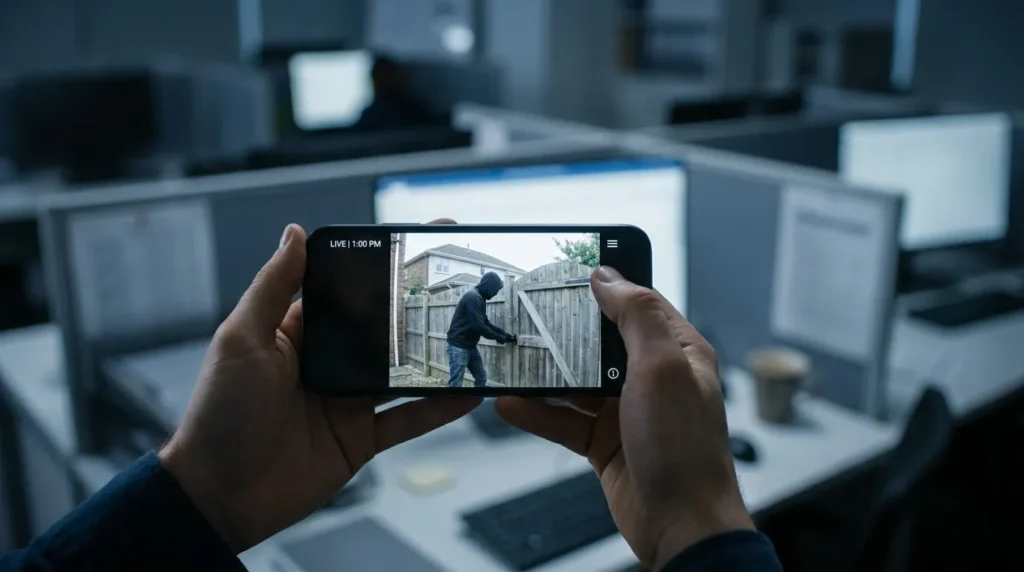
Then one Tuesday afternoon, I got a text from my neighbor. She saw a stranger walking around the side of my house at 1 p.m., trying my side gate, while I was at work and my kids were still at school.
Nothing was taken. He left when a car pulled into the driveway next door. But my hands were shaking when I read that message.
That was the moment I stopped thinking about home security as a “nighttime problem.” I went home that evening and looked at my house the way a stranger would, in broad daylight, and I didn’t like what I saw.
An open garage door. Blinds wide open showing my TV and laptop. A spare key sitting under a flowerpot that anyone could find in ten seconds.
If you’re trying to prevent home invasion daytime risks in your own house, that walk-around is exactly where to start, and it’s exactly what this guide will help you do.
Why This Fear Follows So Many of Us Around
If you’re reading this, you probably know the feeling I’m describing. It’s not always a break-in that scares us. Sometimes it’s smaller than that.
It’s the moment you’re driving to work and suddenly can’t remember if you locked the back door. It’s checking your phone camera app between meetings just to feel a little less anxious. It’s telling your kids to text you the second they get home from school, then staring at your phone until they do.
This constant low-level worry is exhausting. You start avoiding errands because you don’t want to leave the house empty for “too long.” You feel guilty going on vacation. Some people even quit leaving for lunch breaks just to keep an eye on the house through a camera app.
- You lose focus at work because part of your brain is always “at home.”
- You feel embarrassed telling friends you’re nervous, because “nothing has even happened yet.”
- You start seeing every unfamiliar car on your street as a threat.
- You wonder if you’re the only one who feels this on-edge during broad daylight hours.
Here’s the part that might surprise you: you are far from alone, and this worry is actually backed by real numbers, not just anxiety. Data pulled from FBI reporting shows that most residential burglaries happen between 10 a.m. and 3 p.m., with homes generally more likely to be targeted during the day than at night, according to SafeWise’s breakdown of burglary timing data. Weekdays are especially common because that’s when people are at work and kids are at school.
So no, you’re not being paranoid. You’re paying attention to something real, and that’s actually the first step toward fixing it.
9 Steps to Build a House That Looks (and Is) Hard to Hit During the Day
Once I understood when most break-ins actually happen, everything about how I protected my home changed. I stopped focusing only on nighttime locks and started thinking about what my house “says” to a stranger walking by at noon.
Here’s what I learned, broken down into the pieces that actually made a difference for me.
1. Make Your House Look Occupied, Even When It Isn’t
Burglars aren’t usually looking for a fight. They’re looking for an empty house that won’t cause them trouble. Your job is to make your home look like someone is home, even during the workday.
A few things that helped me:
- Leave a TV, radio, or smart speaker playing low background noise during the day.
- Use smart plugs to turn a lamp on and off at random times, not just at night.
- Ask a neighbor to grab packages instead of letting them stack up on the porch all afternoon.
- Vary your parking and departure routine if your schedule allows it, so your comings and goings aren’t predictable.
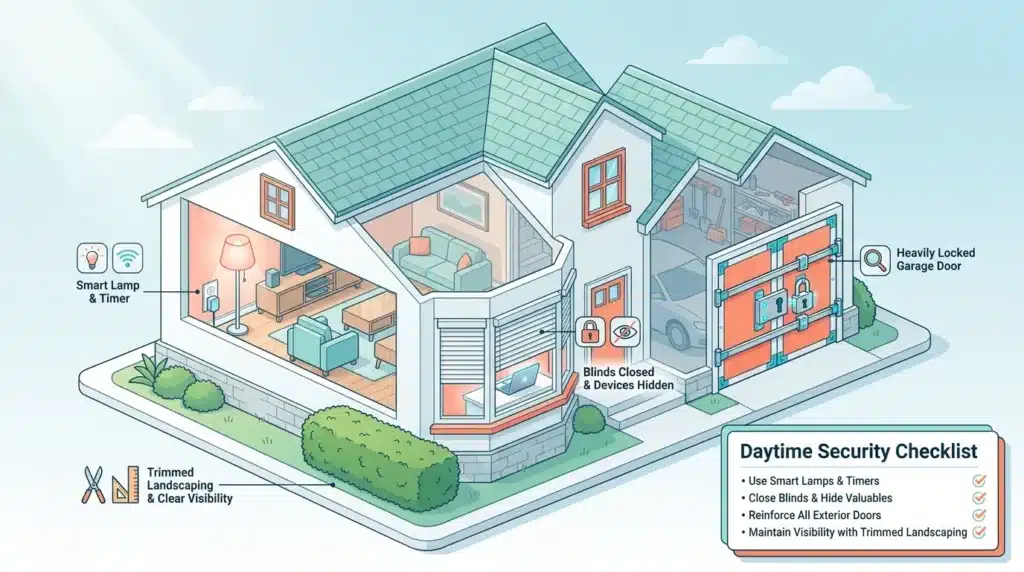
I’ll admit my first “pro tip realization” here was an embarrassing one. For almost a year, my blinds were wide open every single day, showing off a TV, a laptop, and a guitar right from the sidewalk. I basically had a storefront window. Once I started closing blinds on rooms with valuables, I felt an immediate difference in how exposed my house felt from the street.
2. Harden the Entry Points Burglars Actually Use
This is where a lot of people, myself included, get it wrong. We assume a locked door is enough. It usually isn’t, especially against a forced entry.
Doors and windows are still the number one way intruders get inside, so this is where your effort matters most:
- Install real deadbolts (at least a 1-inch throw) on every exterior door, not just a basic knob lock.
- Reinforce the door frame and strike plate with 3-inch screws so a kick can’t tear it loose.
- Check that sliding glass doors have a secondary lock or a security bar, not just the factory latch.
- Trim shrubs and bushes near windows and doors so there’s nowhere for someone to hide while trying to force entry.
- Close and lock your garage’s side door, since it’s one of the most overlooked entry points on the whole house.
If your sliding doors or side entrances still feel like a weak spot, our guide on securing sliding glass doors walks through exactly how to fix that in an afternoon, and our garage side door guide covers the entry point most homeowners forget entirely.
Watch this quick breakdown of visible security habits that make burglars move on to an easier target:
3. Use Cameras and Signage the Smart Way
You don’t need a five-camera surveillance system to make a difference. You need visibility.
A visible doorbell camera or a couple of cameras near main entry points does two things at once. It records anything suspicious, and it makes your house look like more trouble than it’s worth.
Quick Checklist: Daytime Visibility Basics
- Video doorbell installed and pointed at the front walkway
- At least one camera covering the driveway or side gate
- Security system yard sign placed somewhere visible from the street
- Window stickers on ground-floor windows
- Spare key removed from under mats, rocks, or planters
If you’ve ever wondered whether the cheaper route actually works, it’s a fair question. We broke it down here: do fake security cameras really work.
For homes that already have smart cameras, keeping the system itself locked down matters just as much as the hardware. Our guide on securing smart home cameras covers the settings most people skip.
Myth vs. Reality
Myth: “Burglars mostly strike at night when it’s dark and quiet.”
Reality: Government crime data tells a different story. In a recent FBI reporting year, daytime residential burglaries outnumbered nighttime ones by a wide margin, largely because empty daytime homes are simply an easier target than occupied ones.
4. Don’t Forget the Yard and the Perimeter
A house can have great locks and still feel exposed if the yard gives a stranger cover. Tall fences with hidden gates, overgrown corners, and unlit side paths all work in a burglar’s favor, not yours.
Walking your own property line and asking “where could someone hide here for thirty seconds without being seen” is a simple exercise that takes ten minutes and tells you a lot. Our full walkthrough on burglar-proofing your yard goes deeper into fencing, lighting, and landscaping choices that actually hold up.
According to home safety guidance distributed through the U.S. Department of Justice’s crime prevention resources, trimming shrubs and trees near entry points, and keeping those areas well lit, removes hiding spots that criminals rely on. It’s a small chore with an outsized payoff.
5. Master the One Habit That Ties Everything Together
If you only take one thing from this list, let it be this: security is a daily habit, not a one-time purchase.
Fixing your locks and trimming your bushes is a great start. But here’s what nobody tells you: the real win comes from keeping these habits going after the initial motivation wears off. A smart lock or a camera system only works if you actually use it every time you leave, not just at night.
Most people get excited after a scare, upgrade a few things, and then slowly slide back into old patterns within a month or two. I did the exact same thing after my neighbor’s text, until I built a system that didn’t rely on my memory or my mood. I started keeping a simple mental “leaving the house” routine — doors locked, garage closed, blinds adjusted, camera app checked — and it takes me under a minute now.
If you travel often or leave the house empty for stretches during the day, our guide on creating a fake presence while you’re away pairs well with everything above. And if your front door itself has never been upgraded, our full breakdown on reinforcing your front door is a good next stop.
None of this requires a huge budget. Most of what made a real difference for my family cost less than a dinner out. What surprised me most is how quickly the anxiety faded once I actually did the work. Checking my camera app between meetings turned from a nervous habit into a quick, calm glance.
6. Let Your Smart Devices Carry the Weight
You don’t have to be the one who remembers everything. This is exactly where smart home tools earn their keep.
A smart lock with an auto-lock feature will secure your door on its own a set number of minutes after it closes, so a rushed morning never turns into an unlocked house all afternoon. Schlage’s own breakdown of how auto-lock works explains it in a simple way: you get the same peace of mind as a car that locks itself once you drive off.
Pair that with motion-triggered alerts on your doorbell camera, and you’ve got a system that watches your entry points even when your brain is buried in a work call.
7. Build a “Working From Home” or “Away at Work” Routine
If you work from home some days and commute on others, your risk pattern actually changes day to day. Treat each schedule differently instead of using one blanket routine.
On days you’re out of the house:
- Set your smart lighting to mimic a normal daytime pattern, not just an evening one.
- Keep a small radio or speaker running in a main living space.
- Let a trusted neighbor know your rough schedule so they notice anything odd faster.
On days you’re home but distracted with work:
- Keep your front door locked anyway, even though you’re inside. A surprising number of daytime home invasions start with someone simply walking through an unlocked door.
- Glance at your camera app when a delivery notification pops up, instead of assuming it’s always the mail carrier.
8. Loop In Your Neighbors, Not Just Your Gadgets
Technology helps, but a nosy, caring neighbor is still one of the best security tools that exists. I started a simple group chat with three houses on my street. If someone sees a stranger lingering, a car circling twice, or a garage left open, we just send a quick message.
This costs nothing, takes five minutes to set up, and has already caught two situations before they became real problems on our street. If you want to formalize it further, look into whether your area has an active Neighborhood Watch group, since many police departments support and help organize them at no cost.
9. Review Your Setup Like a Stranger Would
Every few months, I do a quick “outsider walk” around my own house. I literally stand across the street and look at my home the way a stranger casing the block might.
Are the blinds open enough to see valuables? Is the side gate latch visible and easy to lift? Is my spare key hiding spot actually as clever as I think it is? This ten-minute habit has caught more weak points than any single gadget I’ve bought.
The Costly Slip-Ups That Undo Good Security Habits
Here’s the hard truth: most people who get hit by a daytime break-in didn’t have zero security. They had partial security, with one or two gaps that a patient burglar eventually found.
Treating Cameras as a Finish Line, Not a Tool
A camera doesn’t stop a break-in by itself. It only helps if someone is actually watching the footage or getting alerted in real time, and if that alert leads to action, like calling a neighbor or the police.
I’ve talked to people who installed a full camera system, felt instantly safe, and then never opened the app again. A camera you ignore is just an expensive way to record your own house getting broken into.
Forgetting the “Boring” Entry Points
Everyone locks the front door. Fewer people think about the side gate, the garage’s pedestrian door, or a ground-floor window that gets left cracked open for fresh air.
Burglars specifically look for these overlooked spots because homeowners rarely check them twice a day. If your side or back entry has never gotten the same attention as your front door, that’s usually the first weak link a patient intruder finds.
Broadcasting an Empty House Without Realizing It
Posting vacation photos in real time, leaving a note on the door for a delivery driver, or telling a wide friend group exactly when you’ll be out of town all send the same signal: nobody is home right now.
None of this is your fault. It’s just an easy habit to fall into in a connected world. The fix is simple, though: save the vacation posts for after you’re back, and keep specific “I’ll be out until Friday” details out of public messages.
Letting Maintenance Slide
A broken porch light, a gate latch that doesn’t quite catch, or a doorbell camera with a dead battery all feel like minor annoyances. To someone scouting your home, they’re an open invitation.
Small, unresolved fixes are exactly what separates a house that gets skipped from one that gets targeted. A quarterly walk-through catches almost all of these before they become a real vulnerability.
Staying Silent Instead of Setting Ground Rules
If you have kids, roommates, or a partner with a different schedule, security only works when everyone follows the same playbook. One person locking up carefully doesn’t help if someone else regularly props the garage door open “just for a minute.”
Sit down and agree on a few shared rules: who answers the door for strangers, whether packages get brought in right away, and what happens if someone unexpected knocks during the day. A household that’s on the same page is far harder to catch off guard.
Common Questions About Daytime Home Invasions
What time of day do most burglaries actually happen?
Late morning through mid-afternoon, generally between 10 a.m. and 3 p.m., is when most residential burglaries occur. This lines up with typical work and school hours, when houses are most likely to sit empty.
Do visible security cameras really stop burglars?
Yes, in most cases. A visible camera adds risk and effort for an intruder, and most burglars are looking for the easiest target on the block, not a confrontation caught on video.
Is it worth getting a smart lock instead of a regular deadbolt?
If forgetting to lock up is a real issue in your house, a smart lock with auto-lock is genuinely worth it. It removes the human error part of the equation, even on your busiest mornings.
How can I tell if my house has been “marked” by someone scouting the area?
Watch for small, easy-to-miss chalk marks, stickers, or tape near your mailbox or door, along with the same unfamiliar car or person appearing more than once at odd hours. Trust that gut feeling if something seems off.
What should I do if I’m home alone and think someone is trying to get in during the day?
Stay somewhere you can lock a door between you and the entry point, call 911 immediately, and make noise if it’s safe to do so, since most intruders leave the moment they realize someone is actually inside.
Does closing my blinds during the day actually make a difference?
It genuinely does. Closed blinds on ground-floor rooms with visible electronics or valuables remove the “window shopping” effect that can turn a random house into a specific target.
Your Next Step Starts Today, Not Someday
Here’s what I want you to take from all of this: you don’t need to fix everything by tonight. Pick one weak spot from this guide, the one that made you wince a little while reading, and handle that first.
For me, it was the spare key under the flowerpot. For you, it might be a side gate, an open blind, or a garage door you always mean to close and forget.
A Simple Action Plan for This Week:
- Walk your property today and note anything an outsider could easily spot or exploit.
- Fix the single biggest gap first, even if it’s small, like moving a spare key or trimming one bush.
- Add one layer of “occupied” signaling, whether that’s a timer light, a speaker, or a doorbell camera.
- Loop in one neighbor or household member so you’re not the only person paying attention.
I still think about that Tuesday afternoon text from my neighbor more than I probably need to. But honestly, I’m grateful for it now. It pushed me to fix things I’d been putting off for years, and my family sleeps a little easier because of it.
If a text like that hasn’t happened to you yet, don’t wait for your own version of it. Start with one small change today, and let that be the moment your home stopped being an easy target.
Disclaimer: This article is for general educational and informational purposes only and does not replace professional security consultation, law enforcement guidance, or emergency services. If you are in immediate danger or believe a crime is in progress, contact your local emergency services right away.