The Two Weeks I Spent Worrying About a House That Wasn’t Even Robbed
Last summer I booked a two-week trip and spent the entire first week of it distracted. I kept picturing my front door, my mail slot, my dark living room window. I checked my home camera app so many times my battery drained by lunch every single day.
Nothing happened. My house was fine the whole time. But I came home more tired from worrying than from the actual trip.
That’s when I realized the problem wasn’t my house. It was that I’d never actually planned for what my house would look like while I was gone. I’d locked the doors and called it done, and just hoped for the best.
Hoping isn’t a security plan. And once I learned how burglars actually decide which houses to target, I stopped guessing and started building a real routine.
If you’ve ever left for a trip and felt that same low hum of worry in the back of your mind, you’re not alone in this. A lot of people feel it every single time they lock up and drive away.
Here’s what that worry usually looks like in real life:
- Constantly checking your phone for camera alerts instead of enjoying your trip.
- Lying awake the first night away, replaying whether you locked every door.
- Coming home early from something fun just because you feel uneasy.
- Feeling guilty for even wanting to travel, because your house feels unprotected without you in it.
None of that is dramatic or silly. Your home is one of the biggest investments you’ll ever make, and feeling protective of it makes sense. The good news is that most of that stress comes from not having a plan, not from your house actually being unsafe. Once you build a simple system for making your home look lived-in, that background worry mostly disappears.
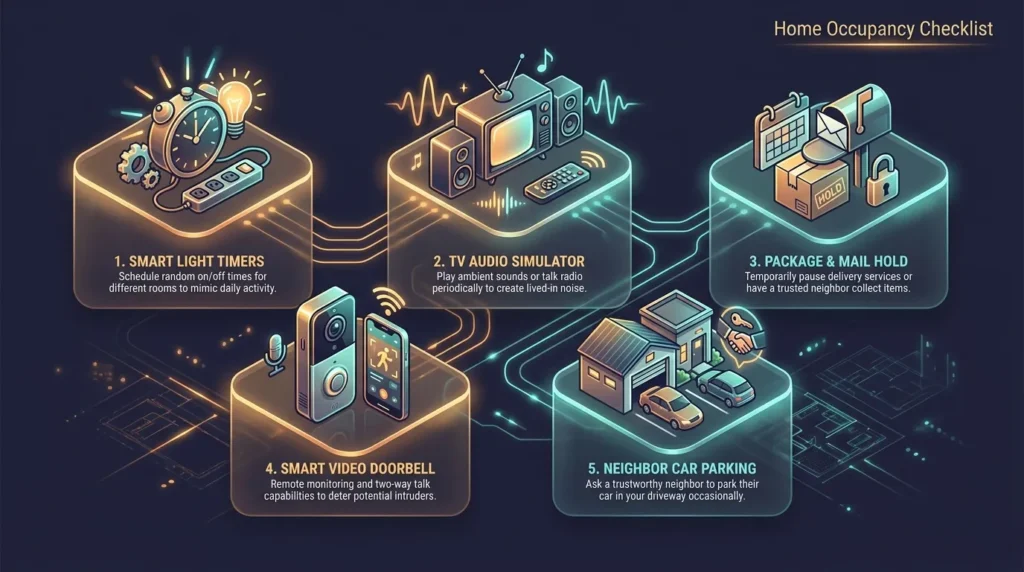
Building a Home That Looks Occupied, Even When It Isn’t
Burglars aren’t guessing randomly. Researchers at the University of North Carolina at Charlotte interviewed over 400 incarcerated burglars about exactly how they pick targets, and the results were pretty clear. Signs of occupancy and visible security were two of the top things that made them walk away from a house entirely.
That means the goal here isn’t to make your home look like a fortress. It just needs to look like somebody’s inside, paying attention.
Get Your Lighting to Tell a Believable Story
A single light left on for two straight weeks doesn’t fool anyone. It actually does the opposite, since a light that never turns off starts to look exactly like what it is: nobody’s home to turn it off.
Use smart plugs or timers set to random on-and-off patterns, not a fixed schedule. Put one in a room visible from the street and another somewhere less obvious, like a back bedroom, so the pattern feels natural instead of robotic.
If you’re setting this up for the first time, it helps to walk through a full plan for securing your home before a vacation, since lighting works best as one piece of a bigger routine, not a standalone fix.
Let Sound Do Some of the Work Too
Light isn’t the only clue burglars look for. Sound matters just as much, especially for anyone casing a house from outside a window or a front porch.
A radio or TV on a timer, set to a normal volume, can make a home feel occupied in a way silence never will. Talk radio works especially well here, since voices carry a more convincing “someone’s home” feeling than music alone.
Pro Tip: I used to think leaving music on was pointless because “burglars can’t hear it from outside anyway.” I was wrong. My neighbor actually mentioned hearing my radio through my window one afternoon, and that’s exactly the kind of ambient noise that makes a passerby assume someone’s inside. It’s a small thing, but it works quietly in the background the whole time you’re gone.
Stop Mail and Packages Before They Pile Up
A stuffed mailbox or a stack of packages on the porch is one of the fastest ways to signal an empty house. It’s also one of the easiest problems to prevent completely.
Hold your mail through your local post office, or ask a trusted neighbor to grab it daily. If you’re expecting deliveries, it’s worth reviewing a few package theft prevention protocols so nothing sits outside for long enough to catch someone’s eye.
Make Your Locks and Entry Points Genuinely Boring to Try
Faking presence works best when it’s backed up by entry points that are actually hard to get through. If a burglar does test your door despite everything else, you want that test to fail fast.
Take a walk around your home and check every entry point the way a stranger would. This includes reviewing whether it’s time to compare smart locks versus deadbolts for your front door, and confirming your front door reinforcement actually holds up under pressure, not just looks solid.
Here’s a short video that shows exactly how fast an unreinforced door can be forced open, and why this single upgrade matters more than most people expect.
Use Cameras and Doorbells as Your Digital Eyes
A visible camera or video doorbell changes the math for anyone considering your house. According to the Center for Problem-Oriented Policing at Arizona State University, visible security measures and occupancy cues are consistently among the strongest deterrents researchers have documented across burglary studies.
Set your doorbell camera to two-way audio mode while you’re away, so you can respond if someone rings the bell or lingers too long. Pair this with a secure home Wi-Fi and smart camera setup so your footage stays private and your devices aren’t an easy target for a tech-savvy intruder.
If you have a pet staying home with a sitter, a pet camera does double duty here too. It lets you check in on your pet and gives you one more live view of activity inside your home while you’re gone.
Ask a Real Human to Show Up, Not Just Your Devices
Technology helps, but nothing replaces an actual person walking around your property. Ask a neighbor to park in your driveway for a night or two, grab your trash cans on pickup day, or just walk up to your door and back like they’re visiting.
This single habit does something your lights and cameras can’t. It creates real, unpredictable movement, which is exactly what a genuinely occupied house looks like from the outside.
The Light-On-All-Night Myth, Explained
A lot of people assume leaving every light on all night is the safest move. It’s actually one of the more common mistakes, and it’s worth clearing up.
| Common Belief | What Actually Works Better |
|---|---|
| Leave one porch light on 24/7 | Use random timers across multiple rooms |
| Keep every light on all night, every night | Mimic a natural pattern: some on, some off, changing daily |
| Draw all curtains completely shut | Leave curtains in a normal, lived-in position |
| Turn off all sound to save energy | Add background sound like a radio on low volume |
According to SafeWise’s home security research, roughly 60% of surveyed burglars said they’d avoid a home entirely if they spotted a working alarm system, which shows just how much visible, active security matters compared to passive tricks alone.
Build a Nighttime Routine Before You Even Leave
The night before any trip, run through your home the same way you would on any normal night. A consistent nighttime home security checklist makes sure nothing gets missed in the rush of packing.
Check every window, confirm your garage door is fully closed, and make sure your alarm system, if you have one, is actually armed and not just assumed to be on. Small oversights like an unlocked side window undo everything else you’ve set up.
Don’t Let Your Own Digital Trail Give You Away
One thing people forget is that presence isn’t just physical. It’s digital too. Posting real-time vacation photos, tagging your location, or announcing your trip publicly can undo every light timer and camera you’ve set up.
According to research from UNC Charlotte’s criminology department, burglars frequently mentioned watching for patterns and information that confirmed a house was empty, and social media makes that information incredibly easy to find. Save the vacation photos for after you’re home.
Faking a presence isn’t about tricking anyone into thinking you never left. It’s about removing the obvious signals that scream “empty house” and replacing them with the small, believable details of everyday life. Once that system is in place, you can actually enjoy your trip instead of checking your camera app every hour.
None of these habits require expensive gear or a full weekend of setup. Most of them take less than an hour to put in place the day before you leave, and once they’re running, they keep working in the background without you having to think about them again.
Turning This Into a Routine You Don’t Have to Think About Twice
My neighbor Mike travels for work almost every other week. When I asked him how he keeps his house looking occupied every single time without losing his mind over it, his answer surprised me.
“I don’t think about it anymore,” he said. “It’s just part of how I leave the house now.”
That’s really the goal here. Not a checklist you dread before every trip, but a routine that runs almost on autopilot once it’s built.
Build a Trip-Length Tiered System
Not every trip needs the same level of effort. A weekend away is different from three weeks overseas, and treating them the same either wastes your time or leaves gaps.
For short trips (1 to 3 nights): lock everything, set your existing timers, and skip anything that requires outside help.
For medium trips (4 to 10 nights): add mail holds, ask a neighbor to check in once, and rotate your lighting pattern.
For extended trips (2+ weeks): bring in a trusted keyholder, arrange lawn care if it’s growing season, and consider a mid-trip house check.
Splitting your plan into tiers means you’re never over-preparing for a quick weekend trip or under-preparing for a long one.
Test Everything Before You Actually Need It
Here’s something a lot of people skip. Setting up smart plugs, cameras, or timers the night before a trip and just trusting they’ll work isn’t a real test.
Run your full system for one evening while you’re still home. Watch the lights change. Check that your camera notifications actually reach your phone. A five-minute test at home saves you from finding out something’s broken from a different time zone.
Rotate Who Knows Your Schedule
It’s tempting to tell everyone you’re excited about an upcoming trip. Try to keep that circle small, and be intentional about who actually needs to know your house will be empty.
Do: tell one or two trusted neighbors directly, in person or by text.
Don’t: post your travel dates publicly, even in a “closed” community group, since you don’t always know who can see it.
Do: ask your keyholder to vary their visit times, not show up at the same hour every day.
Don’t: leave a spare key in the same predictable spot people always guess first, like under a mat or inside a fake rock.
Seasonal Adjustments Matter More Than People Realize
Winter and summer create completely different signals of an empty house. Snow piling up on your driveway or walkway is one of the fastest giveaways in colder climates, since it’s almost impossible to fake from a distance.
If you’re traveling during snow season, arrange for someone to clear your walkway after storms. In warmer months, an overgrown lawn does the same job of quietly announcing nobody’s been around to care for the place.
Loop Your Insurance Into the Plan
Most people never think about home insurance until something goes wrong, but a quick call before a long trip can save you a real headache later. Some policies actually ask about vacancy periods, and leaving your home empty for an extended stretch without telling your insurer can sometimes affect a claim.
Take five minutes to check your policy’s language around “unoccupied” or “vacant” homes. Insurers usually draw a line somewhere between a two-week vacation and a longer absence, and knowing where that line sits means you can prepare for it instead of being surprised later.
This step gets skipped constantly, mostly because it feels boring compared to setting up lights and cameras. But it’s the kind of boring that actually protects you if something does happen while you’re away.
The Morning-Of Walkthrough
Right before you leave, give yourself ten quiet minutes to walk through the house one more time. Not a rushed glance while you’re carrying luggage out the door, but an actual slow pass through every room.
Check that your random lighting schedule is active. Confirm your camera app is showing a live feed. Look at your garage door from the outside, not just the little green light on the opener.
This final walkthrough catches the small things that get missed in the rush of packing, like a window cracked open for fresh air the night before that never got closed again.
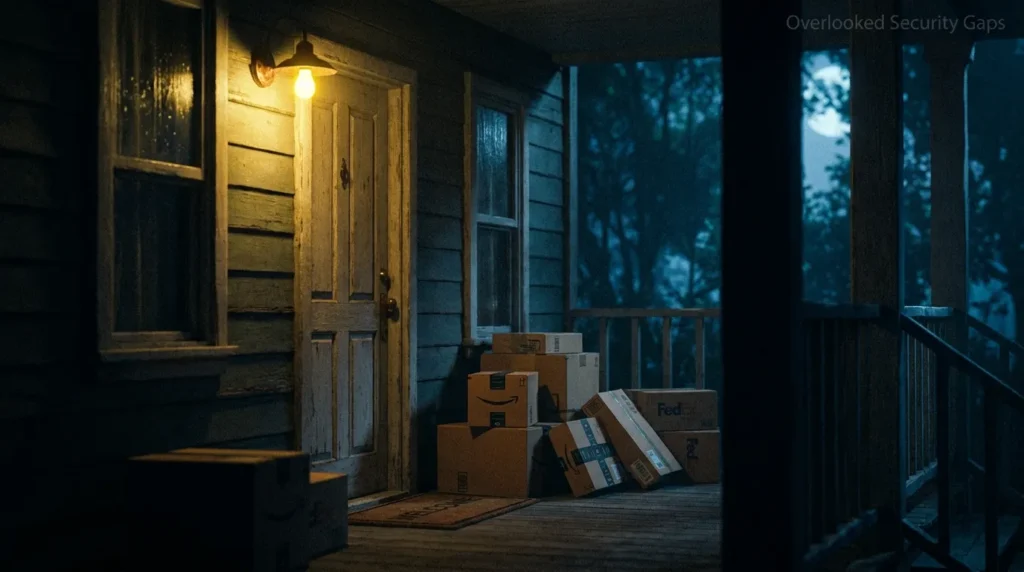
The Mistakes That Quietly Undo All Your Hard Work
You can do almost everything right and still leave one gap that ruins the whole plan. This happens more often than you’d think, and usually not because anyone was careless on purpose.
One of the most common mistakes is assuming devices alone are enough. A smart plug or a camera is only one layer. If your side window is unlocked or your garage code hasn’t been changed in years, none of that technology matters.
Another quiet mistake is letting your routine slip after nothing bad happens for a while. You set everything up perfectly for your first few trips, and then one busy morning you skip the lighting timer because you’re rushing to catch a flight. Nothing happens that time either, so it becomes easier to skip again.
Telling too many people your exact travel dates is a mistake that feels harmless in the moment. A coworker mentions it to someone else, a delivery driver notices the pattern, or a casual social post reaches further than you expected. None of these people mean any harm, but information travels in ways you can’t always predict.
Waiting until the last minute to stop mail or arrange a neighbor check is another one. By the time you remember, you’re already packing, already stressed, and the request feels rushed instead of planned. A neighbor who agrees to help under pressure is far less reliable than one who had a full week to prepare.
Some people also focus so heavily on the front door that they forget everything else. Side doors, garage entry points, and ground-floor windows are just as important, and burglars know most people only reinforce the door they see every day.
The cost of these small oversights isn’t always a break-in. Sometimes it’s just weeks of low-grade anxiety on a trip that should have been relaxing. But when something does go wrong, it’s almost always one of these overlooked gaps, not a failure of the whole system.
Real Questions People Ask Before Leaving Their House Empty
Does leaving a light on at night actually deter burglars?
It can help, but only if it looks natural. A single light on a fixed schedule for weeks in a row often backfires, since it stops looking like normal behavior.
Why shouldn’t you leave a light on in the house at night, every single night?
Because a pattern that never changes is easy to notice from outside. Burglars who watch a house for even a few days will pick up on lighting that’s too predictable to be real.
Does leaving the TV on deter burglars?
Yes, especially combined with lighting, since the flicker and sound both suggest activity inside. Just make sure it’s on a timer so it’s not running the entire time you’re gone.
Do Ring doorbells and similar video doorbells actually deter burglars?
Generally, yes. Visible cameras change the risk calculation for anyone considering your house, since most people casing a property want to avoid being recorded.
What scares burglars away the most?
Based on interviews with actual burglars, visible security systems, unpredictable activity, and nearby witnesses top the list. Surprisingly, expensive gear matters less than simply looking watched and occupied.
How long does it usually take a burglar to decide to target a house?
Research on this varies, but most studies suggest it happens fast, often within a few minutes of observing a property. That’s exactly why small, visible signals like lighting patterns and cameras matter so much, since they’re often what a burglar notices first.
A Word From Someone Who Used to Dread Every Trip
I used to leave for vacations with a knot in my stomach, checking my phone every hour like something was already wrong. Building this routine changed that completely, and now leaving town barely crosses my mind once I’m on the road.
My honest advice is this: don’t try to build the perfect system today. Pick one thing from this guide, set it up this week, and add another piece before your next trip.
That’s genuinely how a full routine gets built, one small habit stacked on the last, until it just becomes how you leave your house.
Disclaimer: This article is for general informational and educational purposes only and does not replace advice from a licensed home security professional, locksmith, or law enforcement agency. Security needs vary by home, neighborhood, and local laws, so always evaluate your own property and consult a professional for a full risk assessment where needed.