The Night I Realized My Windows Were the Weak Spot
I still remember the morning I walked into my kitchen and found glass on the floor. Nobody had broken in. It was just a storm the night before, a branch, and one loud crash that woke me up at 2 AM. But standing there in my socks, staring at shards near my feet, I had one thought stuck in my head: what if that had been someone trying to get in, not a tree branch? My locks were solid. My front door was reinforced. But my windows? I had never once thought about them as a weak point until that moment.
That’s when I started digging into window security film, and I quickly learned I wasn’t the only one who had overlooked this. Most of us spend money on cameras, alarms, and smart locks, but we forget that glass is often the easiest way into a home.
Why Windows Keep Homeowners Up at Night
Here’s the uncomfortable truth: your windows are probably your weakest entry point, and most people never think about it until something happens.
A few things tend to keep homeowners feeling uneasy:
- The “what if” feeling: You lock your doors every night, but a single pane of glass can be broken in seconds.
- False confidence from good locks: Strong deadbolts don’t matter if someone just breaks the glass next to the lock and reaches in.
- Kids and pets near glass: Regular glass shatters into sharp, dangerous pieces, and that’s a real worry if you have children or pets running around the house.
- Storm damage anxiety: If you live somewhere with strong wind or hail, every storm season brings a little dread about your windows holding up.
- Not knowing what actually works: There’s so much conflicting information online that it’s hard to know if window film is a smart investment or a waste of money.
According to the National Crime Prevention Council, windows account for about 23% of all unauthorized entries into homes, with ground-floor windows being the most vulnerable. That statistic alone changed how I looked at my own house. I wasn’t just being paranoid. This is a real, common weak point, and it’s one a lot of us ignore.
What Window Security Film Actually Does (And Doesn’t Do)
Before you spend a single dollar, you need to understand what this film can realistically do for your home. I’m going to walk you through this the same way I’d explain it to a neighbor over the fence—no sales pitch, just the facts.
How the Film Actually Protects Your Glass
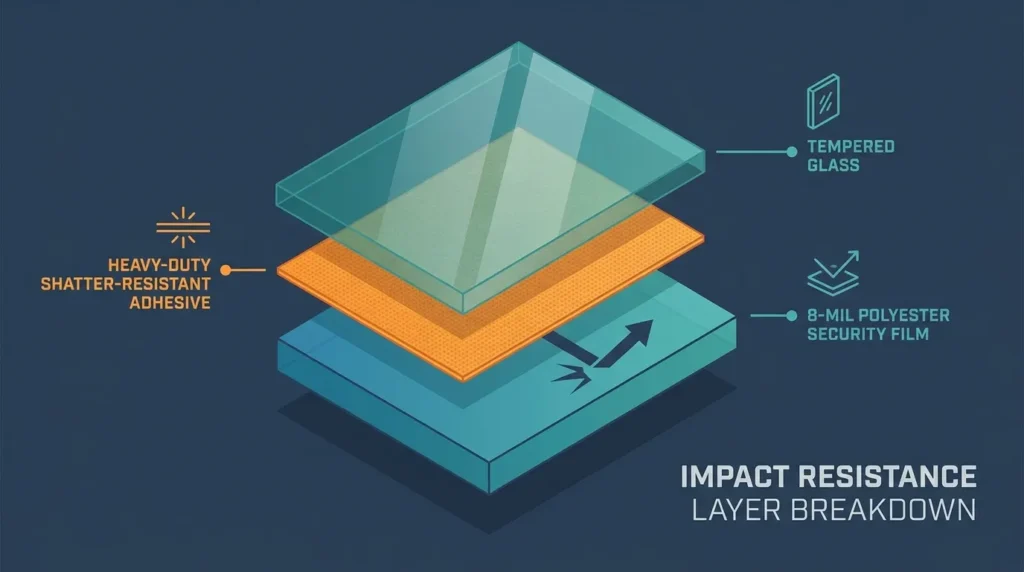
Window security film is a thin, clear layer of polyester that gets applied directly to your glass, usually on the inside. It doesn’t make your window unbreakable. What it does is hold the broken pieces together instead of letting them scatter.
Think of it like the plastic layer inside a car windshield. When a rock hits your windshield, it cracks, but it doesn’t explode into a thousand pieces flying at your face. That’s the same idea here.
This matters for two very different reasons:
- Safety: If the glass breaks by accident (a ball, a storm, a fall), the film keeps sharp shards from flying everywhere.
- Security: If someone tries to break in, the glass cracks but stays in the frame, which slows them down and buys you precious seconds.
Pro Tip: When I first looked into this, I almost bought the cheapest roll I could find online. My mistake was not checking the mil thickness before buying. Thinner film (around 2 to 4 mil) is fine for basic safety, but if you actually want break-in resistance, you need something closer to 8 mil or higher. I learned that the hard way after installing a thin roll that barely held together during a test.
Checking the Standards So You’re Not Guessing
This is the part most blog posts skip, but it matters. Not all “security film” is tested the same way. Look for film that meets an independent safety glazing certification, since that tells you the product was actually tested against real impact standards instead of just marketed as “strong.”
If you live somewhere prone to storms, it’s also worth checking official guidance on protecting windows from severe wind before deciding which type of film fits your climate. Some films are built more for burglary resistance, others for storm debris, and a few try to do both.
Bold this in your mind: thicker film generally means better break-in resistance, but it also usually costs more and can look slightly less clear.
Myth vs Reality: Clearing Up the Confusion
| The Myth | The Reality |
|---|---|
| “Security film makes glass unbreakable.” | It doesn’t stop the glass from cracking. It stops the pieces from flying apart or falling out easily. |
| “Any tinting film works the same way.” | Decorative tint and true security film are made differently. Tint is about privacy and heat, not impact resistance. |
| “Once it’s on, my windows are burglar-proof.” | It slows down and discourages intruders. It does not guarantee they can’t eventually get through. |
| “It’s a one-size-fits-all product.” | Thickness, adhesive quality, and certification all vary a lot between brands. |
Where This Fits Into Your Bigger Home Safety Plan
Window film is not something you install and then forget about everything else. I like to think of it as one layer in a much bigger plan.
For example, if you have a walkout basement, basement windows are a common break-in point that people overlook completely, even after upgrading their main floor windows. The same goes for sliding glass doors, which need their own protection plan separate from regular windows because of how their locking mechanisms work.
I’d also recommend looking at securing your windows from the inside with pins or secondary locks, since film works best when it’s paired with a solid locking system, not used as a replacement for one.
Quick Checklist Before You Buy Window Security Film:
- [ ] Measure every window you plan to cover (don’t guess, actually measure)
- [ ] Decide if your priority is break-in resistance, storm protection, or both
- [ ] Check the mil thickness (8 mil or higher for stronger resistance)
- [ ] Look for a recognized safety certification on the packaging
- [ ] Check if your window locks still work fine after film installation
- [ ] Compare interior vs exterior application options for your climate
- [ ] Set a realistic budget per window, not just for the whole house
Should You DIY It or Call a Professional?
This is where people get stuck. DIY kits are cheaper and give you more control over timing. Professional installation costs more but usually comes with a warranty and a cleaner, bubble-free finish.
If your home has a lot of window features you’re already thinking about upgrading, like reinforcing your front door or checking the side door of your garage, it might make sense to bundle a professional visit for all of it at once instead of doing everything piece by piece.
Here’s a quick way to see how the two options actually compare:
| Feature / Factor | DIY Installation | Professional Installation |
|---|---|---|
| Average Cost | Lower (Material costs only: ~$2–$7/sq. ft.) | Higher (Material + Labor: ~$8–$18/sq. ft.) |
| Time & Effort | High (Requires patience, measuring, & cutting) | Low (Handled entirely by the install crew) |
| Finish Quality | Moderate risk of trapped dust, bubbles, or creases | Flawless, clear, bubble-free finish |
| Tools Needed | Must buy squeegees, utility knives, and solution | Pros bring specialized tools & wet-set adhesives |
| Warranty | Covers product defects only (if installed right) | Covers both product quality and installation labor |
| Best Suited For | Small, standard windows & tight budget projects | Large windows, high-value homes, or thick 8+ mil films |
Watching someone install this correctly makes a huge difference before you try it yourself.
Want to see exactly how the pros apply this without bubbles or peeling edges? This short video breaks down the entire process step by step:
Building Out Your Full Window Security Plan
Film is a great start, but I always tell people not to stop there. Pair it with things like motion lighting outside, trimmed bushes near ground-floor glass, and a full nighttime security checklist so you’re not relying on one single upgrade to protect your whole home.
If you have young kids in the house, it’s also worth reading up on window safety standards for families with kids, since window film interacts with things like emergency escape routes and window guards in ways a lot of people don’t think about until it’s too late.
And don’t forget the outside of your home either. A well-lit, well-maintained yard makes a difference too, so burglar-proofing your yard is worth doing alongside your window upgrades, not instead of them.
Getting the Best Long-Term Results From Your Window Film
Buying good film and installing it well is only half the job. The other half is making it last.
I’ve seen homeowners spend real money on a solid film, then watch it peel or bubble within a year simply because they skipped a few basic care steps. Don’t let that be you.
Clean Your Windows the Right Way (This Matters More Than You Think)
Most window film doesn’t fail because the product was bad. It fails because of how the glass was cleaned afterward.
- Avoid ammonia-based glass cleaners: They can break down the adhesive layer over time and cause the edges to lift. Stick to a simple mix of mild soap and water, or a cleaner labeled safe for tinted or filmed glass.
- Use a soft microfiber cloth instead of paper towels: Paper towels can leave tiny scratches that build up over months and make your film look cloudy.
Watch the Edges Like a Hawk
The edges are where problems start first. If you notice even a tiny bit of lifting near a corner, deal with it right away instead of waiting.
A small lifted edge left alone for a few weeks can let moisture creep underneath. Once that happens, you’re looking at bubbling across a much bigger area, and that usually means a full replacement instead of a quick fix.
Real Scenario: A homeowner I spoke with noticed a small lift near her kitchen window corner. She figured it was minor and left it for two months. By the time she called someone, moisture had spread under nearly a third of the film, and she ended up paying for a full reapplication that could have been avoided with a five-minute fix.
Think About Sun Exposure Room by Room
Not every window in your house gets the same amount of direct sun. South-facing and west-facing windows usually take the most heat and UV exposure, which can shorten film life if you picked a lower-grade product.
If your budget doesn’t stretch to cover every window with premium film, prioritize the ones getting the harshest sun first. Save the standard-grade film for shaded or north-facing windows where wear happens much more slowly.
Combine It With Smart Habits, Not Just Products
Film works best as part of a routine, not a one-time purchase you forget about. A few habits I recommend building into your normal schedule:
- Check every window lock once a month, not just once a year.
- Inspect film edges during your regular window cleaning.
- Keep a small note of your installation date so you know when a warranty check makes sense.
- Walk around your home from the outside occasionally to see what a stranger would see.
Here’s something people rarely think about: film also helps a little with privacy, since it can make it harder for someone outside to see valuables through your glass at a glance. That’s a small bonus layer of protection you get without spending anything extra.
Where People Go Wrong (And Why It Costs Them Later)
I want to be honest with you here, because this part matters just as much as the buying advice. Most of the disappointment people feel with window film doesn’t come from the product itself. It comes from a handful of avoidable mistakes made before, during, or right after installation.
1. Buying Based on Price Alone
I get it. Nobody wants to overspend on something for their home. But choosing the cheapest roll you can find, without checking mil thickness or certification, usually backfires. Thin, uncertified film might hold up fine against a stray baseball. It won’t do much against someone determined to force their way in.
2. Skipping the Surface Prep Step
This one is sneaky because it doesn’t show up right away. If you rush the cleaning step before applying film, tiny dust particles get trapped underneath. At first, it just looks like small bubbles. Over time, those spots grow and cause the film to lift in patches.
3. Assuming One Type of Film Covers Every Need
Someone installs a basic decorative tint thinking it gives them the same protection as true security film, and they don’t find out the difference until something actually happens.
Quick Do’s and Don’ts to Keep in Your Back Pocket:
| Do | Don’t |
|---|---|
| Check mil thickness before buying | Assume all films perform the same |
| Ask for proof of certification | Trust marketing claims alone |
| Clean glass thoroughly before install | Rush the surface prep step |
| Fix lifted edges immediately | Wait “until it gets worse” |
| Pair film with working locks | Treat film as your only layer of security |
4. Ignoring the Frame and Lock Condition
Even the best film in the world can’t fix a broken window lock or a warped frame. If your window doesn’t close and lock properly, applying film is like putting a bandage on a much bigger issue.
Common Questions About Window Security Film
Q: Does window security film actually stop a break-in completely?
A: No, and any seller who tells you that isn’t being fully honest with you. What it does is slow someone down and make forced entry much harder and noisier, which often makes them give up or move somewhere easier.
Q: How much does it typically cost to install?
A: Cost depends heavily on window size, film thickness, and whether you go DIY or hire a professional.
DIY Installation: Costs around $2 to $7 per square foot for the film itself. Covering a single standard window yourself usually costs between $25 and $60 in materials.
Professional Installation: Typically ranges from $8 to $18 per square foot, including materials and labor. For an average 3-bedroom home, professional installation generally runs between $600 and $1,800.
Q: Can I put security film on my windows myself?
A: Yes, many homeowners do their own installation, especially on smaller windows. Just know that larger windows or full-home projects usually turn out cleaner and bubble-free when handled by someone experienced.
Q: Is security film worth it for a home without a big crime problem?
A: Honestly, yes, and not just for break-ins. It also helps with accidental glass breakage, UV protection, and a small privacy boost, so the value isn’t limited to security alone.
Q: Will window film affect how my windows look or open?
A: Good quality film is nearly invisible once applied and shouldn’t interfere with how your windows open or close. If it does affect function, that’s usually a sign of poor installation.
Q: Does this work on every type of window glass?
A: Most standard glass types work fine with security film, but very old, cracked, or already-damaged glass may need repair first.
Your Next Step Starts Today, Not Someday
Looking back at that morning with glass on my kitchen floor, I’m honestly grateful it turned into a wake-up call instead of something worse. It pushed me to finally treat my windows like the security gap they always were.
You don’t need to fix everything in one weekend. Pick one window, maybe the one that worries you most, and start there.
My honest advice as someone who’s been through this decision myself: don’t wait for a scare to make you take action. Check your windows this week, even if it’s just a five-minute walk around your home to look at them with fresh eyes.
Disclaimer: This article is for general educational and informational purposes only and should not be treated as professional security, safety, engineering, or legal advice. Product performance can vary by manufacturer, installation quality, and local building codes, so always consult a licensed professional or your local authorities for guidance specific to your home and region before making security or safety-related decisions.