
The Night I Almost Ignored My Own Gut Feeling
I still remember the first time I went out alone in a city I didn’t know well. I told myself I was just grabbing one drink at a rooftop bar near my hotel. My phone was at 12%, my charger was back in my room, and I hadn’t told a single person where I was going.
About an hour in, a guy I’d never met bought me a drink “as a welcome to the city.” I almost took it without thinking twice. Something in my stomach just felt off, so I said thanks but no, and asked the bartender to make me a fresh one instead.
That tiny decision is the reason I’m writing this post today.
Most people don’t think about bar safety until something almost goes wrong. I didn’t either, until that night made me realize how many small habits I was skipping without even noticing.
Here’s the honest truth: loving nightlife and staying safe are not opposites. You don’t have to choose between having a great night and protecting yourself. You just need a few habits that become second nature.
For a lot of people, going out feels harder than it should. You want to relax, dance, meet new people, and enjoy the music. But there’s also this quiet background worry: Is my drink safe? Will I get home okay? What if something feels wrong and nobody around me notices?
That worry is exhausting. It can turn what should be a fun night into a mental checklist you’re running in your head between every song. Friends stop feeling like they can separate for even five minutes. A trip to the bathroom turns into a group activity because nobody wants to leave a drink unattended.
- You might feel like you’re being “too careful” and ruining the mood.
- You might feel guilty for not trusting a stranger who seems nice.
- You might not even know what to say to a bartender if you feel unsafe.
- You might worry that asking for help will make you look dramatic.
None of that is your fault. Most people were never actually taught how to handle these moments. Nobody hands you a manual before your first night out. So you improvise, you hope for the best, and you carry that low-level stress around without saying it out loud. This guide is here to change that.
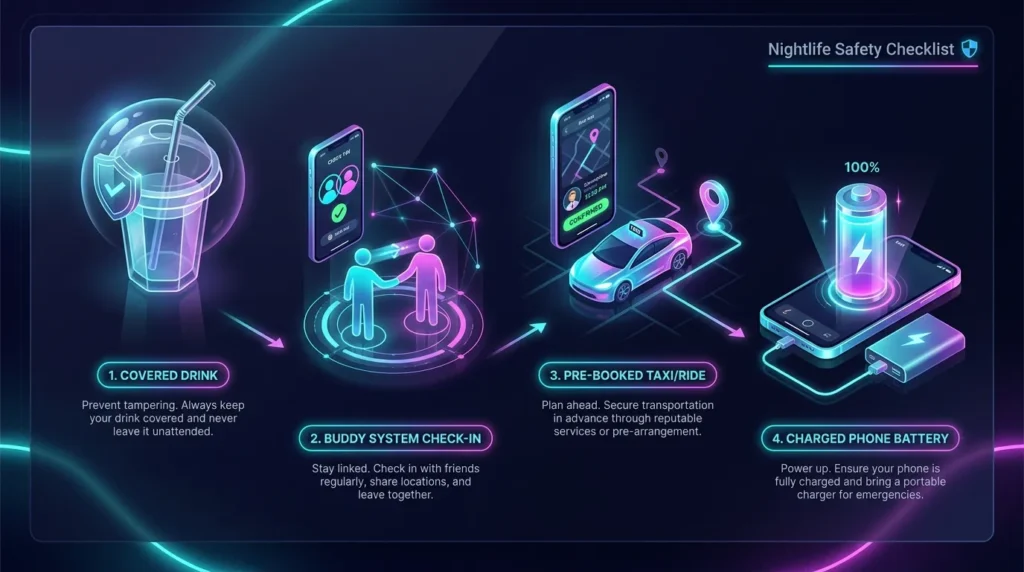
Your Real-World Plan for a Safer Night Out
You don’t need to memorize a huge list of rules. You need a handful of habits that work together, so safety becomes automatic instead of something you have to think hard about every time.
Pick the Right Bar Before You Even Leave the House
Not all bars are built the same. A well-run bar has good lighting near the entrance, visible staff, and a bartender who’s actually watching the room.
Before you go, take two minutes to check reviews for the place. Look for comments about crowd behavior, not just the drink menu. A pattern of complaints about harassment or theft is a real red flag, not a coincidence.
If you’re checking out a new city, it also helps to know the basics of blending in like a local instead of standing out as an obvious visitor, since tourists are often targeted first in crowded nightlife areas.
Treat Your Drink Like It’s Your Wallet
You wouldn’t hand your wallet to a stranger and walk away. Your drink deserves the same respect.
Watch it get made or poured. Keep it in your hand or right in front of you. If you step away, even for two minutes, get a new one instead of trusting it’s still safe.
This isn’t paranoia. According to the U.S. Office on Women’s Health, drugs used to facilitate assault often have no color, smell, or taste, which is exactly why they’re so hard to notice once they’re already in a drink. Knowing this one fact changes how careful people are without even trying.
Pro Tip: I used to think ordering a drink with ice and a garnish made it “harder to spike” because it looked more complicated. That was completely wrong, and honestly a little embarrassing to admit. What actually works is simple: never leave a drink alone, and never accept one you didn’t personally see poured. I learned this the awkward way after a friend pointed it out to me mid-conversation at a bar, and I’ve followed it every single time since.
Know Your Emergency Words Before You Need Them
Some bars and bartenders recognize simple code phrases for when a customer feels unsafe and wants help without making a scene. Asking for a specific drink “by name” at the bar, or simply telling staff directly that you feel unsafe, both work in most places.
The safest move is direct and boring: walk up to any staff member and say clearly, “I don’t feel safe, can you help me.” You don’t need a secret password. Bartenders and security staff are trained to take this seriously, and organizations like the SAFE Bar Network actively train bar staff across the country on exactly how to respond when someone says this.
Here’s a short video that breaks down how bar staff are trained to step in when a guest feels unsafe. Watching it once means you’ll instantly recognize the signals if you ever need help yourself.
Build a Real Buddy System, Not Just a “We’re Together” Group Photo
A buddy system only works if it has actual rules. Before you go out, agree on a check-in time. Agree that nobody leaves with someone new without telling the group first. Agree on where you’ll meet if you get separated.
If you’re traveling solo, this gets even more important. It’s worth reading a full solo travel safety guide before your trip so you have a plan in place before the music even starts, not while you’re standing outside a bar at 1 a.m. trying to figure it out.
Watch for the Common Bar Scams, Not Just the Obvious Dangers
Bar safety isn’t only about physical danger. It’s also about money and belongings. Overpriced “special” drinks pushed on tourists, fake bartenders collecting cash outside the bar, and distraction theft near crowded counters are all common tricks.
Learning to recognize the most common tourist scams abroad helps here too, since a lot of bar-area scams use the exact same distraction techniques used in markets and train stations.
Keep your cash and cards split up. Don’t carry everything in one pocket or one bag pouch. A few simple habits for hiding cash and passports while traveling apply just as well on a night out as they do during the day.
Plan Your Ride Home Before You Order Your First Drink
Decide how you’re getting home while you’re still sober enough to think clearly. Waiting until 2 a.m. to figure out transportation is how bad decisions happen.
Compare ride-sharing safety apps versus local taxis ahead of time so you already know which option is safer in the city you’re in. Some cities have unreliable unlicensed taxis waiting right outside popular bars, specifically targeting people who look like they’ve had a few drinks.
Quick Myth vs. Reality Check
| Myth | Reality |
|---|---|
| “I’ll be fine, I only had one drink.” | Even one drink lowers awareness of your surroundings. Stick to your plan anyway. |
| “Spiked drinks always taste different.” | Most have no taste, smell, or color at all. |
| “Asking staff for help is dramatic.” | Staff at responsible bars are trained for exactly this. It’s their job. |
| “A safeword has to be secret and clever.” | A direct, clear statement works just as well, and is often better. |
If Something Does Go Wrong, Know the Next Step
If you or a friend feels seriously unwell after drinking and it doesn’t match how much you actually drank, treat it as a real medical situation. Confusion, extreme drowsiness, or blacking out fast are signs to act on immediately, not wait out.
Tell a bartender or manager right away, get to a safe and well-lit area, and don’t leave the friend alone. If symptoms are serious, treat it exactly like any other medical emergency abroad and get help fast rather than trying to “sleep it off.”
If you ever suspect an assault happened, organizations like RAINN offer confidential support and can walk you through exactly what to do next, including how reporting works and what your options are.
For International Travelers: A Few Extra Layers of Safety
If you’re out in a country where you don’t speak the local language well, it helps enormously to know a handful of emergency phrases for traveling abroad before your first night out. Being able to say “help me” or “call the police” clearly can matter more than any app on your phone.
It’s also smart to review your destination’s general safety protocol so you understand local laws around alcohol, ID checks, and how local police typically handle nightlife incidents. Rules and norms can be very different from what you’re used to at home.
If you’re a woman traveling solo, checking a list of destinations known for being safer for solo female travelers can help you choose where to go out with more confidence, especially in an unfamiliar city.
Small Habits That Add Up
None of this requires being anxious all night. It’s the opposite. Once these habits become automatic, you actually relax more, because you’re not spending mental energy wondering “what if.”
A few to keep close:
- Charge your phone fully before you leave, or carry a small backup battery.
- Share your live location with one trusted person for the night.
- Keep a written note of your hotel address in your own language and the local one.
- Never let a stranger see you enter your PIN or hotel room number.
According to the NYC Department of Small Business Services’ official nightlife safety guidance, simply knowing your exits and sticking with your group are two of the most consistently effective habits across almost every reported incident. Simple habits, not complicated gadgets, are what actually protect people most of the time.
Going out should feel exciting, not stressful. With the right habits in place before you even leave the house, you can enjoy the music, the people, and the night itself, while staying one step ahead of the moments that could otherwise ruin it.
The Habits That Separate Casual Bar-Goers From People Who Never Get Caught Off Guard
Anyone can follow safety tips for one night. The real difference shows up months later, after the excitement of “being careful” wears off and old habits start creeping back in.
This is where most people actually slip. Not on their first night out, but on their fiftieth, when everything has felt fine for so long that caution starts to feel unnecessary.
Think about it like wearing a seatbelt. You don’t stop wearing one just because you haven’t been in a crash yet. The same logic applies here.
Build a “Home Base” Bar, Not Just a Favorite Bar
Pick one or two bars near where you live and actually get to know them. Learn the staff. Learn the layout. Learn where the exits are without having to look.
When bartenders and security recognize your face, something shifts. You’re no longer just another anonymous customer in a crowded room. You become someone they’d actually notice if something seemed off.
This one habit alone does more for your safety than almost any app or gadget. Familiarity with a space, and being familiar to the people running it, creates a kind of protection that’s hard to measure but easy to feel.
Layer Your Money So One Bad Moment Doesn’t Wreck Your Night
Don’t carry your full budget for the night in one card or one pocket. Split it. Keep a small amount of cash and one card on you, and leave a backup card or extra cash somewhere separate, like a hidden zip pocket or with a trusted friend.
If your wallet gets lost, stolen, or your card gets skimmed at a shady machine, you’re not stuck with zero options and no way to get home. This single habit has saved more nights than any safety app I’ve ever used.
Learn to Read a Room, Not Just a Review
Reviews tell you what a bar was like in the past. Reading the room tells you what it’s like right now. Pay attention to how staff respond when the crowd gets rowdy. Do they step in fast, or do they let things slide?
A bar with a fast, confident staff response to trouble is a very different environment than one where problems sit unaddressed for ten minutes before anyone reacts. You can usually tell within the first twenty minutes of walking in.
Use Discreet Tech Without Relying on It Completely
A small personal alarm clipped to your bag, a smartwatch with an SOS button, or a simple location-sharing app are all useful backup layers. But tech should support your judgment, not replace it.
I’ve talked to people who felt falsely confident just because they had a safety app installed, and then didn’t actually use their instincts when something felt wrong. The app is a backup plan. Your gut is still the main plan.
Debrief With Your Friends the Next Day
This one sounds small, but it matters more than people think. After a night out, talk with your friends about anything that felt strange, uncomfortable, or worth remembering for next time.
Maybe a certain bar felt sketchy near closing time. Maybe a bouncer handled something really well and you want to go back because of it. These little notes build a mental map that keeps you sharper every time you go out again.
The Small Slip-Ups That Turn a Good Night Into a Bad Story
Most bad nights don’t start with one huge mistake. They start with a handful of small, forgivable-seeming decisions that stack up quietly until it’s too late to undo them.
Letting “just this once” become a pattern is probably the biggest one. You skip watching your drink one time because you’re deep in conversation, and nothing happens. So you skip it again. Then again. Eventually the habit that used to protect you just isn’t there anymore.
Another quiet mistake is being too polite in uncomfortable moments. A lot of people, especially women, describe feeling like saying no to a drink from a stranger or walking away from a pushy conversation is somehow rude. It isn’t. Your comfort matters more than a stranger’s feelings for thirty seconds of awkwardness.
People also underestimate how much alcohol changes their judgment in real time. You don’t feel yourself getting less careful. It happens gradually, which is exactly why decisions that seemed obvious at the start of the night stop feeling obvious two or three drinks later.
Traveling alone without telling anyone your plans is another one that catches people off guard. It’s easy to think “I’ll just send a text when I get home,” but that only helps after the fact. Sharing your plan before you leave means someone actually knows to check on you if things go quiet.
Ignoring your gut because you don’t want to seem dramatic is maybe the most common mistake of all. If a situation feels wrong, it usually is wrong, even if you can’t explain exactly why yet. Trusting that instinct, even when it’s inconvenient, is one of the most reliable safety tools you already have and never have to buy.
The cost of these small slip-ups isn’t always obvious right away. Sometimes it’s a stolen wallet. Sometimes it’s a scary walk home alone. Sometimes it’s something far more serious. None of these mistakes make someone careless as a person. They just show how easy it is to let good habits fade once nothing bad has happened in a while.
Common Questions About Staying Safe at Bars and Clubs
Is it normal to feel nervous going to a bar alone?
Yes, completely normal, and it doesn’t mean anything is wrong with you. A lot of regular solo bar-goers still feel a small wave of nerves walking in alone, and that awareness is actually a good thing because it keeps you alert.
What’s the fastest way to tell staff I feel unsafe without causing a scene?
Walk directly to any staff member and say it plainly, something like “I don’t feel safe right now, can you help me.” You don’t need a code word. Most trained staff will quietly help without drawing attention to you.
Should I ever leave my drink with a friend while I use the restroom?
It’s better to just finish your drink or take it with you, even to the restroom. Even a trusted friend can get distracted or pulled into a conversation for longer than expected, and that’s all it takes for a drink to be tampered with.
How do I say no to a drink from a stranger without being rude?
A simple “thanks, but I’m good” is enough, and you never owe anyone a longer explanation. If they push, that reaction alone tells you a lot about whether accepting would have been a good idea.
Are safety apps actually worth using at bars?
They’re a helpful backup layer, especially for solo trips, but they work best alongside good habits, not instead of them. Location sharing and SOS features are great, as long as you’re still paying attention to your surroundings too.
What should I do first if I think my drink was tampered with?
Stop drinking it immediately and tell a staff member or bartender right away. Get to a safe, well-lit spot with people you trust, and if symptoms feel serious, treat it as a medical emergency and get help fast.
Your Simple Checklist for Tomorrow Night
You don’t need to master every single tip in this guide before your next night out. Pick two or three habits that felt most useful to you and start there.
Maybe it’s watching your drink more closely. Maybe it’s finally telling a friend your plans before you leave the house. Small changes, done consistently, build the kind of confidence that actually lasts.
I used to think being careful meant being boring, like I’d have to skip the fun parts of a night out just to stay safe. That was never true. I’ve had some of my best nights ever while still following every habit in this guide, and honestly, knowing I had a plan made it easier to actually relax and enjoy myself.
So here’s my honest advice: pick one habit from this guide and try it the very next time you go out. That’s it. That’s the whole first step, and it’s enough to make a real difference.
Disclaimer: This article is for general informational and educational purposes only and does not replace professional medical, legal, or security advice. Every venue, city, and situation is different, so always use your own judgment and follow local laws and guidance from law enforcement or licensed professionals when needed. If you or someone you know is in immediate danger, contact local emergency services right away.