The Weak Spot Hiding in Plain Sight
Your home is supposed to be the one place you feel completely relaxed. But if you’ve got a big sliding glass door in your living room, there’s a good chance it’s quietly working against that feeling.
That door gives anyone outside a clear view of your TV, your laptop, your whole living room. And in a lot of homes, the lock holding it shut is a thin metal latch that was never built to stop a determined person.
The worry isn’t really about the “stuff” behind that glass. It’s the thought of someone standing on your patio, looking in, deciding your home is worth trying.
If you’ve already looked into reinforcing your front door, your sliding door deserves the same attention. Burglars don’t care which entrance is easiest, they just want the path with the least resistance.
Here’s why so many sliding doors stay vulnerable:
People trust the factory latch that came with the door, even though it’s usually thin metal that bends under pressure. Others buy a cheap plastic dowel from a hardware store, thinking it’s enough, and never check if it actually fits the track. There’s also a lot of advice floating around online claiming that any wooden stick will do the job, which sends people looking for the wrong fix entirely. Some rely completely on an alarm system and forget the glass itself is the real weak point, and a lot of homeowners simply never clean or check the tracks, which lets the door shift just enough to pop the latch loose over time.
None of these mistakes are careless. They just come from not knowing what actually stops a sliding door from being forced open.
What this actually costs you day to day
This isn’t just about the door itself. Living with a door you don’t fully trust has a way of following you around.
You catch yourself listening a little too closely to sounds outside at night. On vacation, you spend more time checking your camera app than actually enjoying the trip. Some people even start hesitating to have guests over, because the living room feels a little too exposed with that door right there.
None of that is dramatic or unusual. It’s just what happens when one part of your home quietly feels unfinished. And it’s fixable, usually faster than people expect.
7 Layers to Lock Down Your Sliding Glass Door
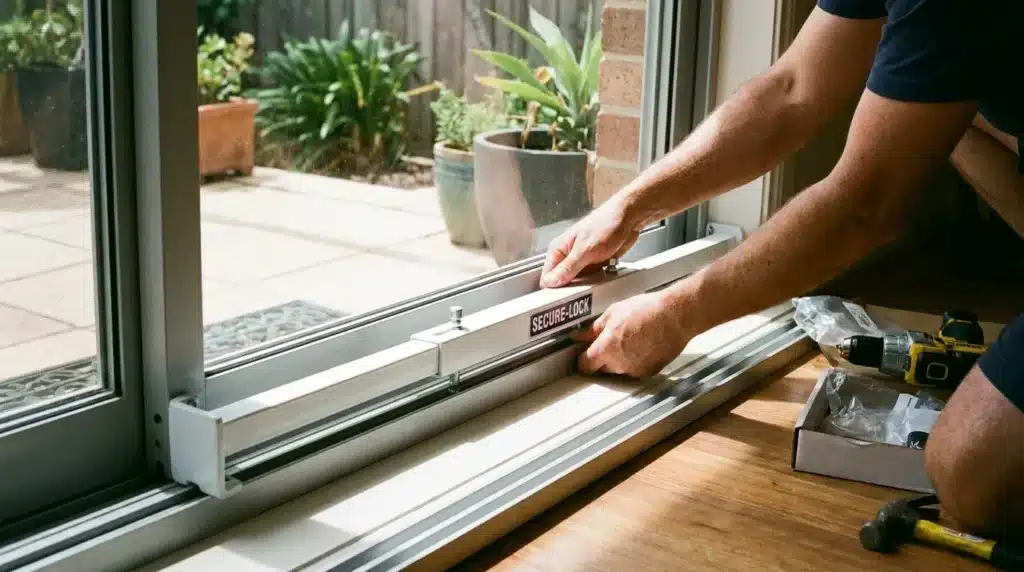
1. Put a Solid Bar in the Track
The simplest fix is also one of the most effective. A metal security bar sits in the bottom track and physically blocks the door from sliding, even if the lock itself gets picked.
Skip the wooden broomstick. If it’s even slightly too short, the door can rattle open just enough for someone to reach in and fish it out.
Pro Tip: I made this mistake myself the first year in my house. I used an old closet rod as a track stick, and it was about a quarter-inch too short. I only found out when I tested it by trying to shove the door open myself. Now I use an adjustable pressure bar that locks tight against both sides of the frame, and it doesn’t budge no matter how hard I push.
2. Add Security Film to the Glass
A sliding door doesn’t need a picked lock if someone’s willing to just break the glass. Security film changes that math.
It’s a clear polyester layer you apply to the inside of the glass. You won’t even notice it’s there. But if someone hits the glass, the film holds the shards together instead of letting them fall out, which turns a quick smash-and-grab into a loud, slow struggle that most people give up on.
There’s a second benefit that has nothing to do with break-ins. The same film keeps glass from scattering across your living room if a storm sends debris into the door, which matters just as much if you live somewhere with severe weather.
The Insurance Institute for Business & Home Safety notes that reinforcing glazing on vulnerable openings is one of the most cost-effective upgrades a homeowner can make against both forced entry and severe weather impact.
3. Install a Second Lock, Separate From the Handle
The lock built into most sliding door handles is a small hook that catches on a strike plate. It’s fine for keeping the door shut against wind, but it’s not built to stop a person.
A secondary bolt lock, installed on the frame above or below the handle, works independently of that factory hook. Two steel pins drive into the frame, and the door genuinely cannot lift or slide until you release them.
If you’re comparing lock types for other doors in your home too, this breakdown of smart locks vs. deadbolts is worth a look, since the “which lock actually holds up” question comes up a lot with sliding doors as well.
4. Light Up the Outside, and the Inside
Burglars work in the dark for a reason, they don’t want to be seen. A motion-activated light near your patio door removes that advantage instantly. The moment someone steps into range, the light flips on, and most people just leave.
Don’t stop at the outside, though. A smart plug on a lamp or two, set to turn on and off at random times in the evening, makes your home look occupied even when you’re not there. That matters just as much for a sliding door as it does for your front entrance, since a lit living room is a lot less inviting than a dark one.
If you’ve wondered whether outdoor lighting actually works or is just a gimmick, this article on whether motion sensor lights deter burglars walks through the research behind it.
Here’s a short video showing how a security bar and film work together in practice, worth watching before you decide which upgrade to start with.
5. Keep the Tracks Clean
This one sounds too simple to matter, but dirty tracks are a real security issue. When dirt and debris build up, the door doesn’t sit flush in the frame, which creates small gaps a pry bar can exploit.
Vacuum the tracks once a month, then wipe them with a damp cloth. Avoid oil-based lubricants like WD-40, since they attract more grime. A clean track means your locks and bars sit exactly where they’re supposed to.
6. Add a Cheap Vibration Alarm, and a Little Uncertainty
Stick-on vibration sensors cost very little and do one job well: if someone taps, pries, or hits the glass, they let out a loud alarm that’s enough to wake the house and scare off whoever’s outside.
Pair that with something even simpler, a “Beware of Dog” sign, even if you don’t have one. It doesn’t need to be true to work. It just needs to make someone standing outside wonder what’s waiting on the other side of that glass, and most people don’t stick around to find out.
7. Block the Door From Being Lifted Out
Here’s something most homeowners never think about: a lot of sliding doors can be lifted straight up and out of their track from outside, without touching the lock at all.
Do:
- Install anti-lift blocks or head-gap screws in the upper track
- Replace exposed exterior clips on the stationary panel with one-way security screws
- Check both the moving panel and the fixed panel, not just the one you use
Don’t:
- Assume the “still” panel is automatically safe just because it doesn’t open
- Skip this step because it “seems unlikely” someone would try it
- Forget to test it yourself once a year
Keeping It Secure When You’re Away Longer Than Usual
A daily bar and lock combo is great for normal life, but a longer trip calls for one more layer. A track lock that tightens with a hex key adds a barrier that can’t be opened with a simple flathead screwdriver, since it needs a specific tool most people won’t carry.
Pair that with your security bar, and you’ve made the door slow and loud to force open, which is usually enough on its own. Most people looking for an easy way in will simply move to the next house.
For the rest of your home during that same trip, this complete guide to securing your home during vacation covers the parts of your routine that go beyond just the sliding door.
One safety note worth keeping in mind: whatever bar or lock you add, make sure someone inside can release it quickly by hand. Fire safety guidance around emergency exits consistently emphasizes that any door serving as an escape route should open with a single, simple motion from the inside, and that same logic applies at home. A bar that takes two hands and thirty seconds to remove is a problem if you ever need to get out fast.
Keeping the Door Secure for the Long Run
Security hardware isn’t a one-time purchase and forget situation. Parts loosen, seals wear down, and habits slip if you don’t check in on them.
Every few months, walk through this:
Check every mounting screw on your locks and tracks, since daily use and vibration loosen them slowly over time. Look at the weather stripping around the frame, and replace it if it’s flat or torn, because gaps there give a pry bar somewhere to grip. Once a month, try lifting the locked door yourself. If it moves more than half an inch, your anti-lift blocks need adjusting.
And at night, close the curtains. If you can see your TV or laptop from outside, so can anyone walking past.
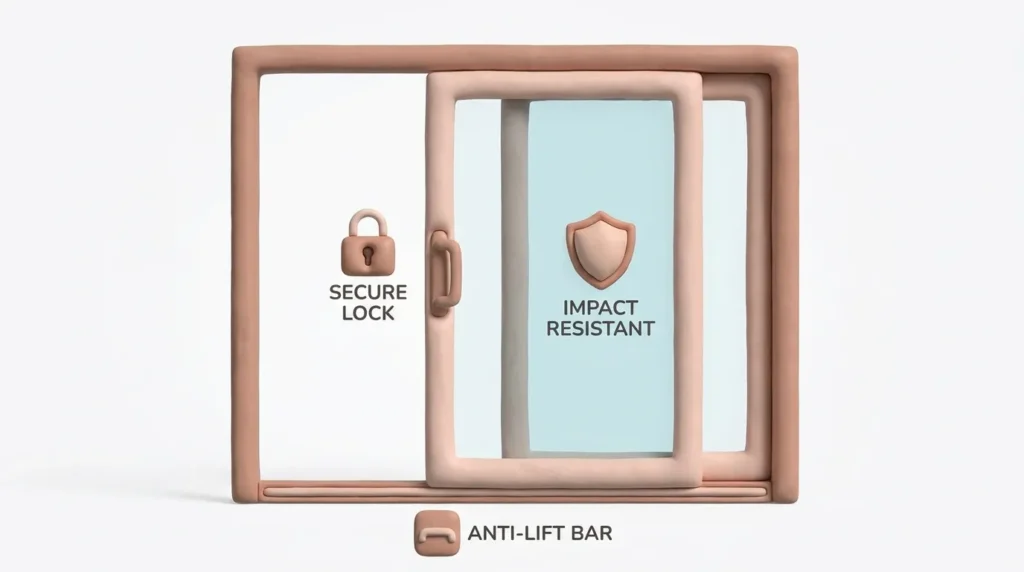
Mistakes That Undo All This Work
Trusting a security sticker instead of an actual lock. A fake camera or a sticker on the window might bluff a casual passerby, but anyone spending real time casing your home will test the door itself, not just look at the glass. If you’re relying on fake cameras anywhere else in your home too, it’s worth reading whether fake security cameras actually work before you count on that alone.
Using a track stick that’s even slightly too short. A quarter-inch gap is all it takes for someone to slide the door enough to hook the stick out with a wire.
Focusing only on the bottom track. If the top of the door isn’t secured against lifting, the bottom lock barely matters, since the whole panel can be tilted out of its frame.
Buying the cheapest plastic hardware available. A lot of it is built to keep a toddler from wandering outside, not to hold up against someone actually trying to force the door.
Here’s how this plays out in real life. A neighbor of mine was confident his sliding door was covered because he’d wedged an old broomstick into the track. One night, someone tried the door, felt it give slightly, and worked the stick loose with a wire hanger through the gap. He was inside in under a minute. A proper adjustable bar, locked tight against both sides of the frame, would have stopped that cold. Half-measures like this are sometimes worse than nothing, because they create a false sense of being covered.
Common Questions About Sliding Glass Door Security
Are sliding glass doors actually a common break-in point?
Yes, they’re one of the more targeted entry points because the lock is often weak and the door can be lifted or pried without much noise. A bar and a secondary lock together close most of that gap.
Is a wooden dowel enough to secure a sliding door?
It’s better than nothing, but only if it fits the track exactly, with no gap at all. Most homeowners find their dowel is slightly too short, which defeats the purpose.
Does security film really stop a break-in?
It won’t make the glass unbreakable, but it holds shattered pieces together, which turns a quiet smash into a loud, slow process most intruders won’t stick around for. Pairing it with window security film that’s already tested for this exact use makes the choice easier.
Can a sliding door really be lifted out of its track?
Yes, and it’s one of the most overlooked vulnerabilities. Anti-lift blocks in the upper track close this gap completely, and they cost very little to install.
How often should I check my sliding door’s security hardware?
A quick check every few months is enough, plus a once-a-month test of whether the locked door can still be lifted. Screws loosen and seals wear down slowly, so it’s easy to miss until you actually test it.
Your Sliding Door, Finally Working For You
You don’t need to replace the whole door or spend a fortune to close this gap. A bar, a secondary lock, some film on the glass, and a light outside, together, that’s usually enough to make a burglar move on to an easier target.
I started with just the bar and the tracks on my own door, and honestly, that alone changed how I felt walking past it at night. My advice is to pick one thing from this list and do it today, even if it’s just cleaning out the track. The rest can follow over the next few weekends, and each layer you add makes that door a little less worth anyone’s trouble.
Disclaimer: This article is for general informational purposes only and does not replace professional security or fire-safety advice. Always ensure any lock, bar, or barrier you install still allows quick, easy exit from inside in case of an emergency, and consult a licensed locksmith or security professional for your specific door type.