What Happens When You Forget to Close the Garage Door
Last month I pulled out of my driveway and got about ten minutes down the road before it hit me — I never watched the garage door close behind me. My son’s bike, my wife’s tools, and a laptop bag were all sitting right there in plain sight. I spent the whole day at my desk half-listening to my phone, half-expecting a call about a break-in. Nothing happened that day. But that one slip made me realize how much I’d been trusting a motor and a remote to do a lock’s job.
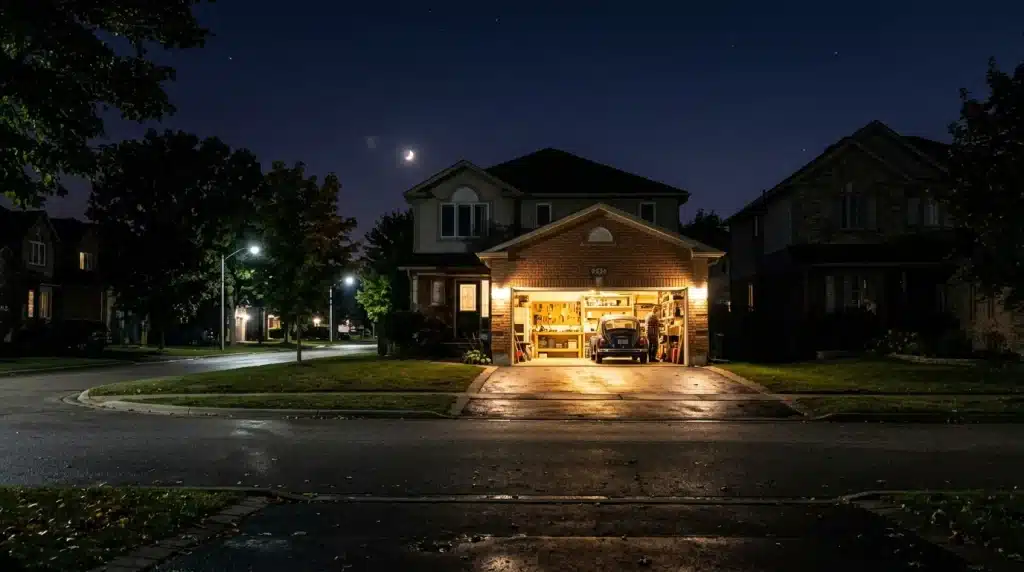
Quick answer: No, it is not safe to leave your garage door open overnight. An open garage gives a burglar silent, unforced entry to your car, your tools, and often a direct door straight into your kitchen or living room. FBI-linked crime data shows well over a third of home break-ins already happen with zero forced entry — through doors, windows, or garages that were simply left open. Tonight, at minimum, engage a manual slide bolt if you have one and deadbolt the interior door leading into your house.
If you’ve ever laid in bed replaying whether you actually pressed the button, you’re not alone. That small, nagging doubt is more common than most people admit.
Here’s what that overnight risk actually looks like for regular families:
- You lose sleep over something you can’t check. Once you’re in bed, there’s no easy way to confirm the door is shut without walking outside in the dark.
- A missing car becomes a signal, not just an inconvenience. An open garage with an empty parking spot tells anyone walking by that nobody is home.
- Your tools become someone else’s tools. Burglars have been known to use items found inside an open garage — a crowbar, a ladder, a hammer — to force their way into the rest of the house.
- The stress doesn’t stay in the garage. Parents especially describe a specific kind of dread about a stranger being that close to a door that leads to their kids’ bedrooms.
You don’t have to turn your garage into a fortress by morning. It just means the open garage door deserves the same respect you’d give an unlocked front door — because to a burglar walking your street at 2 a.m., that’s exactly what it is.
Why an Open Garage Door Attracts Burglars Faster Than You’d Think
What Are Burglars Actually Looking For in an Open Garage?
They’re looking for the fastest, quietest way in — and an open garage is exactly that. Burglary is, by definition, mostly a crime of opportunity, and a wide-open garage removes every obstacle a criminal would normally have to work around: no lock to pick, no window to break, no noise to make.
Once someone is standing inside your open garage, they’re already out of view from the street. They can take their time. They can check whether the door leading into your house is unlocked — which, in a lot of homes, it is, because people assume the “big door” already did the job of keeping intruders out.
According to crime data published by the FBI’s Uniform Crime Reporting Program, a large share of residential burglaries involve unlawful entry rather than forced entry — meaning the person simply walked through an opening someone left available, without breaking anything to get there. Security research from SafeWise backs this up, noting that in more than half of residential break-ins involving unlawful entry, the burglar simply walked through a door or window that was already open. An open garage door overnight fits that exact pattern — and it’s a very different failure than the forced-entry attempts a solid front door is built to resist.
Timing makes this worse overnight specifically. Most burglaries only take a few minutes from entry to exit, and darkness removes the one thing that normally slows a criminal down — the chance a neighbor glances out a window and notices them. A garage that’s been open since dinner and stays open until sunrise gives a passing opportunist an eight-hour window instead of an eight-minute one.
A quick reality check most homeowners get wrong:
Myth: “There’s nothing valuable in my garage, so it doesn’t matter if it’s open overnight.” Reality: The garage itself is rarely the real target. It’s the route — a private, hidden staging area that leads straight to your car keys on the counter, your side door, or your kitchen. Burglars aren’t shopping for old paint cans; they’re shopping for access.
Does Homeowners Insurance Still Cover a Theft If the Garage Was Left Open?
Usually yes, but it’s not guaranteed, and this is the part most homeowners skip past. Most standard homeowners policies cover theft regardless of whether a door was locked, because insurers generally look at whether a loss happened, not exactly how the thief got inside.
Where it gets complicated is a policy clause you’ve probably never read closely: “reasonable care.” Insurers can question or reduce a payout if they believe you didn’t take reasonable steps to protect your property — and a pattern of leaving a garage open overnight, especially if it happens more than once, is the kind of detail that can work against you during a claim review. Insurance-focused legal resources note that this negligence question is exactly where insurers draw the line between an honest mistake and a pattern they can push back on.
The bottom line: one forgetful night probably won’t sink your claim. A habit of it might. Either way, you’re better off treating “reasonable care” as the standard, not the exception, rather than something you only think about after filing a claim and reading a denial letter — this matters even more if you’re regularly leaving your home unoccupied for a stretch of days, since insurers scrutinize those claims more closely.
I’ll admit this one stung a little when I first looked into it — I’d always assumed insurance was a blanket safety net no matter what. After digging into a few real policy breakdowns while researching this for my own house, I stopped assuming and started actually checking my policy’s fine print. I’d suggest you do the same before you ever need to.
What’s the First Fix Before You Even Touch a Lock or a Tool?
The very first fix costs nothing and takes ten seconds: build a closing ritual you can’t skip. Most “I forgot to close the garage” stories don’t come from laziness — they come from distraction. You’re juggling kids, groceries, or a phone call, and the door just isn’t top of mind.
A few concrete ways to make this automatic instead of hopeful:
- Watch the door fully close before you drive away, every single time, even if you’re in a hurry. A half-closed door that reverses due to a sensor blockage is just as open as one you forgot entirely.
- Set a phone reminder for your actual bedtime, not a generic “10 PM” alert, labeled specifically “garage door” so it can’t be mistaken for anything else.
- Add a smart garage sensor that texts you if the door has been open for longer than a set number of minutes — many openers built in roughly the last several years support this through an app, even without replacing the whole unit. Just make sure you also know what to do the moment its battery dies, since a dead sensor gives you false confidence, not real protection.
- Keep your remote off your car’s visor and out of your ignition. If a car parked in the driveway is ever broken into, a visible garage remote hands over a second entry point on top of the first.
- Tell one trusted neighbor to text you if they notice your door open after dark. A second set of eyes costs nothing and covers the nights you’re traveling or simply asleep before you’d normally check.
Something I only started doing after my own scare: I now physically look at the garage bay from my bedroom window before I turn off the lights. It takes four seconds, and it’s caught an open door twice since I started the habit. My wife thought it was overkill the first week. She stopped saying that after the second catch.
Here’s a short video walking through how a distracted-driver moment like mine turns into a full overnight opening — worth two minutes if you’ve ever driven off without checking:
None of this requires new hardware yet. It’s just closing the gap between what you intend to do and what actually happens on a busy, tired evening — which, realistically, is when most garage doors get left open in the first place.
For a broader look at everything that should be locked down before you turn off the lights, our nighttime home security checklist covers the rest of the house too.
The Hardware Fixes That Actually Close the Gap
Habits break down on a busy Tuesday. Hardware doesn’t. Once your closing routine is solid, the next layer is making sure the door itself can’t be beaten even if it does get left open by accident or forced by someone determined.
How Do Thieves “Fish” an Open or Barely-Closed Garage Door?
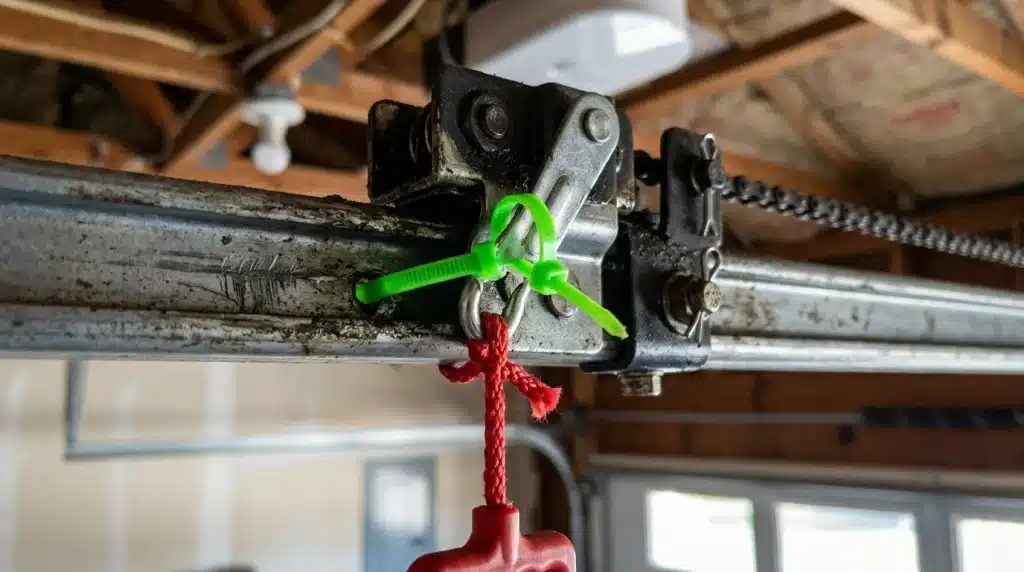
They reach in through the small gap at the top of the door and pull the emergency release cord. This move, sometimes called fishing, disconnects the motor from the door in seconds, letting someone slide it open by hand with almost no noise. It works whether the door was left fully open overnight or just closed enough to look shut.
A bent wire coat hanger is the classic tool for this, and it costs the intruder nothing. The fix on your end is just as cheap and takes about two minutes:
- Find the plastic carriage that rides along the metal track connected to your door.
- Locate the small hole where the release lever sits.
- Thread a plastic zip tie through that hole and around the lever, pulling it snug.
- Trim the excess tail so it doesn’t get caught in the track.
It holds under normal use but snaps if you ever need to pull the cord hard during a real power outage.
Should You Upgrade to a Rolling-Code Garage Door Remote?
Yes, if your opener is more than a decade or two old and you’ve never checked. Older “fixed code” remotes send the exact same signal every time you press the button, which means a cheap code-grabbing device parked near your house can record that signal and replay it later to open your door without you ever knowing. Newer rolling code systems generate a fresh code from billions of possible combinations every single time, so a captured signal is useless the second you press the button again — a distinction explained in more technical detail here.
Most openers built in the last couple of decades already use rolling code by default. If yours doesn’t, a cheap conversion kit usually solves it without replacing the whole unit.
Where Does a Manual Slide Bolt Fit Into This?
A slide bolt turns your garage door from “held by a motor” into “physically locked to the frame.” Most tracks already have a rectangular slot built in for one; if yours doesn’t, a bolt kit is a small hardware-store purchase. Sliding it into place at night takes about five seconds, and no amount of prying or motor override can move the door once it’s engaged.
I started doing this the same week I read about the insurance “reasonable care” clause. It felt like overkill for the first few nights. Now it’s as automatic as locking my car.
One detail people skip: disengage the slide bolt before using your remote in the morning. Trying to force the door open against an engaged bolt can strain or damage the opener motor over time.
What About the Garage Windows and the Door Into the House?
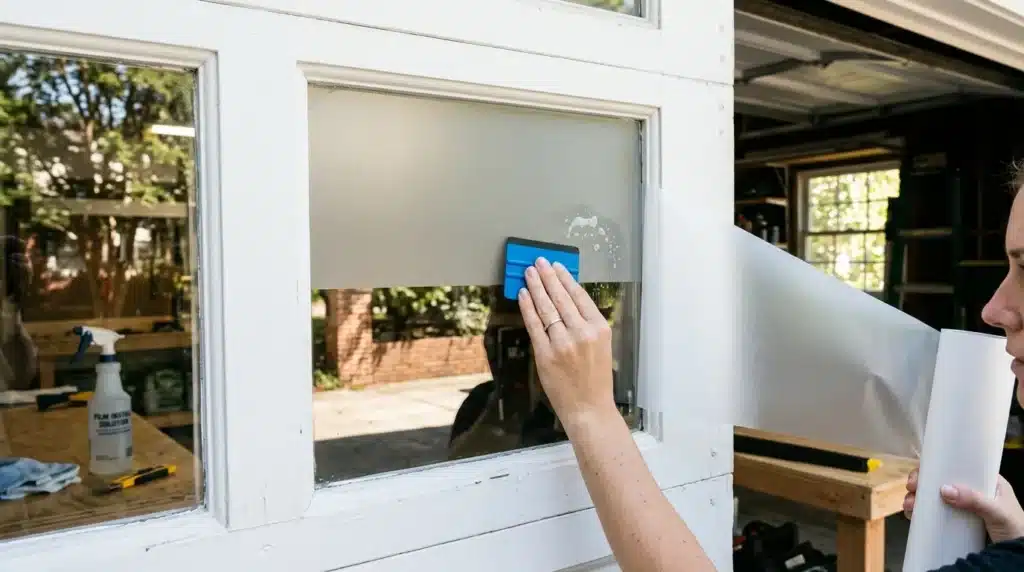
Clear garage windows let anyone walking by see exactly what’s inside — including whether your car is gone. A roll of frosted privacy film, applied in about 20 minutes, blocks that view while still letting daylight through; you can see a full walkthrough of how window film actually performs against break-in attempts if you want the deeper comparison.
The door connecting your garage to your kitchen or living room deserves the same attention as your front door. A solid-core door with a real deadbolt, not the hollow, single-latch door many builders install by default, closes the last gap even if someone does get into the garage itself. If you’re unsure which lock type actually holds up here, this breakdown of smart locks versus traditional deadbolts walks through the trade-offs.
Do Motion-Sensor Lights Make a Real Difference at Night?
They do, mainly by removing the cover of darkness a burglar depends on. A sudden bright light near your driveway signals that movement has been noticed, which is often enough to make someone move on to a quieter target — you can read more on how motion lighting affects burglar behavior if you want the fuller picture. Battery or solar-powered units mounted above the garage and near the side door need no wiring and typically run for months between charges.
Set the sensitivity to catch a person-sized shape but ignore a passing cat, so the light stays meaningful instead of becoming background noise you tune out.
Here’s how these fixes stack up against each other:
| Fix | Rough Cost | Setup Time | What It Stops |
|---|---|---|---|
| Zip tie on release cord | Under $1 | 2 minutes | Coat-hanger “fishing” |
| Manual slide bolt | $10–$25 | 5 minutes | Prying the door up |
| Frosted window film | $15–$30 | ~20 minutes | Visual scouting from outside |
| Rolling-code remote/kit | $30–$80 | 15–30 minutes | Signal interception (“code grabbing”) |
| Motion-sensor light | $20–$50 | 10–15 minutes | Cover of darkness |
None of these promise total protection on their own. Layered together, they significantly reduce how appealing your garage looks to someone scouting the street.
A short before-bed checklist worth keeping by the door:
- Release cord zip-tied or shielded
- Slide bolt engaged
- Windows frosted or covered
- Interior door to the house deadbolted
- Motion light batteries checked monthly
The Slip-Ups That Undo All of This Progress
Good intentions fall apart in small, specific ways. Most of them aren’t about laziness. They’re about a step that felt too minor to matter.
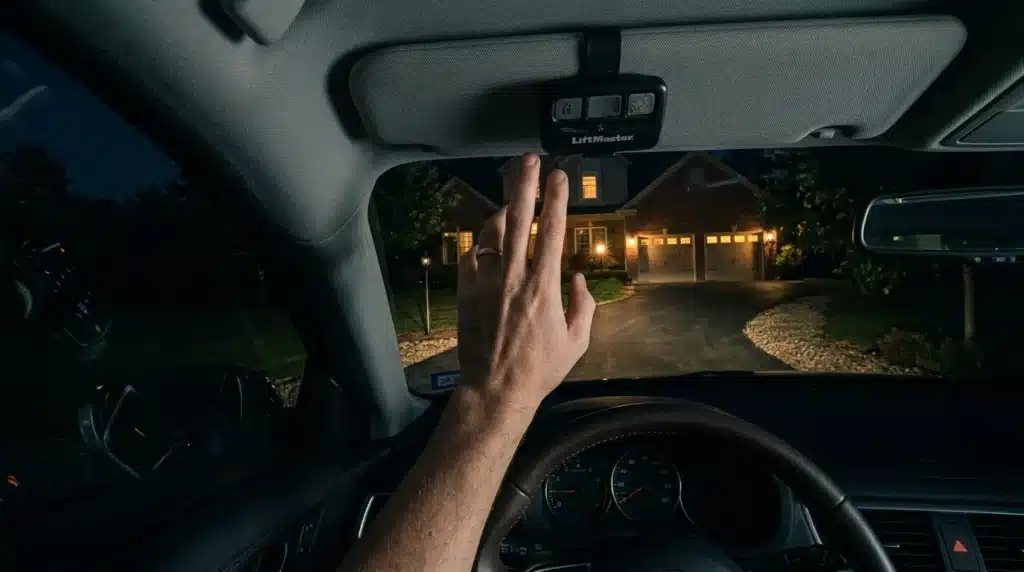
Leaving the remote clipped to your car’s visor is one of the biggest ones. If your car sits in the driveway and gets broken into, that remote hands over a second way into your home on top of whatever was taken from the car itself. A keychain remote you carry with you, or a keypad code you can change, avoids handing over that spare key.
Trusting a fake or dummy security camera near the garage is another quiet risk. A blinking light might slow down a first-time opportunist, but anyone who’s cased a few houses can usually tell a decoy from a working unit within seconds — the research on how well fake cameras actually perform is worth a look before you rely on one as your main deterrent.
Letting the emergency release cord hang too long is a small detail with an outsized effect. The longer it dangles, the easier it is to grab from outside even with a zip tie in place. Tying a simple knot to shorten it, so it’s reachable for you but not for a hand or hook from outside, closes that gap for free.
Skipping the wall panel’s lock or vacation mode is common because most homeowners never notice the button exists. Holding it down disables all handheld remotes, so even a stolen or cloned signal can’t open the door — only the wall panel inside your locked garage can. It makes unauthorized entry through the remote far less likely, though it’s not a substitute for the physical fixes above.
And treating this as a one-time project instead of a habit undoes everything else on this list. Screws loosen, rollers dry out, sensors get knocked out of alignment by a stray leaf or spiderweb. A door that doesn’t close flush can leave a gap wide enough for a pry bar, even with every fix above installed correctly.
Common Questions About Leaving a Garage Door Open Overnight
Is it safe to leave a garage door open overnight if I live in a quiet neighborhood?
No, a quiet neighborhood doesn’t remove the risk. Burglars often prefer low-traffic streets specifically because fewer people are around to notice them, so “quiet” can work against you rather than for you.
Can someone open my garage door from outside without a remote?
Yes, through methods like cord “fishing” with a wire, intercepting an older fixed-code signal, or simply lifting a door that isn’t locked with a slide bolt. A closed door isn’t automatically a secured one.
Does leaving the garage open overnight affect my home insurance?
It can, mainly through the “reasonable care” clause most policies include. A single lapse rarely causes a denied claim, but a repeated pattern can give an insurer grounds to question your payout.
How long does it take a burglar to get through an open garage?
Once the garage is already open, entry itself takes seconds. The bigger time factor is what happens next — checking whether the interior door is locked and how much they can grab before leaving.
Are smart garage door openers worth it just for the overnight alerts?
For most households, yes. An app alert that tells you the door has been open for a set number of minutes catches the exact mistake that causes most overnight exposure — forgetting.
Sleep Easier Starting Tonight
None of the fixes here require a contractor, a big budget, or a free weekend. A zip tie, a slide bolt, a strip of window film, and one new bedtime habit cover most of the gap between “probably fine” and actually secure.
I check my own garage from the bedroom window every night now, and it’s become as automatic as brushing my teeth. That one small habit is the reason I stopped lying awake wondering about it.
Pick one fix from this guide and do it tonight. The rest can wait until the weekend, but that first one shouldn’t.
I’m just a homeowner who got spooked enough by my own mistake to actually research this properly, not a licensed locksmith or security contractor. If you’re dealing with a break-in, a damaged door, or anything beyond routine prevention, it’s worth getting a local locksmith or garage door technician to take a look in person.