You stand at the front door with your keys in hand. Your child is inside, sitting on the couch, waving goodbye. You told them you would only be gone for twenty minutes to grab some milk.
But as you walk to the car, your mind starts racing with “what ifs.” What if the smoke alarm goes off? What if someone knocks on the door?
This is the harsh reality for millions of parents navigating modern life. While trying to implement 5 essential tips for a securely life, we constantly face the deep, emotional struggle of balanced parenting.
“True independence isn’t built by keeping our children locked away from the world; it is forged by gradually giving them the exact tools, guidelines, and confidence they need to navigate it safely on their own.”
- Emotional Readiness: Evaluating if your child handles unexpected situations with absolute calm rather than immediate panic.
- Practical Training: Moving away from outdated assumptions and replacing them with rigorous, real-world simulations.
Finding that balance is hard. It is not just about age. It is about a feeling in your gut that says they might be ready, mixed with a fear that says they are not.
Why Generic Advice Often Leads Families Astray
Many parents look for a magic number. They think that once a child hits a certain birthday, they are suddenly safe. This is where the trouble begins.
- State laws are often confusing. Some states have a legal age, while others leave it up to the parent’s judgment, which adds more pressure. According to authoritative child welfare definitions on Wikipedia’s Latchkey Kids Analysis, legal age limits vary wildly.
- Social media pressure. You see other parents leaving their kids early and feel like you are “behind” or overprotective.
- The “Good Kid” trap. Parents often think because their child is “good” or gets good grades, they are ready for emergencies, which isn’t always true.
- Lack of specific training. Most advice tells you when to leave them, but very few tell you how to train them for the unexpected.
- Outdated checklists. Old safety tips don’t account for modern issues like smart home tech or internet safety. Without a proper child proofing your home safety checklist, parents leave massive gaps in their security protocol.
How the Uncertainty Bites Into Your Mental Peace
The decision to leave a child home alone affects more than just the child. It changes the way you function as a parent and as a person.
- Constant Digital Checking: You find yourself staring at your ring camera or texting them every two minutes, which ruins your focus at work.
- The Weight of Guilt: If you leave them because you have to work, you might feel like a “bad” parent for not being there.
- Paralysis by Analysis: You spend hours reading horror stories online, which only makes your anxiety grow and stunts your child’s growth.
- Loss of Confidence: When you don’t have a clear plan, you feel like you are failing to prepare your child for the real world.
A Deeper Look at the Modern Parenting Dilemma
We live in a world that feels much louder and faster than it used to. Even though statistics show many neighborhoods are safe, our access to 24/7 news makes us feel the opposite.
This creates a massive gap between a child’s desire for freedom and a parent’s need for security. When we talk about home alone safety, we are really talking about trust.
We must ask ourselves: “Have I given my child the tools to handle a problem?” Most parents realize they haven’t actually walked through a fire drill or a stranger-at-the-door scenario.
This lack of preparation is what causes the most intense pain. We feel like we are gambling with their safety, hoping for the best instead of planning for the worst.
But it doesn’t have to be a guessing game. You don’t have to live in fear every time you run an errand. The shift happens when you move from worrying to training.
By the end of this guide, you will know exactly how to measure if your child ready to stay home alone. You will have a clear path to follow. No more guessing. No more heart-pounding fear. Just a safe, confident home.
The 9-Step Blueprint: Training Your Child for Solo Independence
Before we talk about locks and alarms, we have to talk about the child. Every child is a unique person with different levels of focus and calm. Maturity is not a birthday; it is a dynamic set of behaviors. You need to look at how your child handles small problems right now while you are in the house.
Step 1: Evaluate How They Handle “Micro-Crises”
The first step is observing your child’s natural reactions. Do they panic when they spill a glass of juice? Or do they calmly go get a towel? If your child can’t handle a small spill without a meltdown, they aren’t ready for a bigger issue. You want to see if they can follow simple rules when you aren’t looking.
Try a small test. Tell them they cannot use their tablet for thirty minutes while you are in another room. If they sneak the tablet, they might not be ready to follow safety rules when you are gone.
Integrity is a foundational safety skill. If you can’t trust them to follow a “no screen” rule, you can’t trust them to stay away from the stove. Look for these critical signs of readiness:
- They can easily follow multi-step directions without needing constant reminders.
- They know their full name, address, and your phone number by heart.
- They don’t get terrified by strange noises or natural shifts in the house.
- They have a solid, basic sense of time and duration.
Step 2: The “Dry Run” Practice Method
You wouldn’t ask someone to drive a car without a lesson. Staying home alone is the same. You need to practice while you are still nearby.
Start by going outside to work in the garden for 15 minutes. Tell your child you are “away” and they should not come out to find you unless it is an emergency. Gradually increase this time. Go for a walk around the block, then try a store that is only five minutes away.
During these dry runs, don’t just leave; give them a specific “mission” to complete. Tell them their job is to finish their homework or watch a specific show. When you get back, ask them how they felt. Were they scared? Did the house feel too quiet? Listen to their feelings carefully.
If they say they felt lonely or nervous, they need more time. Being “ready” is a mental state for the child too. If they don’t feel safe, they aren’t safe, because fear often leads to bad decisions.
Step 3: Setting Up the “Base Camp” Safety Zone
When your child is home alone, they shouldn’t just wander the whole house at first. It helps to establish a designated “base camp.” This is a specific room where they feel most comfortable, and it should always have a functional phone, a charger, and a reliable way to contact you.
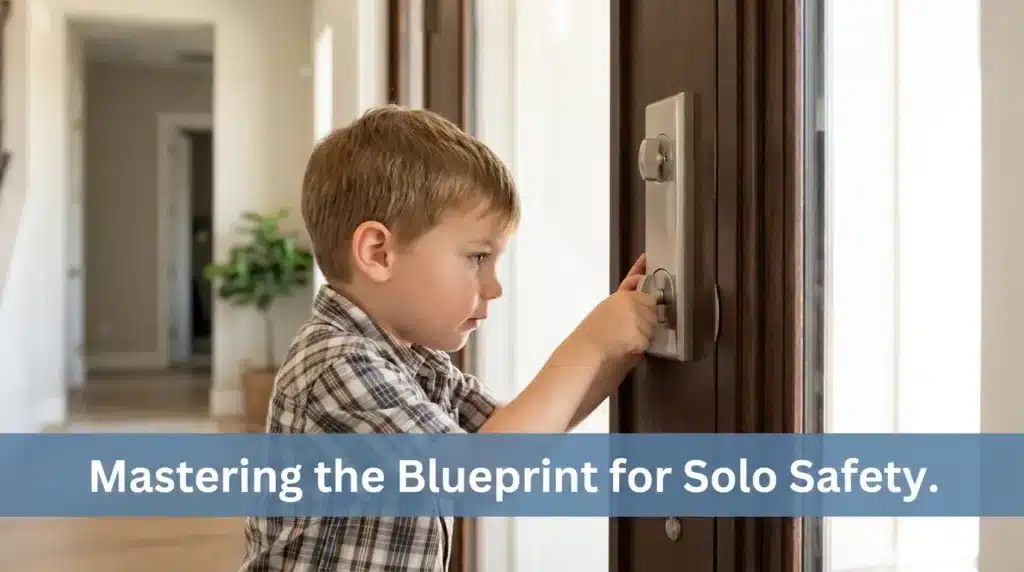
Make sure they know how to lock and unlock the doors perfectly. It sounds simple, but some deadbolts are tricky for small hands. Practice this ten times in a row.
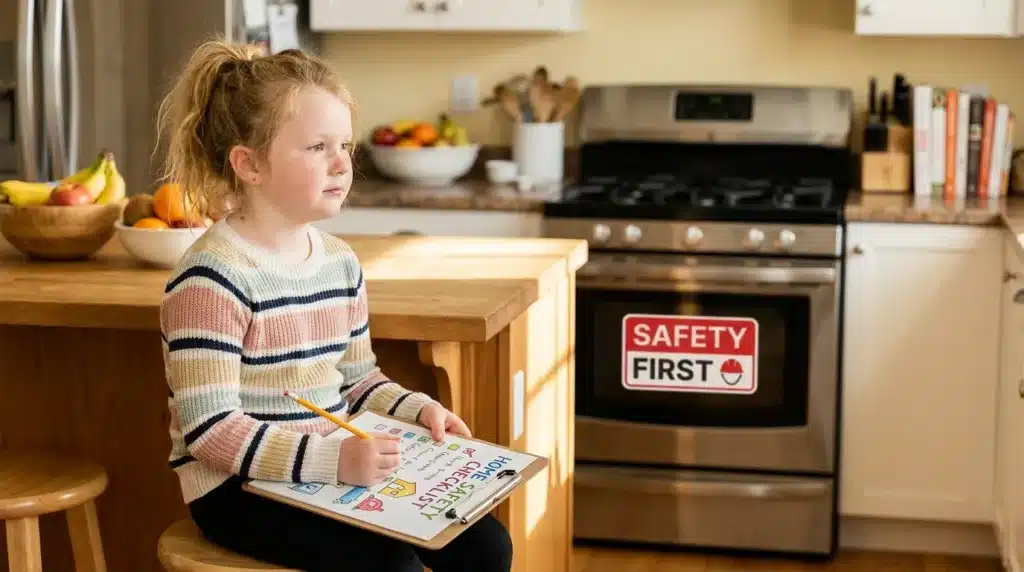
The Kitchen Rule is absolutely non-negotiable. For beginners, the kitchen should be strictly off-limits—meaning no stove, no oven, and no sharp knives. Prepare snacks ahead of time and put them on the counter so the child doesn’t have to climb or reach for anything dangerous.
We want to remove as many risks as possible. If they don’t need to cook, they can’t start a kitchen fire. If they don’t need to use a knife, they won’t get a deep cut.
Step 4: The Emergency Contact Tree
Your child needs to know exactly who to call and in what order. Don’t just rely on them knowing “911” in a sudden panic. Write down a clear list of names and numbers and put it prominently on the fridge or near their base camp:
- Parent 1: Your primary cell phone number.
- Parent 2: Your work number or a partner’s number.
- The “Local Hero”: A trusted neighbor who is home and can be there in 30 seconds.
- Emergency Services: 911 (Explain when to call this versus calling you).
Teach them the difference between a “mom emergency” and a “police emergency.” A clogged toilet is a mom emergency; seeing smoke or someone trying to open the door is a police emergency.
Roleplay these phone calls frequently. Pretend to be the 911 operator, ask them their address, and see if they can stay calm while talking to you. Practice makes this information “sticky” in their brain during moments of crisis.
Step 5: Master the Doorbell Dilemma
The biggest fear for many parents is a stranger at the door. You must implement a strict, non-negotiable “No Door” policy. It does not matter if the person says they have a package or looks like an official delivery driver—the door stays completely shut. This is as critical as educating your family on modern stranger danger tips to keep them secure.
If you have a video doorbell, show your child how to check it safely on a tablet or phone, and tell them they don’t even have to talk to the person. If someone knocks, the child should stay quiet and stay away from the door.
Some parents worry this makes it look like no one is home, but an empty-looking house is often safer than a child talking through a door. If your child feels scared because of a knock, they should call you immediately so you can check the camera remotely and handle the situation.
Step 6: First Aid for Beginners
Small injuries can happen at any time. A minor paper cut or a bumped knee can feel like a total disaster when you are completely alone. Show your child exactly where the first aid kit is located and make sure it is stored in an incredibly easy-to-reach place.
Teach them how to use a band-aid and clean a small scratch safely. Explain that for anything bigger, they must call you immediately. Blood can be terrifying for kids; teaching them that a little blood is normal helps them stay perfectly calm.
We are building their personal competence. For deeper household safety, you should also establish a medication safety home guide to lock away all prescriptions securely.
Step 7: Fire Safety and Exit Routes
This is the most serious part of home alone safety. Your child must know how to get out of the house fast if danger strikes. Walk through every single room together and find two distinct ways out of each area.
Teach them how to check a door for heat with the back of their hand and explain the classic “stop, drop, and roll” rule again. Establish a specific Meet-Up Spot outside, like a designated tree or the neighbor’s porch.
Tell them clearly: “If there is fire or smoke, don’t grab your toys or your iPad. Just get out safely.” Safety is entirely about people, not material things. Repeating this helps them prioritize their life over their belongings during a crisis.
Step 8: Digital Safety and the “No Post” Rule
In the age of social media, being “home alone” can be incredibly dangerous if shared online with the public. Make it a strict, unbroken rule: No posting on TikTok, Instagram, or Snapchat that they are home alone. No “live-streaming” while the house is empty.
The internet is an open window into your home. You do not want the world to know your child is currently solo. Also, discuss what to do if they see something scary online, as boredom might make them wander into unsafe parts of the web.
Set clear boundaries on what apps they can use. If possible, use advanced parental controls to lock certain sites while you are away to keep their minds busy with safe activities.
Step 9: The “I’m Home” Check-in Routine
Consistency is the absolute best friend of home safety. Create a predictable routine for the exact moment you leave and return. When you leave, they should lock the door behind you immediately and text you the word “Locked.”
When you are on your way back, text them “Coming home.” This creates a seamless “security loop” that reduces anxiety and keeps the lines of communication open and active.
This routine effectively reduces the feeling of isolation. Helping your child feel like a true partner in safety is the best way to ensure they follow the rules, turning a scary experience into a moment of genuine growth.
Taking the Next Step in Home Safety Mastery
Now that you have the basic safety steps in place, it is time to look at the advanced layers of protection. It is one thing to know your child can lock a door; it is another to know they can handle a sudden power outage or a minor leak under the sink.
Turning Smart Tech into a Silent Guardian
You can use modern technology to act as your eyes and ears without being an overbearing parent. Smart home sensors are exceptional tools. Place a sensor on the medicine cabinet and the liquor cabinet; if these doors open while you are away, you get an instant alert on your phone.
Another great tool is a smart plug for things like the toaster or hair straighteners. If you worry your teen might leave something on, you can simply turn the power off remotely from your phone. This takes the pressure off the child and creates a reliable safety net.
The “Surprise Scenario” Training Method
Expert parents use an advanced technique called stress testing. You don’t want the first time your child faces a problem to be when they are truly alone. While you are home, simulate a small problem like a sudden Wi-Fi outage or a tripped power breaker.
Try a “Surprise Visitor” drill by having a trusted friend knock on the front door unexpectedly. See if your child remembers to stay quiet and follow the script. This real-world practice builds deep muscle memory so they don’t panic when it happens for real.
Emotional Resilience and the “Scare Factor”
Being home alone is as much about feelings as it is about locks. A child might be physically safe but mentally terrified. Teach your child how to manage their own fear by explaining that houses make natural noises as wood expands and contracts.
Give them a “Comfort Toolkit” consisting of a favorite snack, an upbeat playlist, or a family pet. If they feel a wave of anxiety, teach them the 5-4-3-2-1 grounding rule to pull their brain out of a fear loop and back into reality.
Maintaining Long-Term Success and Safety
Safety is not a “one and done” lesson; it is a living habit that must grow as your child grows. Every few months, have a “Safety Refresh” meeting to talk about how the solo time is going and adjust the rules as they show more responsibility.
If they handle 30 minutes successfully, move it to an hour. Never jump from 20 minutes to four hours in one day. Slow progress builds a solid foundation of trust, making your child feel respected, capable, and eager to protect the freedom they have earned.
Hidden Dangers: Mistakes That Can Break Your Safety Plan
Even the most careful parents can fall into common traps. These mistakes often come from a place of “hoping for the best” rather than preparing for the truth.
Assuming Siblings Are Always Safer Together
One of the biggest mistakes is thinking that two kids are safer than one. While they have each other for company, sibling rivalry can create entirely new risks. If they start to argue or wrestle, a small injury can quickly turn into a full crisis.
Also, the older sibling may not have the emotional maturity to lead, or the younger one might refuse to listen. Only leave siblings together if they have a proven history of working as a team.
Forgetting the “Backup” Neighbor
You might be only ten minutes away, but in a true emergency, ten minutes is an eternity. A major mistake is not having a physical contact person within walking distance. You need a neighbor who is actually home and ideally has a backup key to your house.
Leaving the House “Live” on Social Media
Parents often make the mistake of posting milestone updates while they are away at dinner. This announces to everyone that your house is a target and your child is vulnerable. Always wait until you are back home to share the milestone, as digital safety is just as important as physical locks.
Skipping the “Post-Solo” Debrief
When you get home, don’t just say “I’m back” and walk away. Spend five minutes asking about their experience. If they did have a small scare, talking through it prevents hidden fear from growing into long-term anxiety.
Underestimating the Power of Boredom
A bored child is a child who starts to explore dangerously. Boredom directly leads to unnecessary risk-taking. Always provide a clear, structured activity plan before leaving to keep their hands and minds safely busy.
Answers to Common Questions About Home Solo Safety
Is there a legal age to leave a child home alone?
The answer depends entirely on where you live. Some places have a legal limit of 10, 12, or even 14 years old. However, many locations have no set age and leave it to the parent’s discretion. Always check your local government or police department website for the rules in your area.
What if my child is scared but I have to leave for work?
If your child is truly afraid, they are not ready. Forcing a scared child to stay home can lead to long-term anxiety. In this case, it is better to find a local “after-school” program or a neighbor’s house. You can try to build their confidence with shorter sessions over time.
Can I leave my 10-year-old and 6-year-old together?
Generally, this is not recommended. A 10-year-old is still a child and may panic if the 6-year-old gets hurt or starts crying. The age gap is too small for one to truly “supervise” the other in an emergency. It is best to wait until the oldest is at least 13 or 14 before they watch younger siblings.
Should I tell my child where the emergency key is hidden?
It is better to give them their own key or a digital keypad code. Hiding a key under a mat or a rock is a major security risk. If they have their own key on a lanyard or a code they have memorized, they are less likely to get locked out.
How long can a beginner stay home alone?
For a first-timer, 30 minutes is the golden rule. This is long enough for them to feel the “weight” of being alone but short enough that they don’t get bored or anxious. You can slowly add 15 minutes to each session as they become more comfortable.
A Brighter, More Independent Future for Your Family
Taking the step to let your child stay home alone is a huge milestone. It is a clear sign that you have done a great job raising a responsible person. Don’t let fear hold both of you back; instead, let that fear turn into a practical checklist.
You are giving your child a beautiful gift by telling them, “I trust you. I believe in your ability to handle yourself perfectly.” This trust will stay with them for the rest of their lives, helping them become outstanding adults who can solve problems and stay calm under pressure.
Start small, stay consistent, and keep talking to each other. Take that first 15-minute walk today. Your child is ready to show you what they can do, and you are ready to see them grow.
Disclaimer: The information provided in this article is for educational and informational purposes only. It does not constitute legal or professional safety advice. Every child and home situation is different. Always check your local and state laws regarding the legal age for staying home alone. Parents should use their own judgment and consult with safety experts or local authorities if they have specific concerns about their child’s readiness or safety.