Falling is not just a normal part of getting older. It is a major health event that changes families lives in an instant.
For many families, the home feels like a complete sanctuary. But for an aging senior, a simple loose rug or a dim hallway can become a dangerous trap.
According to comprehensive public health data on Wikipedia, domestic falls are the leading cause of accidental injuries among older adults.
We often see our parents or grandparents as strong, independent individuals. It is incredibly hard to admit they might be getting a bit shaky on their feet.
This emotional denial often leads to severe domestic accidents that could have been easily stopped with proactive planning.
A recent consumer safety analysis by Forbes highlights that smart home modifications drastically reduce long-term eldercare costs.
The psychological fear of falling is very real. It keeps many seniors from moving around freely within their own living space.
They stop doing the things they love because they are scared of an emergency trip to the hospital.
According to safety and wellness guidelines from Healthline, early environmental intervention is key to preserving mobility.
We need to talk about these adjustments openly before a painful crisis happens.
Why Standard Homes Fail Our Aging Loved Ones
Many people think their home is perfectly safe simply because it looks clean and organized.
However, most modern houses are structurally designed for young, active, and fully mobile bodies.
Here is why the usual home setup puts seniors at serious environmental risk:
- Furniture is often placed purely for aesthetics, completely blocking clear, direct paths.
- Most homes contain hidden trip points like raised door thresholds that cause sudden stumbles.
- Lighting is usually too dim in hallways, reducing visibility for older eyes that need more light.
- Safety tools are often rejected because families don’t want the house to look like a clinical hospital.
- Clutter builds up over years, creating random trip hazards like loose shoes and power cords on the floor.
The Mental Toll of Losing Your Stability
A physical fall does much more than just hurt the senior’s body. It breaks their independent spirit.
When a senior falls even once, their world immediately gets smaller due to a loss of physical confidence.
- They lose their sense of total freedom and stop moving around the house naturally.
- Confidence disappears quickly, causing an unnatural gait that actually increases the risk of another slip.
- Anxiety becomes a daily guest, generating constant mental stress that impacts their sleep and heart health.
- Social life suffers immensely as they refuse to leave the house to visit friends or beloved family members.
- The psychological feeling of being a burden grows, damaging their personal sense of dignity.
Understanding the True Cost of a Domestic Fall
When we talk about safety at Securely Life, we look at the big picture.
Fall prevention fits right into our core mission of situational awareness and overall protection.
A single slip in the bathroom is never just a minor accident. For someone over seventy, it often results in severe gait changes or a broken hip.
A broken hip often leads to a long stay in a care facility, forever changing a senior’s ability to live independently.
This is why we focus so heavily on physical safety. It is not just about keeping intruders out; it is about keeping the people inside safe from their own environment.
We also see a strong, direct link between physical vulnerability and Digital Safety risks.
When a senior is injured and stuck in bed, they use tablets and phones much more frequently.
If they are not fully tech-savvy, they quickly become prime targets for online scams.
Implementing a comprehensive child online safety guide works for kids, but seniors need similar digital guardrails when left unsupervised online.
Even general safety confidence is affected. If a senior does not feel safe walking in their own hallway, they will never feel confident traveling or exploring outside.
Everything is connected. By fixing the home layout, we help them stay active and fully protected in every other part of their lives.
We must stop treating senior falls as unpredictable accidents. Most of the time, they are entirely predictable environmental events.
If there is a loose wire or an unanchored rug on the floor, someone will eventually trip on it. Finding these risks early protects our family’s future.
Creating a Bright and Clear Path to Safety
The first thing you should audit in any home is the lighting setup.
As we age, the lenses in our eyes naturally thicken and alter depth perception. A room that looks bright to a thirty-year-old might look incredibly dim to an eighty-year-old.
Step 1: Upgrade Your Home Lighting Strategy
You need to make sure there are absolutely no dark spots or sudden shadows in the house. Start with the main transition zones.
Install motion-sensor night lights in every hallway. These are great because the senior doesn’t have to fumble for a manual wall switch in the pitch dark.
Check the light switches at the top and bottom of the stairs. If a senior has to walk up dark stairs to reach a switch, they are already in danger.
Imagine your elderly father needs a drink of water at 2 AM. If he can simply say, “Lights on,” smart home integration illuminates every hazard instantly.
This is one of the 5 essential tips for a securely life that seamlessly combines technology with Personal Safety.
Step 2: Clear the Floor and Secure the Ground
Take a slow walk through the entire house. Look straight down at the floor. Do you see throw rugs?
Those beautiful little decorative carpets are the number one structural enemy of senior safety. They slide easily and their edges curl up over time.
A senior’s toe can catch on that curled edge very easily. The best choice is to remove them completely from the home environment.
If you must keep them, use double-sided heavy-duty rug tape or industrial non-slip pads to stick them firmly to the hard floor.
Look for clutter creep near high-traffic areas. Shoes near the door, umbrellas, and pet toys are massive trip risks. Create a strict zero-clutter rule.
Make sure all electrical power cords are safely tucked behind furniture. If a cord must cross a walkway, use a heavy-duty plastic cord cover that sticks flat to the floor.
Step 3: Transform the Bathroom into a Safe Haven
The bathroom is statistically the most dangerous room in any household because it combines hard surfaces with slippery water.
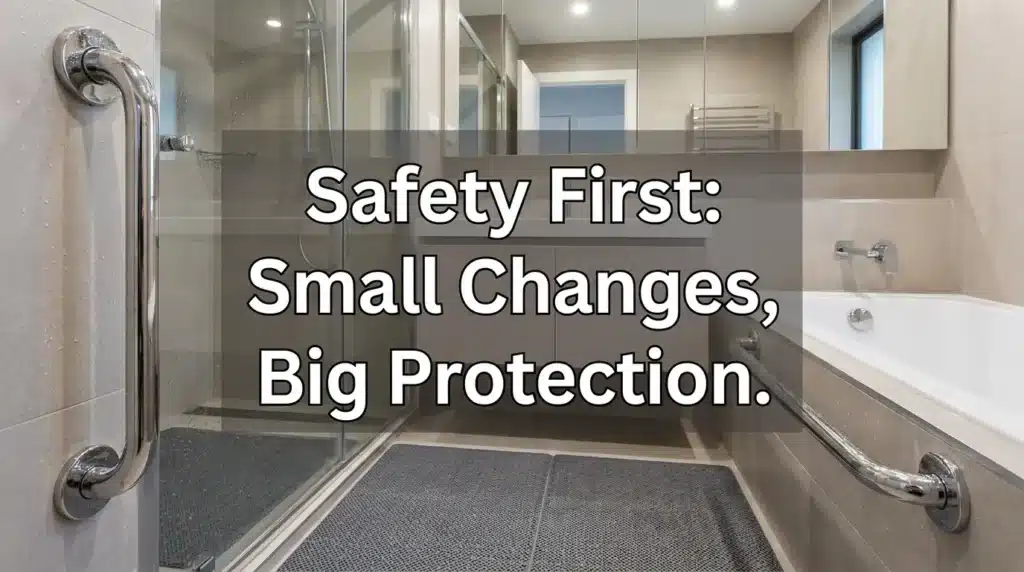
First, install professional-grade grab bars near the toilet and inside the shower stall.
Do not ever use standard towel racks as grab bars. Towel racks are not anchored to hold a human being’s falling weight and will pull right out of the drywall.
Securing high-risk wet zones is an absolute priority.
Just as you would audit temporary spaces using a hotel room security locking guide while traveling, your permanent home requires the same rigorous defense standards.
Use permanent non-slip adhesive strips on the floor of the tub or shower. A simple rubber mat can trap mold underneath and become dangerously slippery itself.
Think about investing in a raised toilet seat. As lower body muscles get weaker, sitting down and standing up alters physical stability. A higher seat reduces straining.
Step 4: Organize for Easy Access
In the kitchen, move the items used most often to the middle shelves. No one should be reaching for heavy cookware on high shelves or bending deep into low cabinets.
Constant reaching and deep bending shifts a senior’s center of gravity drastically.
When you are off-balance, even a small, sudden movement can cause a severe fall. Keep everything within a safe chest-level strike zone.
Check the physical flow of every room. Can a person walk from the fridge to the dining table without zig-zagging around heavy chairs? If not, rearrange the furniture immediately.
Step 5: Footwear is a Safety Tool
Sometimes the underlying danger isn’t the floor structure itself; it’s what the senior is wearing on their feet.
Walking in standard socks on a polished wood floor is exactly like walking on slick winter ice.
Slippers should always have non-slip rubber soles and a fully closed back. Flip-flop style slippers are dangerous because they easily slip off the foot.
Encourage your loved ones to wear sturdy, supportive shoes even when they are hanging out inside the house.
This simple habit provides essential ankle support and much better traction. It is an incredibly easy change that has a huge impact on Family Safety.
We also need to rigorously check the home stairs. If there are stairs, make sure sturdy handrails are installed on both sides of the wall.
Check the physical edges of the steps. If the stairs are carpeted, make sure the fabric is stretched tight. If they are bare wood, add highly visible non-slip adhesive strips.
Strengthening Your Long-Term Home Safety Plan
Physical modifications to the house structure are only half of the story. To truly protect your family, you must look at the physical health of the senior.
Step 6: Managing Medications and Balance
Many older adults take several different prescription pills every day. Some of these medications can make a person feel suddenly dizzy, drowsy, or lightheaded.
Talk directly to their doctor or a trusted pharmacist about potential drug interactions that impact physical balance.
It is an excellent idea to keep a written daily log of when pills are taken. If your loved one feels shaky an hour after a specific dose, you need to document it.
We suggest using a highly visible pill organizer with large, clear labels. This prevents the senior from leaning over or straining their neck to read tiny fonts.
Step 7: Building Strength and Flexibility at Home
A body that moves consistently is a body that stays upright. You do not need an expensive gym membership to keep an aging senior strong.
Encourage your loved one to try gentle, low-impact stability exercises like Tai Chi or basic leg lifts while holding onto a heavy kitchen counter.
These slow, controlled movements strengthen the core muscles that directly control human balance and proprioception.
Regular daily walking is also excellent. Even a brief five-minute walk around the living room keeps lower joints loose and responsive.
Step 8: Regular Vision and Hearing Checkups
We process our physical environment through our sensory organs. If a senior cannot see a structural step or hear an audio warning, they are at extreme risk.
Make sure your loved one has a comprehensive professional eye exam at least once a year to fix lingering depth perception issues.
Hearing is also directly linked to internal balance systems. If there is an undiagnosed inner ear issue, it can cause severe vertigo or spinning sensations.
Keeping up with these routine medical checkups is a pro-level protection secret. It stops a catastrophic physical fall before it ever has a chance to start.
Maintaining Your Success for the Long Run
Setting up a safe home environment is never a one-time project. Hazards can creep back into a household at any time.
We highly recommend doing a quick safety sweep every single Sunday afternoon. Walk through every room and clear away any new clutter.
Check the light bulbs to see if any are flickering or dying. Look at the bathroom mats to ensure they aren’t beginning to peel up at the corners.
Always include the senior directly in this weekly process. Ask them where they feel slightly nervous walking, making safety a collaborative family effort.
Big Mistakes That Put Seniors at Risk
Even with the best family intentions, people often make critical errors that lead to avoidable injuries. Avoid these five common pitfalls:
1. Using Furniture for Unstable Support
Many seniors grab onto the back of light chairs, unstable bookshelves, or curtains to help them balance while walking. This is incredibly dangerous.
Most household furniture is not bolted to the wall structure and can tip over instantly under weight, leading to severe orthopedic injuries.
2. Ignoring Diagnostic “Near Misses”
Sometimes a senior stumbles but catches themselves right before hitting the ground. Laughing it off as a simple trip is a massive mistake.
A near miss is a clear diagnostic warning sign that their physical balance is changing. Investigate why it happened and fix the environmental cause immediately.
3. Choosing Loose or Slippery Footwear Indoors
People often confuse being comfortable with being structurally safe. Wearing loose, backless slippers or standard cotton socks inside is highly risky.
Socks have zero friction on smooth tile or wood surfaces. Always enforce shoes with non-slip rubber soles for total Personal Safety.
4. Doing Too Much Physical Activity Alone
Sometimes seniors feel temporarily energetic and try to carry heavy laundry baskets down steep stairs or reach for high storage spaces independently.
Sudden over-exertion leads to rapid muscle fatigue. When muscles are exhausted, they cannot react quickly enough to save the body from a sudden trip.
5. Keeping an Outdated House Layout
People get emotionally attached to how their house looked thirty years ago. They refuse to move a favorite table or get rid of a nostalgic rug.
Refusing to adapt the home layout to match changing physical realities is a critical mistake that often forces seniors out of their homes permanently.
Common Questions About Senior Fall Prevention
What is the number one cause of falls in the elderly?
The primary cause is a dangerous combination of unaddressed environmental hazards (like loose rugs or poor lighting) and declining lower-body muscle strength.
How can I make a bathroom safe without an expensive remodel?
You can achieve massive safety gains cheaply. Install high-quality non-slip shower strips, anchor tension-based grab bars, and place a sturdy shower chair inside the stall.
Are there smart tech tools to help prevent senior falls?
Absolutely. Voice-controlled smart bulbs prevent walking in the dark, and automated ambient motion sensors can alert family members instantly if an emergency occurs.
Which household flooring is safest for aging seniors?
Short-pile, industrial-grade carpet is generally the safest option. It offers much higher traction than polished wood or ceramic tile and provides a cushion if a slip occurs.
How do I talk to my aging parents about home safety without offending them?
Always frame the conversation around protecting their personal independence. Explain that modifying the home layout ensures they can live there safely for a much longer time.
Creating a Brighter and Safer Future Together
Modifying a home environment for an aging senior is one of the most practical acts of love you can perform. You are actively protecting their physical health.
Start small today. Pick just one high-risk room, like the main bathroom, and optimize the lighting and non-slip surfaces before moving on to the rest of the house.
At Securely Life, we believe every individual has the right to feel completely secure within their own living space. Your defensive adjustments today prevent a medical crisis tomorrow.
Disclaimer: The information provided in this post is for educational purposes only. It is not a substitute for professional medical advice or a home safety assessment by a certified expert. Always consult with a doctor regarding balance issues or medical conditions. Securely Life is not responsible for any injuries that may occur after following these suggestions. Use your best judgment and prioritize professional help for physical installations.