The Night My Landlord Said “Not One Hole in That Wall”
I still remember the exact sentence my landlord said to me on move-in day. He looked me dead in the eye and told me the security deposit would disappear if he found even one screw hole in the drywall. I nodded like it was no big deal, then went home and panicked a little.
My old apartment had a flimsy chain lock and a peephole that fogged up every winter. I wanted a camera by my door and something stronger than that chain, but every product I found online said “screw into the frame” or “drill a pilot hole first.” I felt stuck between wanting to feel safe and wanting my deposit back.
That frustration is what pushed me to figure this whole thing out the hard way, through trial, error, and a few wasted purchases. I promise you don’t have to make the same mistakes I did.
If you’re renting, you already know the feeling. You want to lock your door properly, add a camera, or set up an alarm, but your lease says no permanent changes. Every home security product on the shelf seems built for people who own their walls, not people who rent them.
This creates a real problem for your peace of mind. You hear about package thefts, hallway break-ins, and door-kicking incidents in your building’s group chat, but you feel powerless to do anything about it. You’re not being paranoid. According to the FBI’s Uniform Crime Reporting Program, an apartment unit is legally classified the same as a house when it comes to burglary law, which means renters face the same real risk as homeowners, often with fewer tools to fight back.
Here’s what most renters are quietly dealing with:
- Feeling unsafe answering the door at night because the peephole or lock feels weak
- Worrying that a package or bike left in a shared hallway will disappear
- Wanting a camera by the door but not wanting a angry email from the property manager
- Losing part of a hard-earned security deposit because a past tenant drilled holes and never patched them
- Not knowing what’s even legal to install in a rented space
You are not the only one dealing with this. There is a whole world of security gear built specifically for people in your exact situation, and none of it needs a drill.
Building a No-Drill Security Layer That Actually Works
Think of apartment security less like one big fix and more like stacking small layers. Each layer makes a break-in harder, slower, or louder, which is exactly what discourages most opportunistic burglars. You don’t need every layer on day one. Start with whichever one solves your biggest worry first.
Start With the Door You Already Have
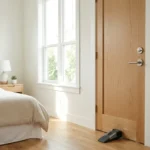
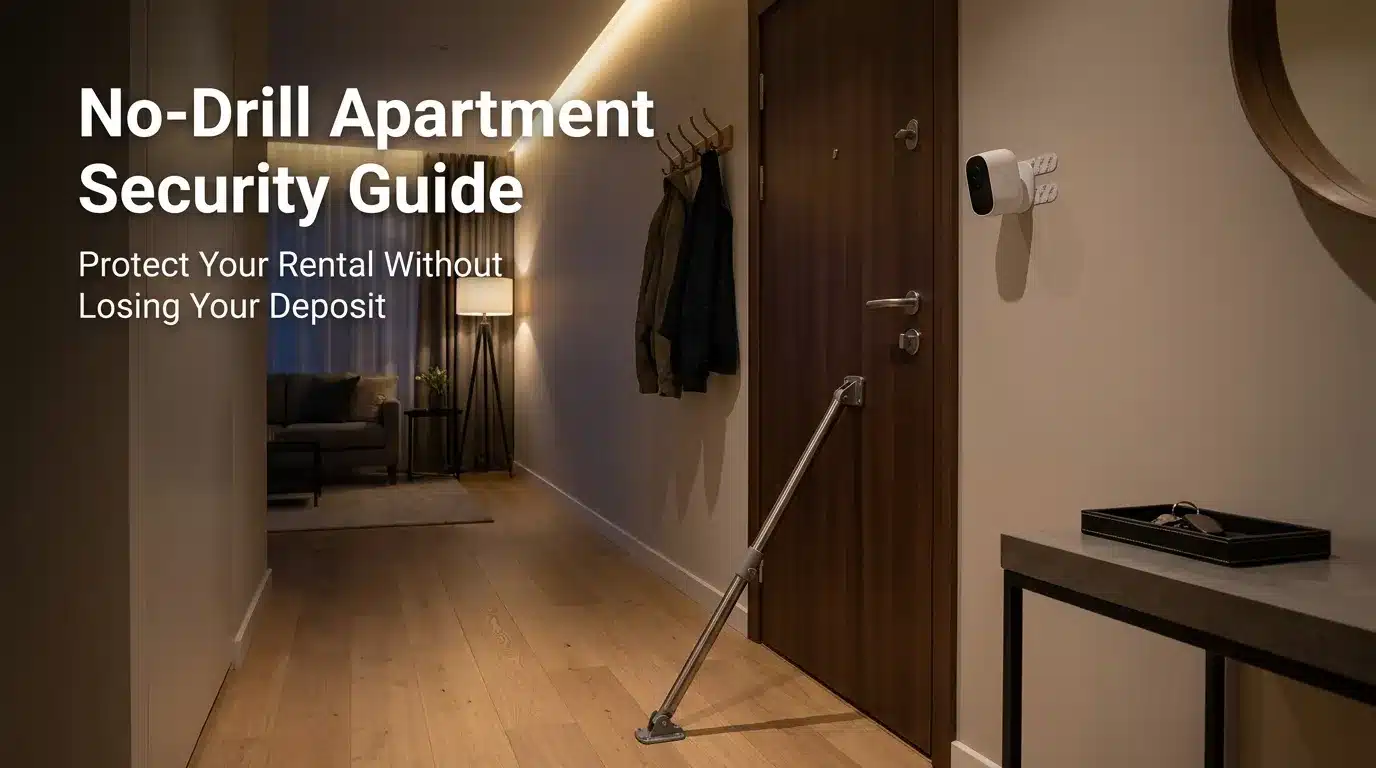
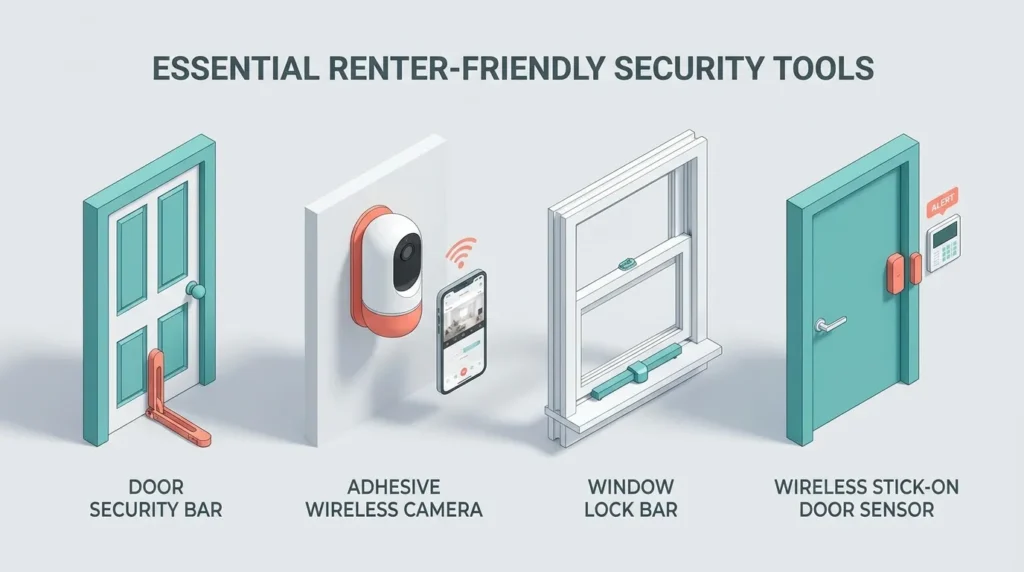
Your front door is doing more work than you think, so give it backup instead of replacing it. A portable door security bar or door jammer wedges under the doorknob and braces against the floor, and it can hold the door shut even if someone has a working key.
These devices travel with you, cost less than a locksmith visit, and take about ten seconds to set up each night. I keep one by my bed and slide it under the door before I go to sleep, and honestly, the sound it makes when I set it is oddly comforting.
If you want something more permanent-feeling without touching the door itself, look at tension-mounted or clamp-style security bars that grip the door frame using pressure instead of screws. Compare this to a standard chain lock and the difference in strength is not close.
| Device Type | Installation | Approx. Strength | Best For |
|---|---|---|---|
| Door security bar | No tools, floor-braced | High | Nightly use, travel |
| Clamp/tension door lock | No drilling, frame pressure | Medium-High | Daily privacy lock |
| Portable travel door lock | No tools, slides into strike plate | Medium | Hotels, shared housing |
| Standard chain lock (factory) | Usually pre-installed | Low | Backup only |
Once your door is braced, your existing lock matters more than you’d think, and this is a good moment to look at smart locks vs. deadbolts and which one is actually safer for a rental setup, since some smart lock models now clip over your existing deadbolt with zero drilling required.
Lock Down Windows Without Touching the Frame
Windows get ignored constantly, and that is exactly why they are a favorite entry point. A cheap window security bar or adjustable pin lock sits inside the track and stops the window from sliding open more than a few inches, all without a single screw.
For ground-floor or fire-escape-accessible units, add a wireless window/door alarm sensor. These stick on with adhesive backing, and they scream loud enough to send anyone running the second the seal breaks. If you want a full breakdown of every angle, our guide on how to secure windows from the inside covers renter-safe options in more depth.
Pro tip from personal experience: I once bought a “heavy duty” adhesive lock that fell off my window in under a week because I didn’t clean the glass first. I learned the hard way that a quick wipe with rubbing alcohol before applying anything sticky makes a massive difference in how long it holds. Skip that step and you’re basically wasting your money.
Add Eyes and Ears With Peel-and-Stick Cameras
You don’t need a drilled-in doorbell camera to see who’s outside your door. Battery-powered smart cameras now come with adhesive mounting plates, and many companies build these specifically with renters in mind.
Watch this quick walkthrough on mounting a no-drill security camera the right way, so you can copy the exact placement that gets the clearest angle:
Once your camera is up, connecting it safely matters just as much as where you point it. Our post on securing your home Wi-Fi for smart cameras walks through locking that connection down so a stranger can’t peek into your own camera feed. The Cybersecurity and Infrastructure Security Agency also recommends turning on multi-factor authentication for any app tied to a physical security device, since a weak password on your camera app can undo all the physical security you just set up.
A quick note on the adhesive itself: not all mounting strips are equal. Command brand strips list their exact weight limits on the packaging, ranging from a few pounds up to fifteen or twenty pounds depending on the strip size, so match the strip strength to the camera’s actual weight instead of guessing.
Make Noise Work in Your Favor
Sound is one of the cheapest, most underrated security tools you have. A simple door hanger alarm slips over the doorknob with no adhesive at all, and it drops small bells or a loud siren the moment the door moves.
Motion-triggered alarms that stick to a wall corner work the same way, and most run on batteries you swap out every few months. Package theft is another sound-solvable problem, and our guide on how to prevent package theft has a few renter-specific tricks that pair well with these alarms.
Light Up the Dark Spots
A dim hallway or a shadowy front step is basically an invitation. Battery-powered motion lights with adhesive or magnetic backs solve this instantly, no electrician required.
Stick one above your door and one near your window, and test them at night before you rely on them, since some models have a delay of a few seconds before triggering. If your building has a shared entry, a small solar light clipped onto a railing can make the whole hallway feel less like a hiding spot.
Your Move-In Day Security Checklist
Before you sign anything or unpack a single box, run through this list. It takes less than twenty minutes and it sets the tone for how safe your new place actually feels.
- Test every existing lock and note anything that feels loose or sticky
- Check your lease for any written rules about security devices or modifications
- Photograph the walls, door frame, and window tracks before you install anything
- Clean glass and wood surfaces before applying any adhesive device
- Add a door brace or jammer for nighttime use
- Install a wireless door or window alarm on the most vulnerable entry point
- Mount a battery camera facing your main entrance
- Confirm your camera app has multi-factor authentication turned on
- Save your leasing office’s after-hours contact number in your phone
If you’re still working through the rest of your move-in list, our ultimate home security guide for beginners is a good next stop, and pairing that with a solid nighttime home security checklist covers the two biggest gaps most new renters miss.
One more thing worth knowing before you buy anything: most standard leases allow reversible security additions even when they ban permanent changes. The U.S. Department of Housing and Urban Development notes that tenants generally keep the right to reasonable privacy and safety measures inside their own unit, as long as those measures don’t damage the property or block emergency access. Read your specific lease language, but in most cases, adhesive and pressure-mounted devices fall well within what’s allowed.
It’s also worth checking with your renters insurance provider. Some insurers offer small discounts for tenants who add security devices like alarms or cameras, according to the Insurance Information Institute’s renters insurance guide, so a quick call could end up saving you money on top of the safety upgrade. And if you’re worried about identity theft alongside physical break-ins, our piece on securing your mailbox from identity theft rounds out this whole no-drill approach nicely.
The Small Habits That Make Your Setup Actually Work
Buying the right gear only gets you halfway there. The renters who stay safest long-term are the ones who treat security as a habit, not a one-time shopping trip.
Here’s something I didn’t expect when I first set everything up: batteries die at the worst possible time. My door sensor went silent for two weeks before I noticed the low-battery light, and I only caught it because I happened to glance at the app while making coffee. Now I check every device on the first of the month, and it takes less than five minutes.
Your phone can also become your best security tool without spending another dollar. Most wireless alarms, cameras, and smart locks connect to an app that sends a push notification the second something moves. Turn those alerts on and actually read them, instead of letting them pile up unread like spam.
Here’s a simple way to think about what helps and what doesn’t:
Do:
- Test every alarm and camera once a month
- Keep spare batteries in a kitchen drawer, not buried in a closet
- Introduce yourself to close neighbors so they notice if someone unfamiliar lingers by your door
- Angle motion lights toward walkways, not directly into anyone’s window
- Re-stick adhesive mounts if they ever feel loose, rather than waiting for them to fall
Don’t:
- Rely on one single device to cover your whole apartment
- Point a camera at a shared hallway in a way that captures your neighbor’s front door too closely
- Leave the default password on any smart lock or camera app
- Assume a “no drill” label means “no maintenance”
- Forget to remove your devices and wipe their app data before you move out
If you live somewhere with a shared balcony door or sliding glass exit, a simple wooden dowel rod cut to size and dropped into the track works better than most people expect. It’s the kind of trick a locksmith would tell a friend, not something you’ll usually see printed on a product box.
One more habit worth building: walk around your own apartment once, pretending you’re the person trying to break in. Stand at your front door and ask yourself what you’d try first. Check your windows from outside if you can safely do so. This kind of five-minute self-audit catches gaps that no product list ever will, because it forces you to think from the other side of the door.
Think about the seasons too, since your risk level shifts throughout the year. Darker winter evenings mean your motion lights matter more, while summer often brings open windows and propped screen doors that quietly cancel out everything else you’ve set up. A five-minute seasonal check, maybe on the same weekend you switch your clocks, keeps your whole system matched to what’s actually happening outside your door.
Building trust with your immediate neighbors pays off in ways a device never can. A quick text saying “hey, I’m expecting a delivery around 3pm, can you keep an eye out” turns a stranger’s package on the doorstep into something someone is actually watching. This costs nothing and often does more than an extra camera ever could.
I also learned to keep a short written note of which device covers which entry point. It sounds unnecessary until your alarm goes off at 2 a.m. and you’re half-asleep trying to remember whether that beep means the window or the door. A sticky note on the inside of a kitchen cabinet solved that for me.
Where Renters Usually Go Wrong (And What It Costs Them)
I want to be honest with you about the mistakes I see people make over and over, because some of them are genuinely costly, not just inconvenient.
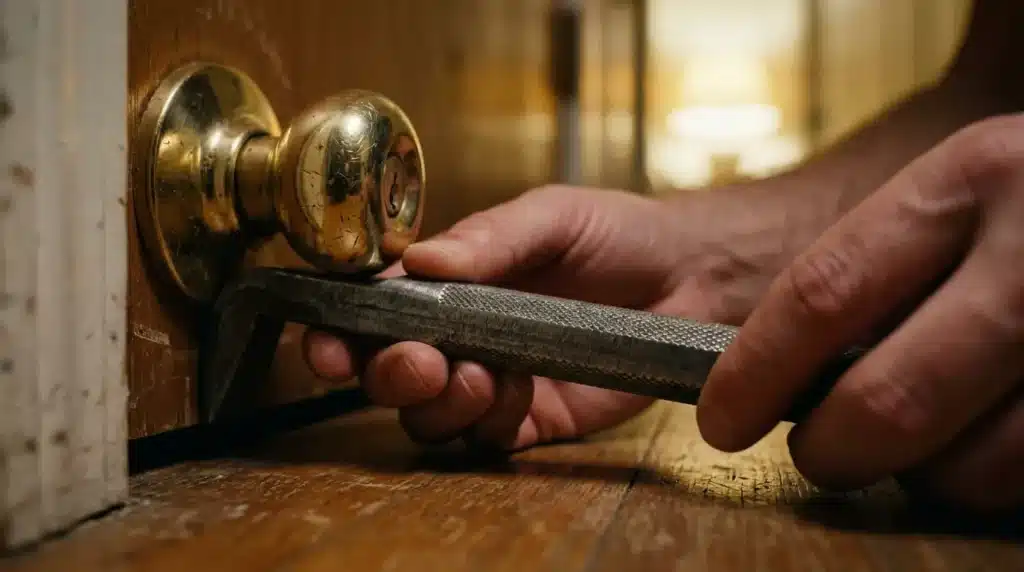
The biggest one is buying gear out of panic instead of planning. Something scary happens in the building, a tenant gets a package stolen or hears about a break-in two floors down, and suddenly everyone is ordering the first camera that shows up in a late-night search. Rushed purchases often mean weak adhesive strips holding a device that’s too heavy, or a camera pointed at the wrong angle entirely.
Another mistake that quietly drains your bank account is ignoring your lease’s fine print. Some buildings have specific rules about exterior cameras, especially ones that face shared hallways instead of just your own doorway. Skipping that read can turn a smart safety upgrade into an awkward conversation with your property manager, or worse, a deduction from your deposit for “unauthorized installation.”
There’s also an emotional trap I fell into myself: thinking one device means you’re done. I put up a door alarm and genuinely felt like my apartment was locked down tight. It wasn’t, because my windows were still wide open to anyone patient enough to try them. Real security comes from layers working together, not one product doing all the heavy lifting.
People also underestimate how much a fake or disconnected camera can hurt them if they lean on it too hard. A dummy camera might discourage a random passerby, but anyone who’s cased your hallway more than once usually figures it out fast. If you’re going to rely on the “deterrent” effect, pair it with something that actually works, like a loud door alarm or a light that switches on with motion.
Finally, don’t ignore what happens when you move out. Leaving an old smart lock code active, or forgetting to unlink a camera from your account, hands the next tenant a security hole they don’t even know exists. It only takes a few minutes to reset everything, and it’s the kind of small courtesy that keeps the whole building a little safer.
Common Questions About No-Drill Apartment Security
Is it legal to put a security camera outside my apartment door?
In most cases, yes, as long as the camera only records your own doorway and not a neighbor’s door or a shared space where people expect privacy. Always double-check your specific lease and local laws, since rules can shift slightly from state to state and building to building.
Will these devices leave marks or damage on my walls?
Good quality adhesive strips and pressure-mounted bars are built to come off clean when removed correctly. The key is following the removal instructions exactly, usually by stretching the strip flat and slow instead of pulling it straight off the wall.
Can my landlord force me to take down a security camera or alarm?
Yes, if it violates something written in your lease or local housing code, your landlord generally can ask you to remove it. This is exactly why reading your lease before installing anything saves you a headache later.
Do wireless door and window alarms need Wi-Fi to work?
Not always. Many basic alarms just need batteries and work as a standalone siren, while smarter versions that send phone alerts do need a Wi-Fi or hub connection. Pick the type based on whether you want a loud local alarm or a notification on your phone while you’re away.
How much should I expect to spend on a full no-drill setup?
You can build a solid starter setup, covering your door, one window, and basic lighting, for around the price of a nice dinner out. Adding a camera and smart lock naturally pushes the total higher, but you can always start small and add pieces over the following months.
What’s the fastest thing I can do tonight if I feel unsafe right now?
Grab a door security bar or even a sturdy chair wedged under the doorknob as a temporary fix while you shop for something permanent. Pair that with your phone’s flashlight pointed toward any dark hallway spot, and you’ve already improved your situation in under two minutes.
Your Next Move Starts Tonight
Every renter deserves to feel calm walking through their own front door, and none of that calm requires a single drill or a broken lease agreement. Small, reversible upgrades add up fast when you stack them the right way.
I look back at that nervous version of myself on move-in day, and I wish I could tell her it really is this simple. You don’t need permission to feel safe in your own home, and you don’t need permanent changes to make that happen.
Pick one thing from this guide, whether it’s a door brace, a window alarm, or just a five-minute walk-around audit, and do it before the week is out. Future you will be glad you didn’t wait.
Disclaimer: This article is for general informational purposes only and does not replace professional security consultation, a locksmith’s advice, or your landlord’s specific lease terms. Product weight limits, adhesive strength, and local landlord-tenant laws can vary, so always check current manufacturer instructions and your own rental agreement before installing any device. Securely Life is not responsible for property damage, security deposit disputes, or losses resulting from the use or misuse of the tips shared here.