I remember lying in bed a few years ago, hearing a loud thud right outside my bedroom window. My heart started racing, and I realized that my cheap front door lock was the only thing between my family and whoever was out there. That scary night changed everything for me and pushed me to find a real way to protect my home so I could finally sleep in peace again.
Your home is supposed to be the place where the world stops and your peace begins. Yet, for many people living in modern cities across the US and Europe, that peace is often fragile.
You might find yourself lying awake at night, listening to every small sound outside your window. The thought of a stranger entering your private space is not just a worry about property; it is a worry about the safety of your loved ones.
This feeling of being exposed can slowly drain your energy and ruin your quality of life. You start to double-check every lock multiple times, but you still don’t feel quite right.
Stop worrying about home intruders and start taking control of your environment today. If you are looking for a solid starting point, explore these 5 essential tips for a securely life to build a foundation of safety.
Why Standard Security Often Leaves You Exposed
Many homeowners believe that a simple alarm system and a standard door lock are enough to keep them safe. Unfortunately, professional intruders know exactly how to find the holes in these basic defenses.
- Standard door frames are often made of soft wood that splits with a single strong kick.
- Most windows have simple latches that can be popped open with a small screwdriver in seconds.
- Homeowners often buy the cheapest hardware available, which lacks the strength needed to stop a determined criminal.
- A lack of a clear safety routine means entry points are often left unlocked by mistake during the day.
The Mental Burden of Living Without a Plan
When you don’t have a structured approach to your security, you live in a constant state of “what if.” This psychological weight affects how you sleep, how you work, and how you interact with your family.
- You feel a heavy responsibility to protect your children but don’t know where the real weak spots are.
- The confusion caused by thousands of security products makes you feel paralyzed and unable to act.
- This lack of action leads to more anxiety, creating a cycle that only breaks when you have a professional roadmap.
According to data from the FBI Uniform Crime Reporting, most residential burglaries happen during the day when people are at work. This reality proves that your home needs passive defenses that work even when you are not there to watch.
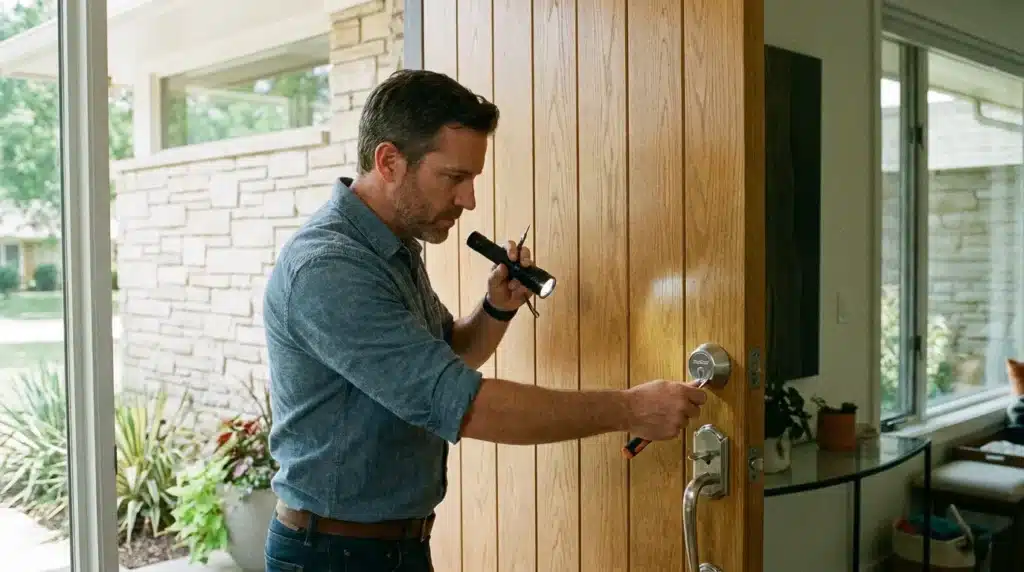
The Master Blueprint for Total Residential Security
Creating a truly safe environment requires a layered approach that targets every possible entry point. You cannot fix everything with a single gadget; you need a system that works together to repel intruders.
In this first part of our comprehensive guide, we will focus on the most important physical barriers: your doors and your windows. These are the front lines of your home’s defense.
Phase 1: Hardening the Front Door Against Brute Force
Your front door is the primary target for most burglars because it is the most logical way into a house. If your front door is weak, nothing else in your security plan really matters.
Most people think their door is strong because it feels heavy, but the strength actually lies in the hardware. If you are using short screws in your strike plate, your door is only as strong as a small piece of wood.
You can significantly increase your resistance by learning how to secure your front door from intruders using expert-approved methods. This includes replacing standard hardware with heavy-duty steel components.
Replacing your existing screws with three-inch versions allows them to grip the solid wall studs behind the frame. This simple change can make the difference between a door that stands firm and one that collapses.
One mistake I made for a long time was trusting the tiny, short screws that came with my door frame. I was shocked to learn they only grab onto a thin piece of decorative wood and offer almost no protection against a strong kick. Now, I always swap them for three-inch hardened steel screws because it anchors the door to the actual bones of the house, making it much harder to break.
The Great Debate: Smart Tech vs. Traditional Strength
As you upgrade your entrance, you will face a choice between modern convenience and old-school durability. Many homeowners are now looking at electronic solutions for their daily needs.
When you weigh your options, consider the breakdown of smart locks vs. deadbolts to see which fits your specific security level. While smart locks offer tracking, a high-grade mechanical deadbolt is often harder to physically break.
Regardless of which one you choose, the installation must be perfect. A poorly installed high-end lock is no better than a cheap one from a bargain bin.
Reinforcing the Strike Plate and Hinge Side
The strike plate is the metal piece on the door frame where the bolt enters. If this piece is small, a kick will rip it right out of the wood.
You should install a box-style strike plate with multiple long screws. This distributes the force of a kick across a much larger area of the wall.
Don’t forget the hinges on the other side of the door. If your door opens outward, the hinge pins might be exposed to the outside, allowing someone to simply pop them off.
Using simple ways to reinforce your front door like security studs or non-removable pins prevents this bypass. Every small detail you address makes your home a much harder target for criminals.
Check out this detailed walkthrough below to see how you can make your door as solid as a tank! It perfectly shows the reinforcement steps we just discussed and will give you the confidence to start your own security upgrade today.
Phase 2: Securing Windows and Glass Entry Points
Windows are the second most common entry point because glass is naturally fragile. Most people forget to secure their windows because they think the height or the visibility will stop a thief.
However, many burglars are willing to break a small pane of glass to reach inside and turn the latch. This is why you need secondary locks that do not rely on the factory-installed latch.
If you are a tenant, you might not be allowed to drill holes in the window frames. Fortunately, there are many effective ways to secure windows from the inside that are completely renter-friendly and easy to remove.
Dealing with the Danger of Sliding Glass Doors
Sliding glass doors are a major security risk for many suburban homes in the US. They are often tucked away in the backyard where an intruder can work without being seen by neighbors.
Most sliding door locks are incredibly weak and can be lifted off their tracks with a simple tool. This is a massive vulnerability that you must address immediately.
You can learn how to secure sliding glass doors by using security bars that fit into the track. This prevents the door from being slid open even if the lock is picked or broken.
“A window or a sliding door should not be an easy invitation. With the right reinforcement, these glass areas can become just as strong as your walls.”
Applying a thick security film to the glass is another professional secret. This film keeps the glass from falling out even if it is hit with a hammer, forcing the intruder to keep hitting it and making a loud noise.
Phase 3: The Importance of Perimeter Lighting and Visibility
Visibility is the enemy of the intruder. Criminals want to work in the shadows where they can take their time without being noticed.
Motion-activated lights around your doors and windows are a powerful deterrent. When a light suddenly turns on, most thieves will assume they have been spotted and will run away.
You should also keep your landscaping tidy. Tall bushes near your windows or front door provide the perfect hiding spot for someone waiting for you to leave.
Trim your hedges to a height of three feet or less and keep tree branches at least seven feet off the ground. This creates a “clear zone” around your house that makes it impossible for someone to hide.
Phase 4: Establishing the Digital Wall of Defense
While physical barriers are the first line, digital security is the second. In our connected world, your home security system is often linked to your internet.
Protecting your network is a step that many people overlook until they experience a breach. Your Wi-Fi is the bridge that allows your cameras and smart locks to communicate.
The Cybersecurity & Infrastructure Security Agency (CISA) recommends using a separate network for your smart home devices. This keeps your private data safe even if one of your cameras is compromised.
Never use the default password that came with your router. These are well-known to hackers and can be found online in seconds.
Phase 5: The Role of Habit and Daily Routines
Even the best locks and the strongest glass film will not work if you don’t use them. Security is a lifestyle that requires you to be consistent every single day.
Make it a habit to check every door and window before you go to bed. This routine ensures that a momentary lapse in memory doesn’t leave your family in danger.
As you move through this guide, you will see how these physical and digital layers work together. By hardening your home, you are creating an environment where you can finally relax.
In the next part of this roadmap, we will cover how to manage your home safety when you are away and how to handle the specific risks of the garage and porch.
Your journey to a securely life is just beginning. Take the time to implement these first steps today to protect what matters most to you.
Protecting the Digital and Secondary Entry Points
In the first part of this roadmap, we looked at how to harden your doors and windows. Now, we must focus on the parts of your home that are often overlooked but are very popular with intruders.
The modern home is more than just wood and glass. It is a network of smart devices and secondary structures like garages that need their own specific set of rules.
Phase 6: Securing the Digital Gateway of Your Smart Home
Many people install high-quality cameras and smart locks but forget that these devices rely on a Wi-Fi signal. If your internet is not protected, a hacker can sit in a car outside your house and disable your entire system.
Your router is the brain of your home security. If you leave it with the factory settings, you are essentially leaving a spare key under the digital doormat.
You must learn how to secure your home Wi-Fi for smart cameras to keep your private data safe. Using a strong, unique password and a modern encryption standard like WPA3 is the first step.
Regularly updating the software on your cameras and router is also a necessity. These updates often fix security holes that hackers use to gain access to your home network.
According to a guide from Google Safety Center, using two-factor authentication on all your security apps adds a layer that is very hard for criminals to bypass. Even if they get your password, they still cannot log in without your phone.
Phase 7: Fortifying the Garage and the Front Porch
The garage door is often the weakest point in a residential building. Most standard garage openers can be bypassed in seconds with a simple coat hanger.
Thieves use the hanger to pull the emergency release cord through the top of the door. Once that cord is pulled, the door can be lifted by hand, giving the intruder full access to your tools and your cars.
You can prevent this by using a few DIY tips to secure your garage door overnight such as installing a shield over the release cable. A simple zip tie can also provide enough resistance to stop a quick break-in attempt.
Another growing problem for homeowners in the US and Europe is porch piracy. Losing a package is not only expensive but also tells criminals that your home is an easy target.
You can stop this trend by learning how to prevent package theft from your front porch using lockboxes or motion-activated cameras. Having a clear sign that says you are monitoring the porch often makes thieves choose a different house.
Phase 8: Maintaining Security During Long-Term Absence
The greatest test of your home security happens when you are not there to watch it. An empty house is a magnet for opportunistic burglars who look for subtle signs of neglect.
Before you leave for a trip, you must create the illusion that the house is still occupied. This includes using smart light timers that turn on and off at natural times throughout the evening.
Professional consultants suggest securing your home while you are on vacation by stopping your mail and asking a neighbor to park their car in your driveway. A house that looks busy is a house that stays safe.
Avoid posting about your travels on social media until you are back home. Sharing your location in real-time is like giving a public invitation to anyone who wants to visit your empty property.
Phase 9: The Final Nightly Safety Routine
True security is built on habits that you repeat every single day. A high-tech alarm is useless if you forget to turn it on before you go to sleep.
You should develop a consistent nighttime home security checklist to ensure every door and window is locked. This routine should also include checking that your porch lights are on and your garage is closed.
Doing this every night removes the anxiety of the unknown. You can sleep peacefully knowing that you have personally verified the safety of your sanctuary.
Advanced Strategies for a Lifetime of Security
To go beyond the basics, you must think like a security professional. This means looking at your home as a series of obstacles that a criminal must overcome.
Mastery of Psychological Deterrence
The goal of security is not always to catch a burglar but to make them walk away before they even try. Criminals are looking for a path of least resistance.
If your home looks like it will take too much time or make too much noise to enter, a thief will go somewhere else. This is why visible security measures, like cameras and signs, are so effective.
Use gravel around the perimeter of your house instead of soft grass. The sound of someone walking on gravel is very loud and can alert you or your neighbors to an intruder.
The Power of Community Awareness
Your neighbors are some of your best security assets. A neighborhood where people look out for each other is much harder for a criminal to operate in.
Join or start a local watch group where people share information about strange cars or suspicious behavior. When a thief knows that a whole street is watching, they will feel too exposed to take a risk.
Studies from The National Crime Prevention Council show that community involvement significantly reduces property crime in residential areas. Communication is a tool that costs nothing but provides massive benefits.
“A home is only as safe as the habits of the people living inside it. Tech is the tool, but your awareness is the true shield.”
Long-Term Hardware Maintenance
Over time, even the best locks can wear down or become loose. Set a schedule to inspect all your physical security every six months.
Check that the strike plates on your doors are still tight and that the deadbolts move smoothly. If a lock feels sticky, use a graphite-based lubricant to keep it working perfectly.
Inspect your window screens and frames for any signs of tampering or rot. A rotten window frame is very easy to pry open with a simple screwdriver.
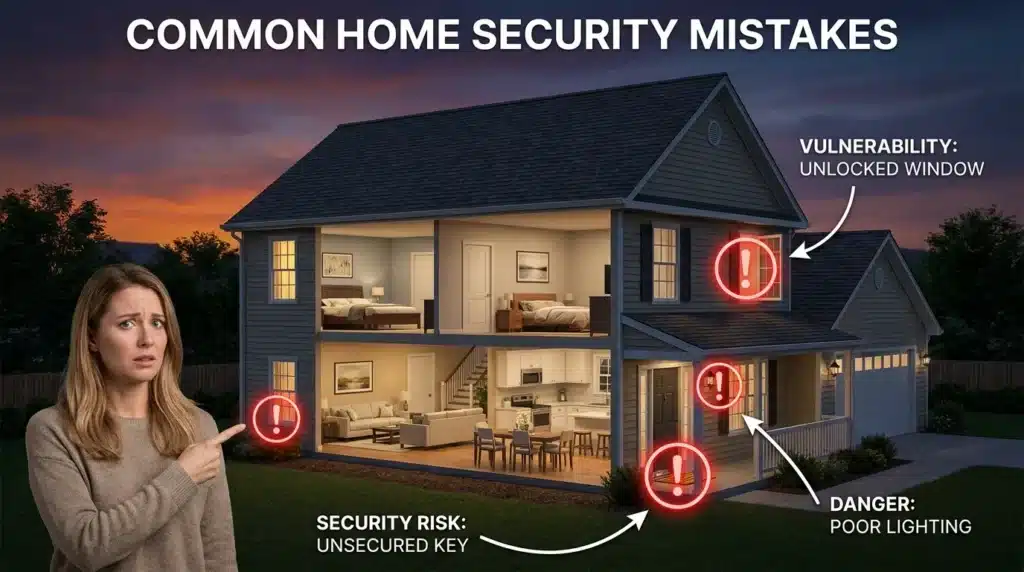
Fatal Errors: Common Pitfalls That Put You at Risk
Many homeowners spend thousands on gadgets but still fail because they make simple mistakes. Understanding these pitfalls will help you stay one step ahead of anyone who wants to harm your home.
- Leaving Spare Keys in Predictable Spots: Burglars know all the common hiding places, like under a rock or on top of a door frame. It is much better to leave a spare with a trusted neighbor or use a smart lock code.
- Neglecting the Security of the Second Floor: Many people leave their upper-floor windows unlocked, thinking a thief cannot reach them. However, an unlocked ladder in your backyard or a sturdy drainpipe is all a criminal needs to get upstairs.
- Oversharing Digital Life with Strangers: If you have smart cameras, make sure your account is protected with a very long and complex password. If someone gets into your app, they can see exactly when you are home and what you are doing.
- Ignoring the Visibility of Valuables: If you have an expensive TV or a computer near a window, close your curtains at night. Thieves often “window shop” to find the houses that have the most valuable items inside.
- Failing to Test Alarms and Sensors: Many people assume their system is working because the light is green. You should trigger your alarm at least once a season to make sure the siren and the monitoring center are both responding.
If you avoid these mistakes, you will be ahead of 90% of other homeowners. The key is to be proactive and fix small problems before they become big vulnerabilities.
Answers to Your Most Common Security Questions
1. Is a smart lock really safer than a traditional deadbolt?
Smart locks offer convenience and tracking, but a high-quality physical deadbolt often has more brute-force resistance. For the best security, use a smart lock that is built on top of a grade-one rated deadbolt.
2. How can I protect my porch from package thieves?
Using a video doorbell is a great start because it allows you to speak to the person at the door. You can also use lockboxes or have packages delivered to a local pickup point if you are not home.
3. Do security signs and stickers actually work?
Yes, they act as a psychological deterrent. While they won’t stop a professional, they will make an opportunistic thief think twice about choosing your house.
4. Can hackers really get into my home security cameras?
Yes, if you use a weak password or an unencrypted Wi-Fi network. Always update your firmware and use two-factor authentication to keep hackers out of your private life.
5. What is the most important thing to do before going on vacation?
The most important step is to make the house look lived-in. Use smart timers for your lights and have someone collect your mail so it does not pile up and signal an empty house.
Taking the First Step Toward a Protected Future
Building a securely life is a journey that starts with a single decision to be more prepared. You do not have to turn your house into a prison to feel safe.
Small changes, like better screws in your door frame or a new nightly routine, add up to massive protection. You have the power to create an environment where your family can grow and flourish without fear.
Use the strategies we have discussed today to build your defense layer by layer. Start with the front door and work your way through the rest of your property.
Nature and the world outside are beautiful, but your home is where your heart is. Protecting it is the most important job you have.
Go ahead and test your locks today. A safer tomorrow is waiting for you, and it starts with the actions you take right now.
Since I started following this roadmap, I finally sleep through the night without jumping at every tiny sound from the backyard. You don’t have to do it all in one day, but making just one small change this weekend will give you a sense of relief that is worth every bit of effort. Go ahead and take that first step toward a safer home—you and your family deserve that peace of mind!
Safety Disclaimer: The information on Securely Life is for general educational purposes. Home security involves complex risks, and no system is 100% foolproof. We recommend consulting with professional security installers and local law enforcement for specific advice. Securely Life is not responsible for any losses, injuries, or damages resulting from the use of this information. Always follow local laws and regulations regarding home modifications and surveillance.