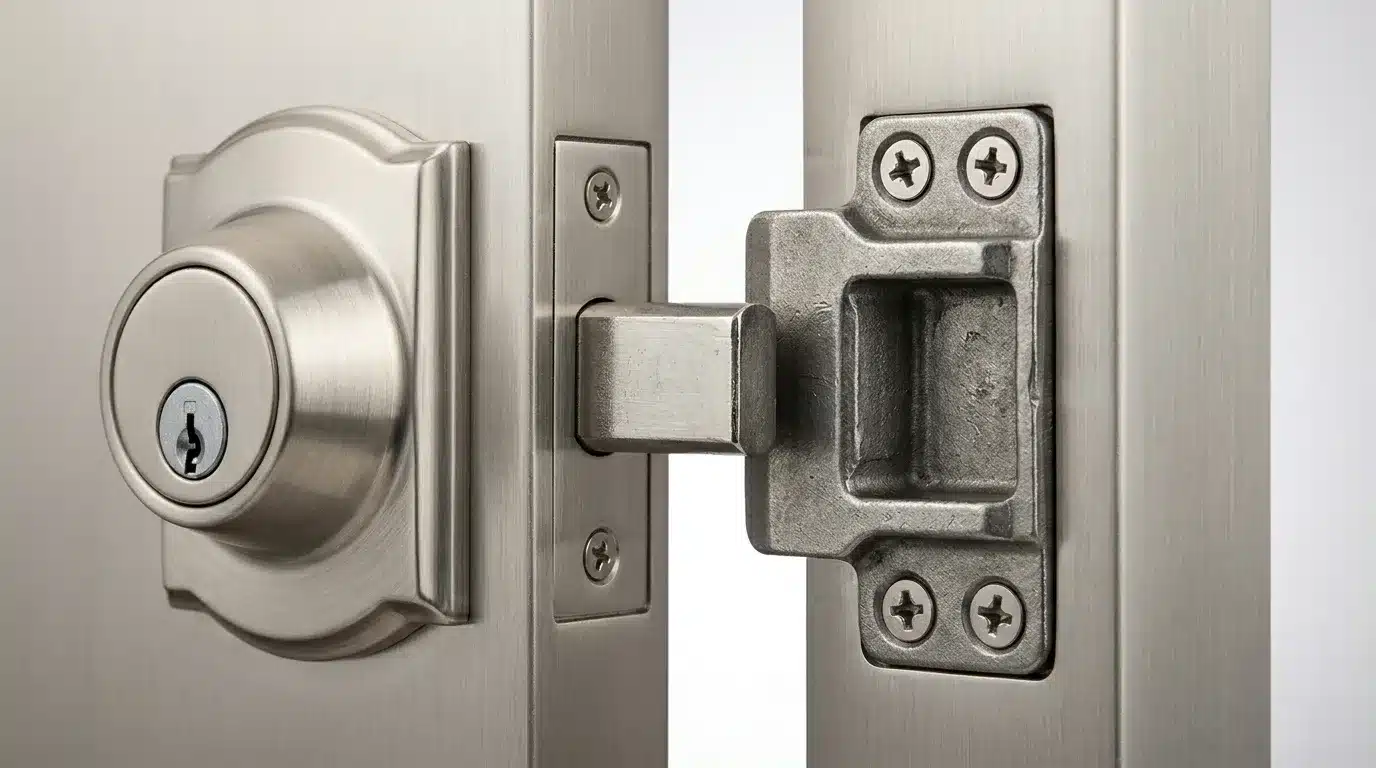
My Front Door Held — Barely — And That Changed Everything
My front door held the night I tested it, but only just. I leaned my full body weight against it, and I felt the whole frame flex under the pressure. My deadbolt was locked. My strike plate screws were still holding. But I could feel wood giving way behind that thin metal plate, and that scared me more than any break-in story I’d read online.
I went to bed that night and couldn’t stop thinking about it. My lock was fine. My door frame wasn’t.
That gap between “locked” and “actually secure” is where most forced entries happen. It’s not usually the lock that fails first.
Quick Answer: A front door resists forced entry when three things work together — a Grade 1 or Grade 2 deadbolt, three-inch screws anchoring the strike plate and hinges into the wall stud, and a reinforced door frame that spreads kick force instead of concentrating it on one weak spot. Skip any one of these, and the other two matter a lot less.
Here’s what most people don’t realize until it’s too late. A locked door and a secure door are not the same thing.
Living with that uncertainty wears on you in ways you don’t notice at first.
- You check the lock twice before bed, even though you already know it’s locked
- Every sound outside at night gets your full attention
- You start assuming the worst about strangers walking near your house
- Being away from home for the day means checking your phone more than you’d like to admit
None of this is dramatic. It’s just a low, constant hum of worry that builds up over weeks and months. And most of it comes down to one thing: not actually knowing whether your door would hold if someone tried.
What Actually Stops a Door From Being Kicked In?
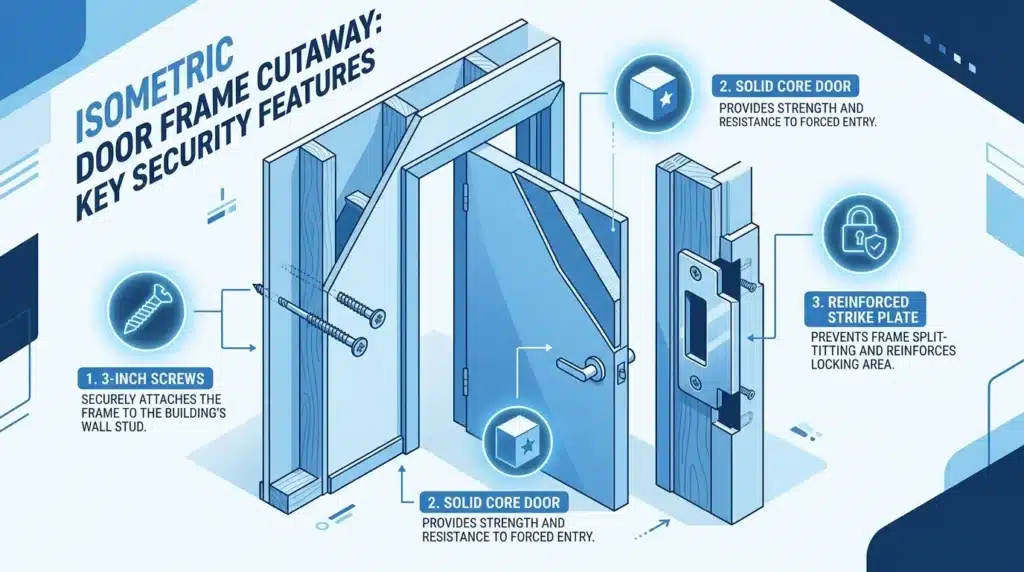
A door resists a kick when the force gets spread across the structural frame of the house instead of a thin strip of trim. That means the deadbolt, the strike plate, and the hinges all need to be anchored into the wall stud, not just the wood the door frame is built from.
What Deadbolt Grade Actually Resists Forced Entry?
A Grade 1 or Grade 2 deadbolt, rated by ANSI, resists forced entry because it’s tested against thousands of pounds of pressure and repeated strikes before it ever reaches a shelf. Most builder-grade doors ship with a Grade 3 lock, which is rated for far less.
Two details matter here:
- The ANSI grade — Grade 1 is the standard used in commercial buildings; Grade 2 is a solid residential step up from the default. (A Schlage B60N is a widely trusted example of a Grade 1 option if you want a specific model to search for.)
- The bolt throw — look for a one-inch throw, meaning the bolt extends a full inch into the frame once locked.
If you’re deciding between a traditional deadbolt and a connected smart lock, our breakdown of smart locks vs. deadbolts covers which setup actually holds up better under force, since the “smart” part doesn’t change the physical grade of the bolt.
Why Do Three-Inch Screws Stop a Kick-In?
Three-inch screws stop a kick-in because they reach past the door trim and bite into the wall stud behind it, turning the strike plate into part of the house’s structural frame instead of a piece hanging on thin wood.
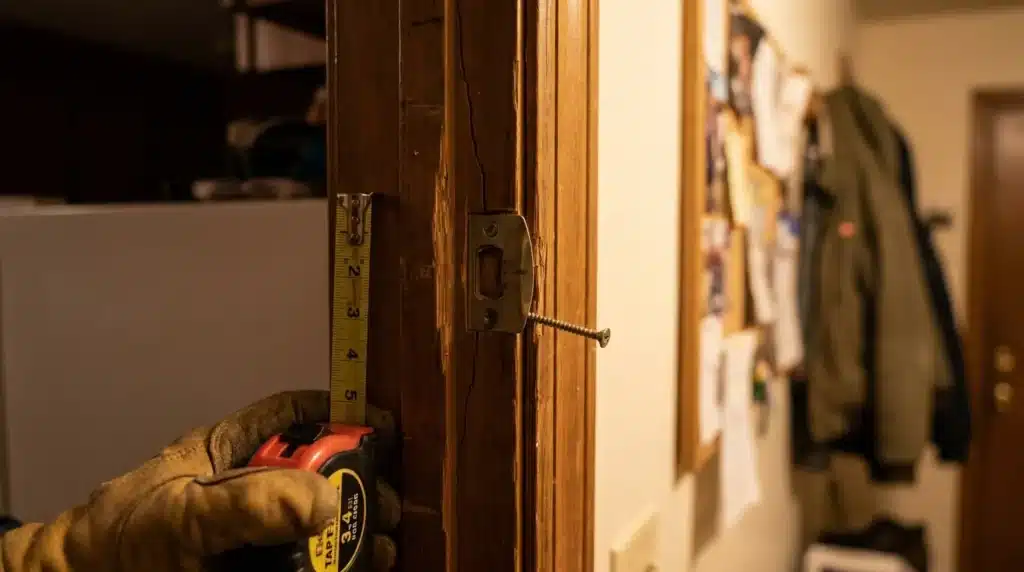
Most factory strike plates come with half-inch screws. Those screws only grip the trim — not the stud behind it. Here’s how to fix that:
- Remove the factory screws from your strike plate and top/bottom hinges.
- Replace them with three-inch hardened steel screws (look for #9 x 3-inch construction screws or hardened wood screws — skip drywall screws, they snap under pressure instead of biting into the stud).
- Drive each screw slowly once you feel resistance — that resistance is the stud.
- Repeat on both hinges, not just the lock side.
(Publishing note: mark this 4-step list as a How-To Block in Rank Math or Yoast so it’s eligible for How-To rich results on searches like “how to install longer strike plate screws.”)
I made this mistake myself. I spent close to $150 on a fancy deadbolt before I ever checked my own strike plate screws. Looking back, the five-dollar box of screws should have come first — the expensive lock had nothing solid to actually anchor into.
Watch this quick fix in action:
Where Does a Door Frame Actually Fail First?
A door frame usually fails at the strike plate, not the lock, because that’s where the wood is thinnest and the factory screws are shortest. Understanding where the risk concentrates helps you know what to fix first.
| Weak Point | Risk Level | Why |
|---|---|---|
| Strike plate screws under 1 inch | High | Never reach the wall stud |
| Hollow-core or thin composite frame | High | Splits under direct kick force |
| Hinges attached at one point only | Medium | Lets the door lift out of the frame |
| Gap between frame and wall stud | Medium | Creates flex that absorbs less force |
| Reinforced steel frame plate | Low | Spreads force across the whole jamb |
I saw this play out firsthand when I helped a friend clean up after a break-in at her place. Her lock hadn’t been picked — the deadbolt was still extended when we found the door lying flat. What failed was the wood around the strike plate. One kick, and it split clean along the grain.
You can check for the FBI’s national data on how forced entries happen through the FBI’s Crime Data Explorer, which tracks residential burglary patterns across the country.
Can Burglars Remove a Door Through the Hinges?
Yes — if your door swings outward and the hinges are exposed, a burglar can tap the hinge pins out with a nail and hammer and lift the entire door out of the frame without ever touching the lock.
Two fixes handle this:
- Security hinges or non-removable pins, which lock the two hinge plates together with a hidden stud
- Three-inch screws on the hinge side, matching what you did on the strike plate
If your door swings inward instead, the hinge pins aren’t exposed, but the screws should still be upgraded — an inward-swinging door under enough pressure can still pull the hinge screws loose from thin trim.
Myth vs. Reality: Myth: A security chain is enough to stop someone from forcing the door open. Reality: A chain is held on by screws even smaller than a factory strike plate. One firm push tears it out of the frame in under a second — it stops a delivery person, not a break-in attempt.
Home hardware stores now sell reinforcement kits that combine a steel strike plate cover with matching three-inch screws in a single box, which is worth checking if you want the hinge and lock side handled in one purchase. For general guidance on choosing certified security hardware, the Master Locksmiths Association publishes independent testing standards that aren’t tied to any single manufacturer.
Do Smart Locks Add Real Reinforcement, or Just Convenience?
A smart lock adds convenience and awareness, but the physical reinforcement still comes from the deadbolt grade and the screws holding it in place — the smart features sit on top of that, they don’t replace it.
Where a smart lock does add real value is visibility. A camera-equipped lock lets you see who’s at the door before you commit to opening it, which matters more than most people realize — most forced entries happen when someone answers the door to a stranger rather than when a lock is actually picked.
A few practical setup details make a real difference here:
- Turn on two-factor authentication on the lock’s app, not just a password
- Give delivery drivers or contractors a temporary code that expires after 24 hours, not a permanent one
- Keep the smart lock on its own guest network if your router supports it, separate from your laptops and phones
For broader guidance on securing connected devices at home, CISA’s guidance on smart home security is a solid, vendor-neutral starting point.
Low-Cost Fixes You Can Do This Weekend
If budget is tight, these fixes give you the most protection for the least money, roughly in order of return:
- Three-inch screws on the strike plate and hinges — around $5, done in 15 minutes
- A security hinge or hinge pin set — around $10–15 per hinge
- A door reinforcement kit covering the strike plate area — around $30–80
- A Grade 1 deadbolt upgrade — around $40–100, the highest single cost but also the most tested component
None of these require a contractor. A cordless drill and a Saturday afternoon cover all four.
Beyond the Strike Plate: Layering Your Door’s Full Defense
A reinforced strike plate handles the lock side. The door itself and the glass around it are the next layer, and most people never get to either one.
Is Your Door Slab Actually Solid, or Just Heavy-Looking?
Knock on your door. A dull, dense thud means solid wood or steel-clad construction. A hollow, drum-like sound means two thin wood sheets with cardboard in between — and that door can be kicked through directly, independent of how strong your lock is.
Replacing a hollow-core door with a solid one runs $150–$400 installed, depending on material. If that’s not in the budget right now, a metal door shield wraps around the lock area for $20–$40 and stops a pry bar from splitting the wood where the deadbolt sits.
For the frame itself, a jamb reinforcement kit — a strip of galvanized steel running the height of the door frame — spreads kick force across several feet of wood instead of concentrating it on the six inches around your strike plate. Most kits install in under an hour with a drill and cover both the lock side and the hinge side in one piece.
What About Glass Sidelights Next to the Door?
Glass panels beside a front door skip the lock entirely — break the glass, reach in, turn the deadbolt. Security window film, a heavy-duty polyester layer applied directly to the glass, is the standard fix; it doesn’t stop the glass from cracking, but it holds the pieces together so a hand can’t get through.
A related detail people miss: most forced-entry attempts last under 60 seconds. That number matters because it means your goal isn’t making a break-in impossible — it’s making it take long enough that the person gives up or gets noticed. A reinforced frame and film-treated glass both work by adding time, not by being unbreakable.
If your entry includes a sliding glass door instead of sidelights, the same reach-through risk applies, and our guide on protecting windows from the inside covers film application in more detail for larger glass surfaces.
Keeping the Outside of Your Door Uninviting
Motion-triggered lighting above the entrance adds a layer that has nothing to do with hardware. A sudden change in light when someone steps onto the porch creates a moment of exposure most people don’t want, and our breakdown of whether motion sensor lights actually deter burglars walks through where placement matters most.
What a Weak Frame Actually Costs You Later
A neighbor of mine skipped the frame upgrade for almost two years after moving in, figuring the factory deadbolt was enough on its own. A single kick during an attempted break-in split the jamb near the strike plate, and the repair — a new frame section, matching trim, and repainting — ran close to $600, well past what three-inch screws and a jamb kit would have cost upfront.
That gap between prevention and repair is the real argument for doing this now rather than after something happens. A $30–$80 reinforcement kit is a rounding error next to frame carpentry, a new door, or a insurance claim.
Pairing physical reinforcement with basic awareness closes the loop. A camera at the entrance — even a simple doorbell camera — means you have a record if something does happen, and our guide on securing your home Wi-Fi and smart cameras covers keeping that footage actually private instead of exposed on an unsecured network.
If you travel for extended periods, the same entry points need attention before you leave, not after — our guide to securing your home during vacation walks through what to check the week before a trip.
The Fixes People Skip — And What It Costs Them
Reinforcing the lock side and skipping the hinges is the most common gap. If a strike plate is anchored into the stud but the hinges are still held by half-inch screws, the door doesn’t need to be forced at the lock at all — it comes loose at the hinge side instead.
A secondary door gets treated as an afterthought. Homeowners spend real time and money on the front door, then leave the garage-to-house interior door with its original builder-grade lock. Burglars often use the garage as a staging point specifically because nobody reinforced that door — our guide to securing a garage side door covers the same hinge and frame issues from that angle.
A security chain gets trusted as real protection more often than it should be. It’s rated to slow down an unwanted guest, not resist force — the screws holding it are often smaller than the ones on a factory strike plate.
Overtightening a reinforcement kit is a mistake that comes from good intentions. Cranking the screws down past the point of resistance can bow the frame itself, which then keeps the door from closing flush and creates a new gap.
Do’s and Don’ts at a glance:
- Do measure your strike plate screws before buying replacements — anything under 2 inches needs upgrading
- Don’t assume a heavy-looking door means a solid core; test it by knocking
- Do treat every exterior-facing door, including garage and side entries, the same way you treat the front door
- Don’t skip the hinge side because the lock side already got the upgrade
None of these fixes make a home completely burglar-proof — no single measure does. What consistent reinforcement does is significantly reduce the risk that a forced-entry attempt succeeds quickly and quietly, which is what most opportunistic break-ins depend on.
Common Questions About Front Door Reinforcement
Does a stronger door frame actually stop a break-in?
Not on its own, but it removes the fastest option. A reinforced frame turns a 10-second kick-in attempt into a loud, slow process that most intruders aren’t willing to risk.
Do security bars work as well as frame reinforcement?
Yes, as a secondary layer. A door security bar uses floor friction and body weight to brace the door, so even if the lock fails, the bar keeps the door from swinging open.
Is a metal door frame better than a reinforced wood frame?
Metal resists kicking and prying slightly better out of the box, but a wood frame with three-inch screws and a steel jamb kit performs close to the same level for a fraction of the cost.
Will insurance costs go down after reinforcing a front door?
Some home insurers offer small discounts for verified security upgrades, though this varies by provider and region — the Insurance Information Institute has a general overview of how security upgrades can factor into home insurance.
How often should I recheck my door’s hardware?
Every six months is a reasonable habit. Wood shifts with humidity, screws back out with regular use, and a five-minute check catches problems before they turn into a weak point.
Do I need to reinforce a back door the same way?
Yes, and often more so. Back doors face less foot traffic and fewer witnesses, which makes them a preferred target once the front door looks reinforced — the same screw, hinge, and frame fixes apply there too.
Can I reinforce a metal security door the same way?
Metal doors already resist kicking well, but the surrounding wood frame is usually still standard lumber. The frame — not the door slab — is where the same three-inch screw and jamb kit upgrades still matter.
Your Door, Checked and Ready
You don’t need every upgrade on this list done in one weekend. Start with the cheapest, highest-impact fix — the screws — and work outward from there as time and budget allow.
Before you go, a quick checklist for anything you’re still missing:
- Strike plate and hinge screws upgraded to three inches
- Deadbolt rated Grade 1 or Grade 2 with a one-inch throw
- Glass sidelights treated with security film, if present
- Motion lighting installed at the main entrance
- Secondary doors (garage, side entry) matched to the same standard
- A six-month reminder set to recheck everything above
I went through this exact process on my own house, one weekend project at a time, and the difference in how I feel walking up to my own door now is worth more than the total I spent getting there. If you only do one thing today, go check your strike plate screws — you’ll know within thirty seconds whether they’re doing their job.
I’m just a homeowner who worked through these fixes on my own place, not a licensed locksmith, so if your frame is already damaged or your door is an unusual size, it’s worth having someone local take a quick look before you start drilling.
What did you find when you checked your own front door? Were your strike plate screws shorter than an inch? Let me know in the comments below, and I’ll be happy to answer any questions!







2 thoughts on “Front Door Reinforcement: The Complete Forced-Entry Defense Guide”
Comments are closed.