The First Night in My New House, I Didn’t Sleep At All
I still remember lying in my new bedroom, staring at the ceiling, listening to every creak the house made. I had just signed on a place I loved, boxes were stacked everywhere, and I felt like the luckiest person alive. Then it hit me around 1 a.m. I had no idea how many people out there still had a key to my front door. My real estate agent had one. The previous owners probably had a spare. Maybe a neighbor who used to water their plants had one too. I got up, checked the deadbolt three times, and told myself I would fix this in the morning.
That feeling doesn’t go away on its own. It sits in the back of your mind while you’re hanging curtains and unpacking dishes.
A new house can feel like someone else’s house for weeks if you skip the basic safety steps. You’re excited about paint colors and furniture layouts, but your brain also knows this space hasn’t fully “clicked” as yours yet.
Here’s what that mental noise actually looks like day to day:
- You jump at every sound the house makes because you don’t know its normal creaks yet.
- You keep wondering who else has access, and that thought pops up right when you’re trying to fall asleep.
- You feel guilty for not childproofing outlets or checking for hazards sooner, especially if you have kids or pets.
- You put off “boring” safety tasks because unpacking the kitchen feels more urgent.
- You get a little jumpy every time a car slows down outside, even though it’s probably nothing.
None of that is dramatic or unusual. It’s just what happens when your nervous system hasn’t caught up with your paperwork yet. The good news is that most of this fades fast once you knock out a handful of concrete tasks. You don’t need a security degree. You just need a clear order of operations, which is exactly what I’m giving you below.
Your Move-In Week Security Checklist, Room By Room
I’m going to walk you through this the same way I did it in my own house, starting with the one thing that matters more than anything else on this list.
Rekey Or Replace Your Locks Before Anything Else
This is not optional, and it’s not something to “get to eventually.”
You genuinely cannot know how many copies of your house key are floating around. Past homeowners, agents, contractors, dog walkers, even a well-meaning neighbor could still have one. According to guidance from This Old House, rekeying is usually cheaper and faster than replacing the whole lock, and it renders every old key completely useless.
Pro Tip: I made the mistake of rekeying only the front door on my first house and skipping the side and garage doors because I was tired and it was getting dark. Two weeks later I realized the garage door still worked with the old key. Do every exterior lock the same day, even if it means one extra trip to the hardware store.
If you’re weighing whether to go with a standard rekeyed deadbolt or upgrade to something app-controlled, this comparison of smart locks vs. deadbolts breaks down which option actually holds up better for a first-time buyer’s budget and needs.
Give Your Front Door Some Real Muscle
A lock is only as strong as the door frame around it. Cheap strike plates and short screws are one of the easiest things for a burglar to force open in seconds.
Swap in a reinforced strike plate and 3-inch screws that reach the wooden stud behind the frame, not just the trim. It’s a fifteen-minute job. This guide on how to reinforce your front door walks through exactly which hardware to grab.
Walk Every Window Like You’re Checking For a Way In
Windows get ignored constantly, and that’s exactly why they’re a favorite entry point. Spend twenty minutes walking around your home and testing every single window, including the ones on the second floor that people assume are automatically safe.
Ground-floor and basement windows deserve the most attention. If you have a walkout basement or window wells, take a look at this breakdown on how to secure basement windows from break-ins. For the rest of the house, this guide on how to secure windows from the inside covers pin locks, sensors, and reinforced glass film that won’t ruin your view.
Get Eyes On Your Entry Points
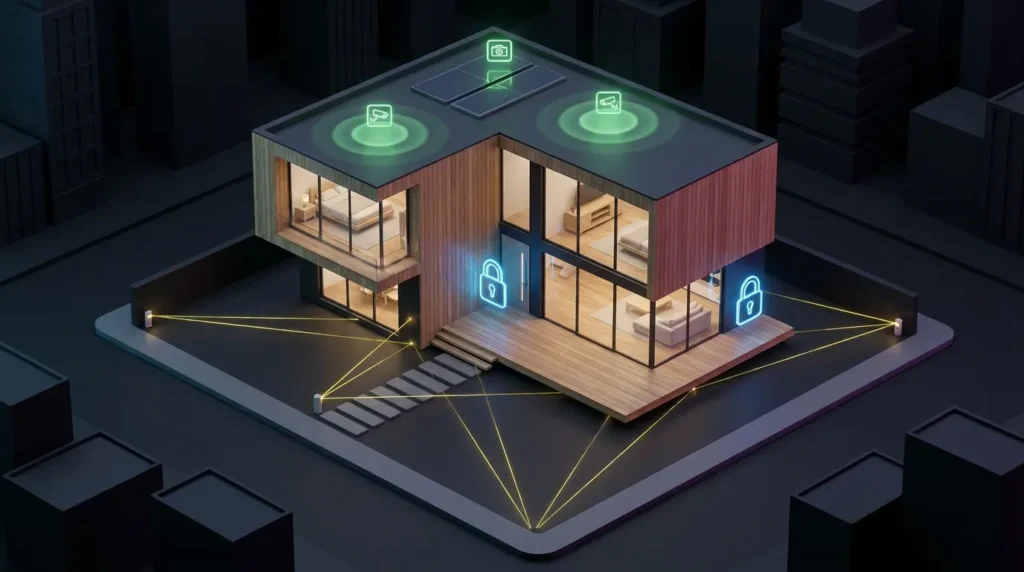
You don’t need a full surveillance setup on day one, but a doorbell camera and one or two outdoor cameras go a long way toward peace of mind, and they help you actually see who’s approaching before you open the door.
The tricky part is placement. A camera aimed wrong is basically decoration. This guide on securing your smart home cameras covers where to mount them so you’re not left with dead zones right at your own front step.
Here’s your quick video walkthrough of camera placement mistakes most new homeowners make:
Test Every Smoke and Carbon Monoxide Alarm In the House
This one gets skipped constantly because it feels less urgent than locks, but it shouldn’t. You have no way of knowing how old the alarms are or whether the last owner ever swapped the batteries.
The National Fire Protection Association recommends testing every smoke alarm monthly using the test button, and replacing any unit that’s past its ten-year mark. If you press the button and hear nothing, that alarm has been silently useless this whole time, which is a scary thought once you actually stop and think about it.
Check Behind the Furniture For Overloaded Outlets and Old Cords
Once the furniture is in place, it’s easy to forget what’s plugged in behind it. New homeowners often inherit outlets that are already maxed out from the previous owner’s setup, or extension cords that have been sitting there for years.
The U.S. Consumer Product Safety Commission points to overloaded extension cords and power strips as a leading cause of residential electrical fires. Pull your furniture out for five minutes, check for cracked cords, and make sure nothing heat-producing (like a space heater) is plugged into a strip instead of directly into the wall.
Walk the Yard the Way Someone Casing Your House Would
Stand at your curb at night and look at your own house. Can you see straight through a window into your living room? Is there a dark stretch by a side door where nobody would notice someone standing there for a while?
Burglary is still one of the more common property crimes across the country, and the FBI’s Uniform Crime Reporting data shows that residential properties make up the majority of all reported burglary offenses. Trimming bushes near windows, adding motion-sensor lighting, and closing sightlines into your home all make a real difference. This guide on how to burglar-proof your yard has a longer walkthrough if your landscaping needs more work.
Lock Down the Mailbox and Package Drop Zone
Identity theft and package theft are two problems new homeowners rarely think about until it happens to them. Mail from previous owners, new account statements, and delivery boxes sitting on the porch are all easy targets.
This guide on how to secure your mailbox from identity theft covers simple fixes like locking mailboxes and mail-forwarding steps that close the gap fast.
Sweep the House For Hidden Hazards If You Have Kids Or Pets
Security isn’t only about break-ins. It’s also about the everyday hazards a new house might be hiding, especially if the previous owners left plants, cleaning supplies, or décor behind.
Some houseplants that look totally harmless are actually dangerous if a pet chews on them. The ASPCA keeps a running list of plants that are toxic to dogs and cats, and it’s worth a five-minute check before you decide what stays in your new yard or windowsill.
Myth vs. Reality: “Burglars Only Strike At Night”
Myth: Break-ins mostly happen after dark while everyone’s asleep.
Reality: A large share of residential burglaries actually happen during the day, while people are at work or school. Daytime is often when a house looks the emptiest and most predictable. That’s exactly why cameras, timers on lights, and a locked-up look matter just as much at 2 p.m. as they do at 2 a.m.
Your Printable First-Week Checklist
- [ ] Rekey or replace every exterior lock, including the garage
- [ ] Reinforce the front and back door strike plates
- [ ] Test every window lock on every floor
- [ ] Install or reposition doorbell and outdoor cameras
- [ ] Test every smoke and carbon monoxide alarm
- [ ] Check outlets and cords behind furniture for overloading
- [ ] Add motion-sensor lighting to dark corners of the yard
- [ ] Secure your mailbox and set up package alerts
- [ ] Check the yard and windowsills for anything unsafe around kids or pets
- [ ] Walk your whole property once at night to see what a stranger would see
Once you’ve worked through that list, do one more thing before bed. Take a slow walk through your house, room by room, and just notice how it feels. Most people tell me it’s the first night the house actually starts to feel like theirs, not the last owner’s, not the agent’s — just theirs.
If you want to take this a step further and build out a full evening routine, this nighttime home security checklist is a good next read once the move-in basics are handled.
What Security Researchers Wish Every New Homeowner Knew
Here’s a scenario worth sitting with for a second. Two neighbors move into identical houses on the same street, the same week. One spends an hour on security. The other spends a whole weekend on it. Six months later, which one do you think still has their guard up?
Almost always, it’s the second one, and not because they’re more anxious. It’s because they built habits instead of just finishing a checklist.
Q: Isn’t a checklist enough on its own? A: A checklist gets you to a safe starting line. It doesn’t keep you there. Locks get left unrekeyed after a repair visit, cameras drift out of position, and alarm batteries quietly die. Without a rhythm to catch those slips, a “secure” house slowly becomes an average one again.
Q: So what actually keeps that starting line intact?
Layering is the real answer, and it works like this:
| Layer | What It Does | Where It Fails Alone |
|---|---|---|
| Locks & doors | Slows down or blocks entry | Doesn’t warn you it happened |
| Lighting & cameras | Deters and records activity | Doesn’t physically stop anyone |
| Alarms & routines | Alerts and interrupts an attempt | Useless if batteries are dead |
No single layer covers the gaps the others leave. That’s not a flaw in any one product. That’s just how physical security has always worked, long before smart devices existed.
A few habits make that layering hold up over time:
- Set a recurring reminder, not a one-time task, to check batteries in alarms and cameras. Quarterly works well for most people.
- Update access codes after any contractor, cleaner, or house sitter has had temporary entry, the same way you’d change a password after sharing it.
- Ask your insurer directly whether monitored alarms, smart locks, or cameras qualify you for a premium discount. Many homeowners never ask, so they never get offered.
- Hold off on public moving-day posts until you’re settled in. Real-time addresses and “we’re traveling” captions are exactly the kind of details you wouldn’t hand a stranger on the street, so don’t hand them online either.
- Walk your own property once a season, at a different time of day each time. Bushes grow, sensors drift, and lighting angles change with the seasons in ways you won’t notice from inside the house.
None of this requires new spending in most cases. It just requires a repeat visit to the same handful of tasks, on purpose, instead of assuming day-one effort holds forever.
The Slip-Ups That Quietly Undo All That Hard Work
Not every security failure looks like a break-in. Most of them look like a Tuesday afternoon where nothing happens, and that’s exactly the problem, because nothing happening teaches you that a gap is fine when it isn’t.
A homeowner assumes the previous owners “handled it.” Old codes stay active. A camera app is still linked to a stranger’s account. Nobody decided to skip these steps on purpose. They just assumed someone else already had.
A checklist gets started, then quietly abandoned. Life with unpacked boxes is loud and busy, and testing a smoke alarm feels like it can wait. It usually can, right up until the one night it can’t.
Moving boxes pile up at the curb, logos facing the street. It’s a small thing, and it feels harmless. To anyone driving by, it’s a printed list of what’s now sitting inside your house.
The garage gets treated as an afterthought. Homeowners will triple-check a front deadbolt and never think twice about the side door into the garage, even though it’s often the weaker entry point on the whole property.
Electrical safety gets pushed to “someday.” It doesn’t feel like security work, so it gets skipped. A cracked cord behind the couch doesn’t announce itself until it’s already a problem.
Kids get left out of the conversation. Parents mean to talk about house rules and just never find the right moment. Then an alarm goes off during a random errand run, and the kids at home have no idea what to do.
Do’s and Don’ts, side by side:
Do: Reset every code and camera login the day you get your keys. Don’t: Assume “the last owners were careful people” means anything for your safety.
Do: Finish your alarm and cord checks in the first week. Don’t: Let “boring” tasks slide behind “exciting” ones like paint colors.
Do: Break down and hide moving boxes quickly. Don’t: Leave a curb full of clues about what’s inside your home.
Every item on that list is fixable in under an hour. What actually costs you isn’t the task itself. It’s the false sense of safety that builds up while the task sits undone.
Your Questions About New Home Security, Answered Plainly
How fast should I actually change the locks after closing?
Same day, if you can manage it. If moving day is too chaotic, make it the very first thing you do the next morning, before the kitchen boxes.
Does rekeying really do the same job as new locks?
For locks that aren’t old, damaged, or sticking, yes. Rekeying changes the internal pins so old keys stop working, and it costs a fraction of full replacement.
My street feels safe. Do I still need cameras and alarms?
A calm-looking street doesn’t mean nobody’s watching for an easy opportunity. Basic cameras and good exterior lighting are inexpensive enough that “feels safe” isn’t a strong reason to skip them.
What’s the one task people regret skipping the most?
Testing smoke and carbon monoxide alarms. It’s quick, it’s free, and it’s the task homeowners mention wishing they hadn’t put off, almost every time it comes up.
I’m renting my new place. Does any of this still apply to me?
Most of it does, just in a non-permanent form. Portable alarms, removable window locks, and a battery-powered video doorbell all work without touching your landlord’s property, though it’s smart to check your lease first.
How often should I really redo this whole checklist?
You shouldn’t need to redo the big items, but a quick seasonal walk-through catches the small stuff, dead batteries, drifted cameras, overgrown bushes, before it becomes a real gap.
A Word From Someone Who’s Been Exactly Where You Are
I’m not going to pretend every homeowner needs to become obsessive about this. Most of what actually protects a house is a short list of unglamorous tasks, done once properly and then revisited a few times a year.
Your action plan for tomorrow can be this simple: pick the one item from this guide that’s been sitting on your mind, and finish it before the day ends. Not the whole list. Just one thing.
I still think back to that first restless night in my new house, and honestly, I’m a little amused by how much I overthought it. A handful of solid habits fixed what a whole night of worry couldn’t. My honest hope for you is that your first night in your new place feels a lot calmer than mine did, and that starts with whichever task on this list you tackle first.
Disclaimer: This article is intended for general informational purposes only and does not replace a professional security assessment, a licensed locksmith’s advice, or guidance from local law enforcement. Security needs vary by home, neighborhood, and personal circumstances, so consider consulting a qualified professional for recommendations specific to your situation.