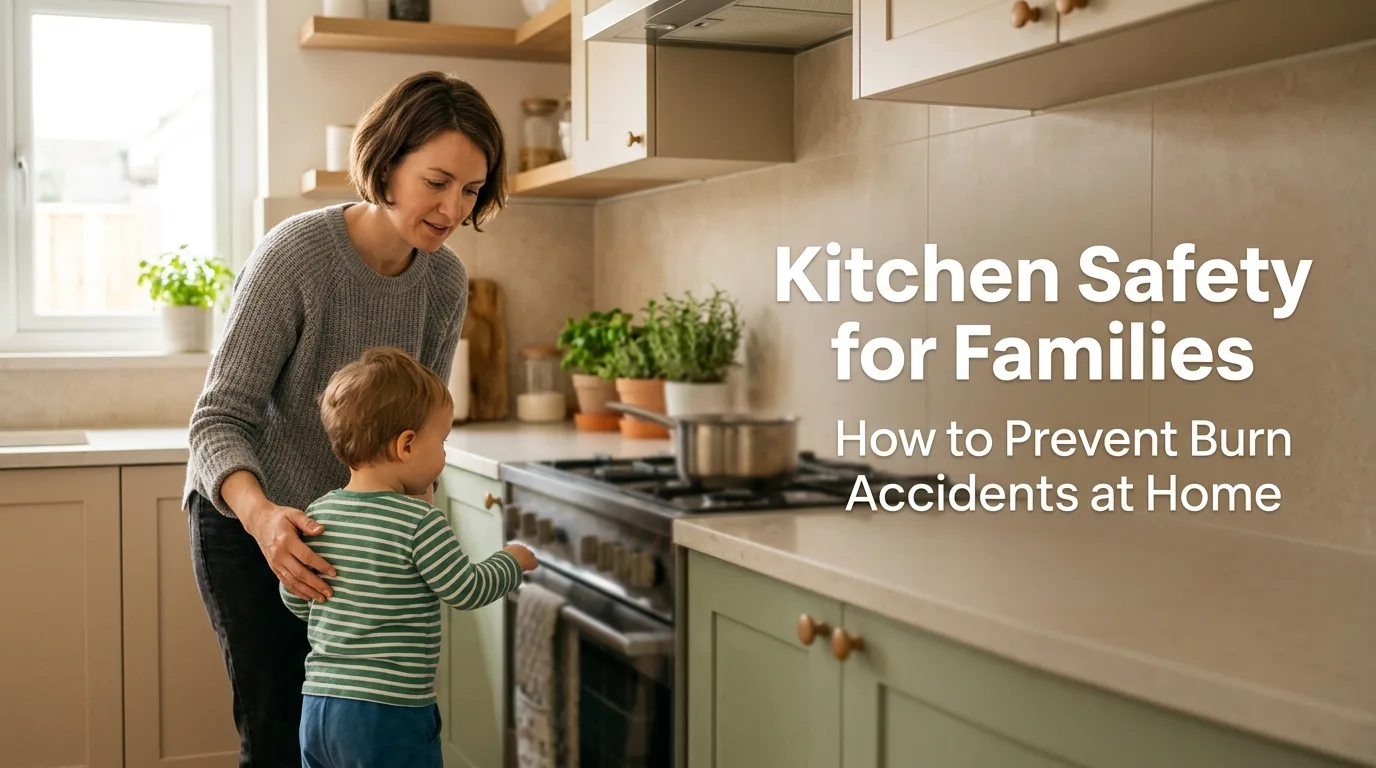
The Night My Daughter Grabbed a Hot Pan Handle
I still remember the sound. It was a small clatter, then a scream that stopped my heart for a second.
My daughter was three. I was stirring soup on the stove, and I turned my back for maybe ten seconds to grab a spoon from the drawer. That was enough time for her to reach up and pull on the pot handle sticking out over the counter edge.
Nothing spilled that day, thank God. But my hands were shaking for an hour after. I kept thinking, what if the pot had been full? What if I had turned my back for twenty seconds instead of ten?
That one moment changed how I cook forever. I started noticing every hot surface, every dangling cord, every unattended pan in a whole new way.
If you are reading this, you have probably had a scare like this too. Or maybe you are just trying to get ahead of one before it happens. Either way, you are in the right place.
Why This Fear Never Really Goes Away
Here is the hard truth. The kitchen is one of the busiest, most dangerous rooms in your entire home.
You are juggling hot liquids, sharp tools, and a curious toddler who wants to see everything you are doing, all at the same time. It is exhausting.
Parents feel this pressure every single day, and it shows up in small, quiet ways:
- That flash of panic when you hear your child’s footsteps behind you while a pot is on the stove.
- The guilt after reading a scary story online about a burn injury and wondering if your kitchen has the same risks.
- The mental exhaustion of trying to cook dinner, watch your kids, and keep the dog away from dropped food, all at once.
- The nagging worry that one distracted moment could turn into an emergency room visit.
This stress is real, and it is not something to just push aside. Burn injuries are one of the leading causes of accidental harm to young children in the United States, and most of them happen right at home, in the kitchen. Knowing this does not need to scare you. It just means you deserve a clear, simple plan, so cooking time feels calm again instead of nerve-wracking.
That is exactly what we are building together in this guide.
Building a Kitchen That Protects Your Family Automatically
The goal here is not to make you paranoid about every spoon and stove knob. The goal is to set up small habits and small changes so safety happens without you having to think about it every second.
Think of it like putting guardrails on a road. You still drive carefully, but the guardrails catch the moments when things go wrong.
Create a Clear “No-Go Zone” Around the Stove
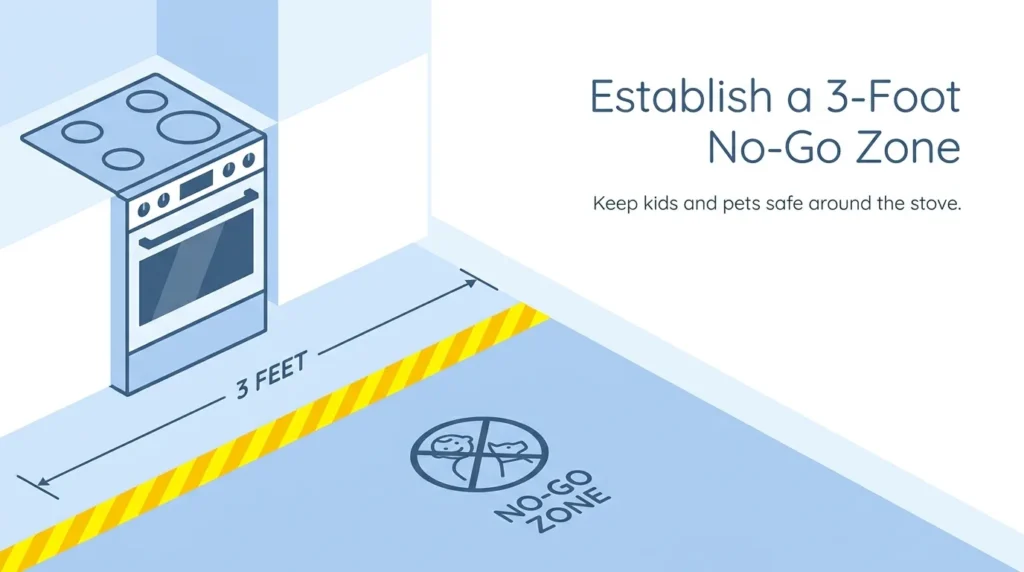
The single most effective habit you can build is a simple invisible boundary around your cooking area.
Experts recommend keeping kids at least three feet away from the stove, oven, and any spot where hot food or drinks are carried. This buffer gives you time to react if a child suddenly runs toward you.
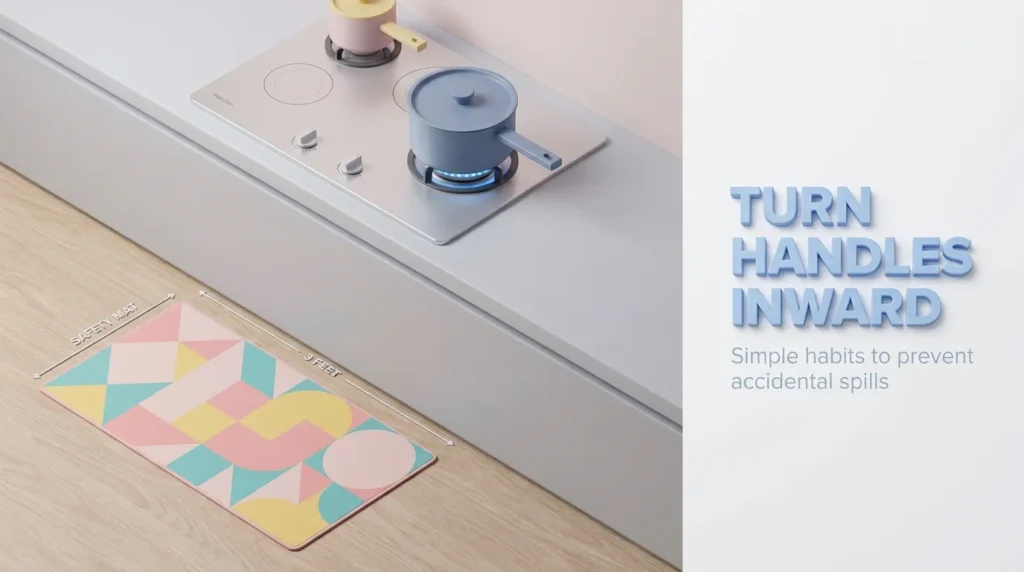
A simple trick that works well: put a colorful floor mat or tape line on the floor about three feet from your stove. Tell your kids that spot is “lava” and they cannot cross it while you are cooking. Young kids respond really well to this kind of game-like rule.
This single habit alone stops a huge number of kitchen burns before they ever start, according to guidance from the American Burn Association, which points to distracted, unsupervised moments near the stove as one of the biggest risk factors for home burns.
If you already have a broader safety routine in place at home, this fits naturally alongside your family safety blueprint, since kitchen habits are just one piece of a bigger, calmer household routine.
Turn Every Handle Inward, Every Single Time
This one sounds small, but it matters a lot.
Pot and pan handles that stick out over the counter edge are basically an invitation for small hands to grab and pull.
Make it a rule for your whole household: the second a pot goes on the stove, the handle gets turned toward the back or the center. Not after you remember. Right away, every time.
I used to skip this step when I was in a rush, telling myself I would just watch the pot closely. That was a mistake. Distraction happens faster than you think, and habits protect you when your attention slips for even a second.
Understand the Real “Danger Zone” in Your Kitchen
Most parents picture the stovetop as the only risk area, but the true danger zone is wider than that.
It includes:
- The stovetop and oven door, which stay hot long after you turn them off.
- The microwave, especially with liquids like soup or hot cocoa that can superheat unevenly.
- Counter edges where cups of coffee or tea sit within a toddler’s reach.
- Appliance cords hanging down from counters, like kettle cords or slow cooker cords.
A child pulling on a dangling cord can bring an entire pot of boiling water down on themselves in less than a second. This is why checking cord placement matters just as much as watching the stove itself.
If your child is already curious about outlets, cords, and drawers in general, it is worth pairing this habit with a full childproofing your home safety checklist, so the same careful eye you use in the kitchen carries into every other room.
Here’s a video that breaks down these danger zones visually, which honestly makes it easier to spot them in your own kitchen:
Set Your Water Heater to a Safer Temperature
This tip surprises a lot of parents because it has nothing to do with cooking at all.
Tap water that is too hot can cause a serious scald burn in just a few seconds. The fix is simple: set your home water heater to 120 degrees Fahrenheit or lower.
This one change protects your family every time someone washes their hands, fills a pot, or runs a bath, not just during cooking. It is a “set it once and forget it” kind of safety win.
Keep Dry Oven Mitts Within Arm’s Reach
A damp or wet potholder can actually make burns worse, not better, because moisture turns into steam against a hot surface.
Keep a dry oven mitt or potholder hanging right next to your stove, so you are never tempted to grab a dish towel in a rush. When lifting lids off hot pots, always tilt the lid away from your face and body first, so steam escapes safely instead of hitting your skin.
Teach Older Kids the Microwave Rule
If your kids are old enough to microwave their own snacks, this next part matters a lot.
Foods like soup, noodles, and hot cocoa can heat unevenly in a microwave, creating hidden hot spots. Teach your kids to always let food sit for thirty seconds after the microwave beeps, and to stir before the first bite.
A quick realization I had: I once assumed my older child understood this because I had mentioned it once. Turns out, kids need reminders more than once. Now I keep a small sticky note near the microwave as a visual cue, and it works far better than a one-time conversation.
Watch for Hidden Hazards Beyond Just Heat
Burn prevention is a big part of kitchen safety, but it is not the only risk hiding in that room.
Cleaning products under the sink, medications left on the counter, and even certain house plants can be dangerous if a curious toddler gets to them. It is worth doing a quick walk-through of your kitchen with these risks in mind, similar to the approach in this common household poison hazards prevention guide.
If you keep medication in the kitchen for convenience, a closer look at your medication safety home guide is worth the ten minutes it takes to read.
And if pets share your kitchen space too, dropped food like onions, grapes, or chocolate can be just as risky for them as hot surfaces are for kids, which is exactly what this pet safety at home guide walks through in detail.
Add a Layer of Smart Monitoring
Habits are the foundation, but a little extra help never hurts, especially on busy weeknights.
A simple smart camera placed with a view of your kitchen lets you glance at your phone for a quick check, even if you step into another room for a moment. Paired with a smart door lock, you also get peace of mind that your child cannot wander outside while you are focused on a boiling pot.
Home monitoring tools like these will not replace supervision, but they do add a helpful safety net during the busiest parts of your day. According to product safety research from the U.S. Consumer Product Safety Commission, simple environmental checks and monitoring reduce the window of time a hazard goes unnoticed, which is often the real difference between a close call and an actual injury.
If a Burn Does Happen, Act Fast and Calmly
Even with every precaution in place, small accidents can still happen. Knowing the right first response matters just as much as prevention.
For a minor burn, run cool (not ice-cold) water over the area for about ten minutes. Avoid butter, ice, or ointments, since these can trap heat or damage the skin further, a point echoed clearly by burn care guidance from the Mayo Clinic.
For a burn that blisters badly, covers a large area, or appears on the face or hands, seek medical care right away instead of treating it at home.
If your child is old enough to be briefly on their own in another part of the house while you finish cooking, it also helps to have clear expectations set through something like a 9-step home alone safety readiness guide, so both of you feel confident during those short windows.
Practice the Plan, Not Just the Rules
Rules only work if your family actually remembers them under pressure.
Once a month, walk through your kitchen safety routine out loud with your kids. Point to the stove, point to the “no-go zone,” point to the oven mitts. Repetition builds real habits, not just good intentions.
This same idea of practicing safety instead of just talking about it applies well beyond the kitchen too, similar to the reasoning behind regular fire escape drills for kids. A plan your family has actually practiced sticks far better than one you only mentioned once.
A Calmer Kitchen Is Within Reach
None of these habits require expensive gadgets or a total kitchen renovation. They just require a little intention, repeated daily until they become second nature.
Start with one habit this week. Turn every handle inward. Set that water heater temperature. Put down a “no-go zone” line on the floor. Small changes, done consistently, add up to a kitchen that feels calm instead of stressful.
You already care enough to read this far, and that alone puts your family ahead of most. Keep going, one small habit at a time.
Making These Habits Last Longer Than a Week
Anyone can follow a safety rule for a few days. The real challenge is keeping it up for years, especially once the first scare fades from memory.
I noticed this in my own house. After that pot-handle moment, I was careful for about a month. Then life got busy, and old habits started creeping back in.
What actually fixed it for me was tying safety habits to something I already do daily. I put my potholder right next to my car keys, so I see it every time I grab my keys to leave. Small placement tricks like this remove the need for willpower.
Adjust Your Rules As Your Kids Grow
A three-year-old and a nine-year-old need very different kitchen boundaries. What worked last year might be too strict, or too loose, for where your child is now.
Every few months, ask yourself one simple question: is my kid ready for a bit more responsibility in the kitchen, or do they need the same boundary a little longer?
For younger kids, the “no-go zone” rule usually stays the same. For older kids learning to cook, focus shifts toward teaching them directly, like how to test if a pan handle is hot before touching it, or how to use oven mitts correctly instead of just having a rule to stay away.
Do a Seasonal Kitchen Safety Check
Busy holidays, birthday parties, and big family gatherings often bring more people, more pots on the stove, and more distraction into your kitchen at once.
Before any big cooking event, walk through your kitchen for two minutes. Check handle positions, check cord placement, and remind visiting family members about your “no-go zone” rule too.
A quick do’s and don’ts list that helps during busy seasons:
- Do keep one adult “on duty” near the stove at all times during group cooking.
- Do ask grandparents or guests to follow the same handle and cord rules you use daily.
- Don’t let multiple pots and pans crowd the front burners during a holiday meal.
- Don’t assume older kids automatically remember rules from last year without a quick reminder.
Teach Through Small Moments, Not Big Lectures
Kids tune out long safety speeches fast. What actually works is teaching in tiny moments that happen naturally.
While cooking together, narrate what you are doing out loud. Say things like, “I’m turning this handle in because it’s hot,” instead of giving a formal lesson later.
Over time, these small comments build real understanding, without ever feeling like a lecture. Your child starts noticing hazards on their own, which is the real goal here.
Where Good Intentions Quietly Fall Apart
Most kitchen accidents don’t happen because parents don’t care. They happen because a few common gaps sneak into daily routines, often without anyone noticing.
The biggest one is assuming a habit is “set” after doing it once or twice. A parent turns pot handles inward for a week, feels confident, then slowly stops as life gets busier. The habit was never fully locked in, it just looked that way for a short while.
Another quiet mistake is treating supervision as an all-or-nothing thing. Parents often believe if they are physically in the kitchen, their child is automatically safe. But being present and being watchful are two very different things, especially when a phone call or a sibling argument pulls your attention away for even thirty seconds.
There is also a common mistake around trusting memory over placement. Many parents believe they will simply “remember” to move a hot dish away from the counter edge or unplug a kettle cord. Relying on memory during a busy dinner rush is asking a lot of anyone, and it is exactly why physical habits, like fixed cord placement, work so much better than good intentions alone.
One more mistake worth mentioning is underestimating how fast toddlers move. A child can go from the living room to right next to the stove in under five seconds. Parents often picture their child as slower or more cautious than they actually are, especially during an exciting or chaotic moment like a family gathering.
Finally, some parents skip talking to babysitters, grandparents, or other caregivers about their specific kitchen rules. A rule that only you follow is not really a safety system, it is just a personal habit. Anyone spending time in your kitchen with your kids needs to know the same boundaries you do.
None of these mistakes come from carelessness. They come from being human, juggling too much, and assuming good intentions are enough. Building small, physical habits closes these gaps far better than willpower ever could.
Common Questions About Kitchen Burn Safety
What is the safest age to let a child help with cooking?
There is no single magic age, since every child develops differently. Most experts suggest simple, supervised tasks like stirring cold ingredients can start around age four or five, while anything near heat should wait until a child clearly understands hot versus cold and can follow instructions consistently.
How far should kids stay from the stove while cooking is happening?
A distance of about three feet is a solid, easy-to-remember rule for most homes. This gives you enough space and time to react if your child suddenly runs toward the stove area.
Are microwave burns really as serious as stovetop burns?
Yes, and many parents don’t expect this. Liquids heated in a microwave can develop hidden hot spots, which is why stirring and a short waiting period after heating matters just as much as stovetop caution.
What should I do if my child gets a small kitchen burn?
Run cool water over the area for about ten minutes, and avoid ice, butter, or home remedies. If the burn blisters heavily or covers a large area, treat it as a reason to seek medical care rather than waiting it out.
Is it worth using a baby gate to block the kitchen entirely?
For very young toddlers, yes, a baby gate can be a simple, effective extra layer of protection during active cooking times. It is not a replacement for supervision, but it does buy you valuable reaction time.
Your Kitchen, Calm and Confident, Starting Today
You don’t need to overhaul your entire kitchen overnight to make it safer. A handful of small, repeated habits protect your family far more than any single big change ever could.
Turn the handles in. Keep that water heater setting in check. Draw your “no-go zone,” and stick to it, even on your busiest days.
My own scare in the kitchen taught me that safety isn’t about being perfect every second. It’s about building habits strong enough to catch you on the days when you’re distracted, tired, or simply human. Start with just one habit today, and let it become second nature before you add the next.
Disclaimer: This article is for general informational and educational purposes only and does not replace professional medical, safety, or childcare advice. Every home and child is different, so please consult a qualified healthcare provider, burn specialist, or certified safety professional for guidance specific to your situation. Securely Life is not liable for any injury, loss, or damage resulting from the use of information provided in this post.