The 2 A.M. Moment Every New Parent Knows
I still remember standing over my daughter’s crib at two in the morning, just watching her breathe. She was fine. She was sleeping. But I couldn’t make myself go back to bed. My hands hovered over the crib rail like I was waiting for something to go wrong. My husband finally pulled me back to bed and said, “You’ve checked her four times tonight.” He wasn’t wrong. I had.
That fear doesn’t come from nowhere. Somewhere in the back of my mind was every scary headline I’d ever half-read about infant sleep. Nobody hands you a manual when you leave the hospital. You just bring this tiny person home and hope you’re doing it right.
If you’re reading this at 1 a.m. with your phone brightness turned all the way down so you don’t wake the baby, I want you to know something first: you’re not overreacting, and you’re not alone.
Why This Worry Feels So Heavy
New parents carry a specific kind of exhaustion. It’s not just the lack of sleep. It’s the constant low hum of “did I do that right?” running under everything else.
You second-guess the mattress. You second-guess the blanket someone gave you as a gift. You wonder if the nursery is too warm or too cold. You read one article that says one thing and another that says the opposite, and now you have twelve browser tabs open and more questions than you started with.
- You lie awake replaying whether you positioned the swaddle correctly
- You feel guilty for wanting five uninterrupted hours of sleep
- You get unsolicited advice from relatives that contradicts what your pediatrician said
- You start to dread nap time instead of enjoying it, because your brain won’t stop scanning for danger
This isn’t weakness. It’s love, running on very little sleep. The good news is that safe sleep isn’t some mysterious skill only “natural” parents figure out. It’s a short list of clear, physical steps. Once you know them, that background hum gets a lot quieter.
Building Your Baby’s Sleep Space From the Ground Up
Let’s start with the space itself, because most of the anxiety around infant sleep comes down to one question: what is actually supposed to be in this crib?
The Bare Crib Rule
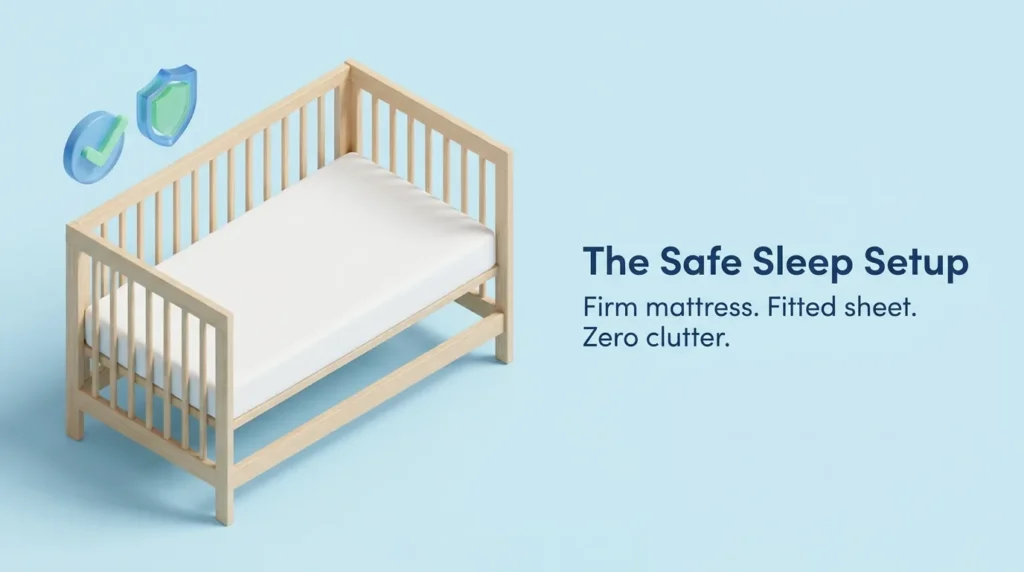
Here’s the part that surprises a lot of new parents: an empty crib is a safe crib. No bumpers, no stuffed animals, no loose blanket, no pillow. Just a firm, flat mattress and a tight-fitting sheet.
I know how strange this feels. Baby registries are full of soft crib sets with matching bumpers and plush toys, so it looks wrong to leave the crib “bare.” But according to guidance from the American Academy of Pediatrics, a clear sleep surface with nothing loose inside it is one of the strongest ways to lower the risk of accidental suffocation.
If you’re working on the nursery right now, this is also a good moment to think about the room as a whole space, not just the crib. Our child-proofing checklist walks through the rest of the room, from cord placement to furniture anchoring, so the crib isn’t the only safe spot in an otherwise risky room.
Pro Tip: I made the mistake of keeping a beautiful knit blanket draped over the crib rail “just for looks” during my daughter’s first month. A friend who’s a labor and delivery nurse gently pointed out that even a decorative blanket near the crib can end up inside it during a sleepy 3 a.m. feed. Now I keep anything soft on a chair across the room, not anywhere near the sleep space.
Back to Sleep, Every Single Time
Every nap. Every night. On their back. This one guideline does more to lower risk than almost anything else, and it applies from birth until your baby can reliably roll both ways on their own.
It can feel counterintuitive if your baby seems to fuss more on their back, or if you were raised in a generation that used tummy sleeping. Guidelines have changed for a real, evidence-based reason, and the CDC’s reproductive health resources explain the research behind this shift clearly if you want to read more.
If your baby has started rolling over during the night, you don’t need to flip them back every time you check on them. Once a baby can roll both directions on their own, you can let them find their own position.
Room Sharing, Not Bed Sharing
Keeping your baby’s crib or bassinet in your bedroom for at least the first six months is linked to a lower risk of sleep-related infant death, while sharing an actual sleep surface with your baby raises that risk.
This distinction matters because “co-sleeping” gets used loosely to describe both situations, and they are not the same thing at all.
- Room sharing: Baby’s crib or bassinet is in your room, near your bed
- Bed sharing: Baby sleeps on the same surface as an adult
If nighttime feeding is exhausting you to the point where you’re worried about falling asleep with the baby in your arms, that’s a real safety conversation worth having with your pediatrician, not something to push through silently.
Here’s a quick, honest look at why this comes up so often:
Here’s a short video that walks through exactly what a safe sleep setup should look like inside the room, which is genuinely useful if you’re a visual learner like I am.
Watching the Temperature, Not Just the Blanket
Overheating is one of those risks that’s easy to miss because it doesn’t look dramatic. A too-warm nursery, one extra layer of clothing, and a hat left on indoors can add up fast.
A simple guide: dress your baby in about one more light layer than you’d wear comfortably in that same room. If a sleep sack or wearable blanket keeps them warm enough, skip the loose blanket entirely.
What About Pacifiers, Swaddles, and “Extra Help” Products
A pacifier at nap time and bedtime has actually been linked to a lower risk of sleep-related death, once breastfeeding is well established. Swaddles are fine for very young infants who haven’t started trying to roll, but once rolling starts, it’s time to transition out of the swaddle so your baby’s arms are free to reposition themselves.
Skip any product marketed as a “sleep positioner” unless your pediatrician has specifically prescribed one for a medical reason. Wedges, inclined sleepers, and positioning pillows sound reassuring in an ad, but they aren’t part of standard safe sleep guidance.
When Pets and Siblings Are Part of the Picture
If you have a curious cat who loves warm, quiet spaces, or a toddler who wants to “help” tuck the baby in, the nursery needs a second look beyond just the crib itself. A closed door, a pet gate, or simply keeping the crib out of paw’s reach solves most of this. Our guide on keeping pets and babies safe together goes deeper into managing that adjustment if you’re introducing a new baby into a home with an established pet.
A Quick Word on Monitors and Smart Nursery Tools
A video monitor or a smart camera won’t replace any of the physical steps above, but it can genuinely ease that 2 a.m. urge to check the crib in person every twenty minutes. Look for one with a stable night vision picture and a reliable connection, rather than the flashiest feature list. It’s a comfort tool for you, not a substitute for a safe crib setup.
Medication, Supplements, and the Nursery Shelf
New parents often keep a small shelf of vitamins, gas drops, or their own medication within arm’s reach of the changing table for convenience during late-night feeds. It’s worth double-checking that shelf is out of reach as your baby starts grabbing at everything within months, not years. Our medication safety guide covers safe storage that grows with your baby instead of needing a redo every few months.
Bringing It Back to the Whole House
A safe crib matters most inside a home that’s already thinking about safety as a whole. If you haven’t mapped out the bigger picture yet, our family safety blueprint is a good next stop, and our piece on common household poison hazards is worth a read once your baby starts exploring outside the crib.
And if you’re lining up outside help for overnight shifts or date nights down the road, our guide on how to vet a babysitter walks through the exact safe sleep questions worth asking before anyone else puts your baby down for a nap.
None of this is about being perfect. It’s about knowing the handful of things that actually matter, so the rest of your energy can go toward the parts of this stage that are genuinely wonderful — like the first time your baby falls asleep on your chest and you finally exhale.
Keeping This Going When Your Baby Changes Every Month
Here’s something nobody warned me about: safe sleep isn’t a one-time setup. It’s a moving target that shifts as your baby grows.
What worked at six weeks won’t necessarily work at six months. Your baby starts rolling. They start pulling up on the crib rail. They start figuring out how to wiggle a leg through the slats. Each new skill means a fresh look at the sleep space.
Reassess Every Time There’s a New Skill
Think of this as a simple habit, not a full audit. Every time your baby hits a new physical milestone, take thirty seconds and look at the crib again with fresh eyes.
- Just started rolling? Time to stop swaddling with the arms tucked in.
- Started pushing up on hands and knees? Double-check nothing loose has snuck back into the crib.
- Starting to pull to standing? Lower the mattress height before you get a surprise at 3 a.m.
A quick way to remember this: new movement, new mattress check. It takes seconds and it becomes automatic after the first few times.
I kept a short sticky note on the inside of the nursery door listing the exact things to glance at whenever my daughter hit a new milestone. It sounds almost too simple to work, but that small habit once caught a loose mobile clip hanging lower than it should have, well before it turned into a real problem. Small systems like this tend to do a lot more work than they get credit for.
Sleep Regressions Won’t Break Your Progress
Around four months, and again closer to the one-year mark, plenty of babies go through a rough patch where sleep falls apart for no obvious reason. This is common, and it doesn’t mean you did anything wrong with the setup.
During a regression, it’s tempting to bring the baby into your bed just to get everyone some rest. I understand the pull completely, and I’ve felt it myself at 4 a.m. with a baby who would not settle. But this is exactly the moment to lean harder on room sharing instead of bed sharing, even when you’re running on fumes.
A rocking chair in the nursery, a firm decision to feed and return baby to the crib rather than staying in your bed, and asking a partner or family member to take one night shift can get you through a regression without changing your baby’s sleep setup.
Travel and Sleeping Away From Home
Hotels, grandma’s house, a friend’s guest room — none of these come with a crib you’ve already checked. A portable, travel-approved play yard with its own firm mattress and fitted sheet solves this without much extra planning.
Skip the temptation to let baby nap on a hotel bed “just this once” surrounded by pillows. The exact same risks apply away from home as they do in your own nursery.
Daycare, Grandparents, and Anyone Else Watching Your Baby
Your safe sleep habits only protect your baby when everyone caring for them follows the same rules. This is one of those conversations that feels awkward to bring up with a mother-in-law who raised three kids “just fine” a generation ago, but it’s worth having anyway.
A short, friendly note works better than a long lecture: “Here’s exactly how we do naps — back to sleep, nothing extra in the crib, and the room a little on the cool side.” Most caregivers appreciate clear instructions rather than guessing.
If you use a daycare center, it’s worth asking directly what their written sleep policy actually says, rather than assuming it matches your own approach. Licensed centers usually have a clear policy on hand, and reading it takes just a couple of minutes.
Where Good Intentions Quietly Go Wrong
Most parents who run into trouble aren’t careless. They’re tired, and tired brains make small compromises that feel harmless in the moment.
The couch nap is the big one. You’re exhausted, baby finally settles on your chest, and moving them feels like it will wake them right back up. I’ve fallen asleep on the couch with my daughter more than once during that first month, and looking back, that’s exactly the scenario safe sleep guidance warns about most strongly. A couch is soft, it has gaps and cushions a baby can slip into, and an exhausted adult isn’t a reliable backup plan.
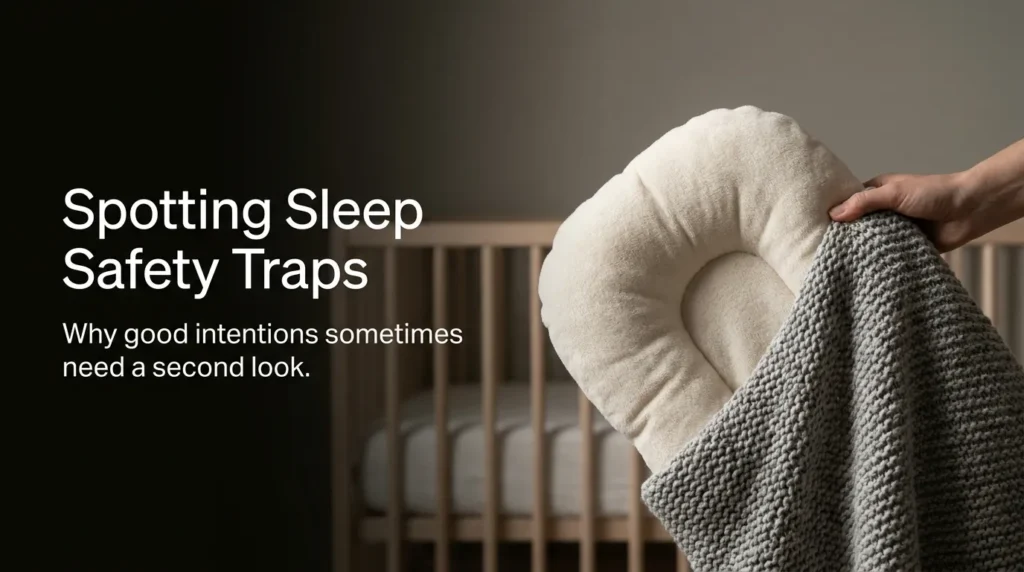
Another quiet mistake is the “just this once” blanket. Grandma gives you a gorgeous handmade quilt, and it feels wrong not to use it. So it goes in the crib for one nap, just to try it out. One nap is all it takes for something to go wrong, which is why the safest approach is simply never using loose blankets in the crib at any age young enough for this guidance to apply.
Overdressing follows the same pattern. A worried parent adds one more layer “just in case,” then a hat for good measure, then wonders why the baby seems fussy and flushed. Overheating doesn’t always look dramatic from the outside, which is exactly why it’s easy to miss.
There’s also the trap of following advice from a decade or two ago without checking if it still holds up. Sleep guidance has changed meaningfully over recent years as research has improved, and what a grandparent did with confidence for their own kids isn’t always what current evidence supports now. This isn’t about anyone being wrong on purpose. It’s that the science moved forward, and it’s fair to gently share updated guidance from your pediatrician when it comes up.
The last one is subtle: skipping the crib reassessment after a growth spurt or new milestone. A baby who suddenly rolls, sits, or stands changes the entire risk picture overnight, and the crib that was perfectly safe last month might need one small adjustment this month.
Common Questions About Newborn Sleep Safety
Is it normal for my baby to grunt and squirm while sleeping on their back?
Yes, this is extremely common and usually nothing to worry about. Newborns are noisy, wiggly sleepers by nature, and back sleeping doesn’t change that.
What if my baby only naps well when held?
This happens with a lot of babies, especially in the early weeks, and it doesn’t undo your nighttime safe sleep habits. Just make sure someone stays awake and alert while baby naps in arms, rather than both of you drifting off together on a couch or bed.
Do I need to buy a specific “safe sleep” branded mattress?
Not necessarily. What matters is firmness and a snug fit inside the crib or bassinet frame, not a specific brand name or price point. A firm, flat mattress that matches the crib’s dimensions with no gaps around the edges meets the guidance.
When can my baby start using a pillow or blanket?
Most guidance points to around the first birthday as a general marker, though your pediatrician may give you a more specific answer based on your baby’s development. There’s no need to rush this, even if other babies you know already have one.
Is a video monitor actually necessary, or just a nice extra?
It’s genuinely optional. Plenty of parents do just fine with a simple audio monitor or no monitor at all, especially with room sharing already in place. A video monitor is a comfort tool for your own peace of mind, not a safety requirement.
My baby sleeps better on their stomach. Is it really that risky to let them stay there?
I know this one is hard, because a fussy baby who settles instantly on their tummy feels like relief. Back sleeping is still the safest choice for every sleep period until your baby can roll both ways on their own, even on the nights it feels like the harder option.
Your Next Nap Time Starts Fresh
You don’t need to memorize every guideline perfectly tonight. You just need the next nap to be a little safer than the one before it, and then the one after that a little safer still.
I think back to that anxious version of myself hovering over the crib at 2 a.m., and I wish I could tell her that most of this comes down to a short, clear list, not some impossible standard. Bare crib. Back to sleep. Room sharing, not bed sharing. Everything else builds on those three things.
My honest advice, from one tired parent to another: pick one thing from this guide you haven’t done yet, fix it tonight, and let the rest come naturally over the next few weeks. That’s exactly how I got through it, one small adjustment at a time, and I promise it gets easier faster than it feels like it will right now.
Disclaimer: This article is for general informational purposes only and is not a substitute for professional medical advice, diagnosis, or treatment. Always talk with your pediatrician or a qualified healthcare provider about your baby’s specific sleep needs and health.