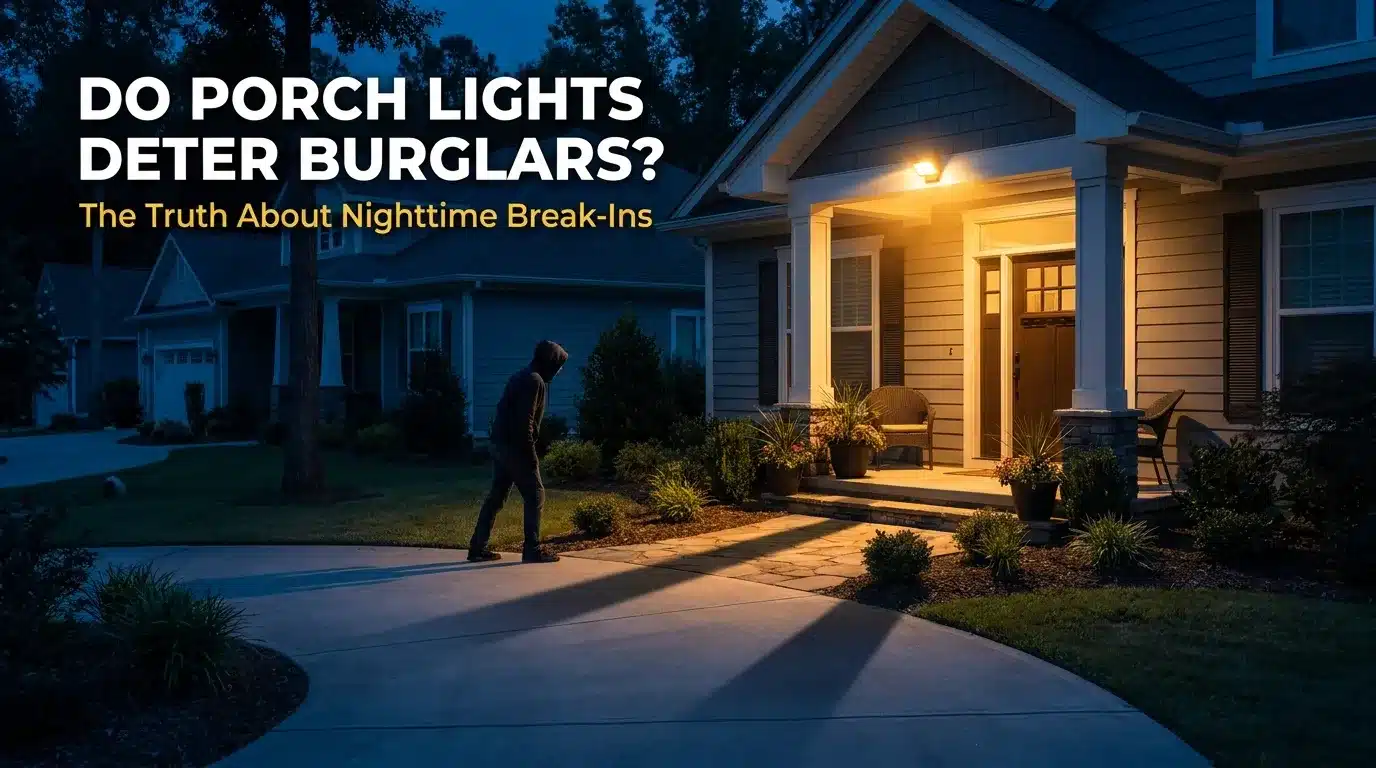
My neighbor’s Ring camera caught a guy testing three different doorknobs on our street last spring — all before 11 p.m., with every single porch light on the block switched on and glowing. I watched the clip a dozen times, and it bothered me for weeks. My own porch light had been burning the same way, every night, for two years, and I’d never once questioned whether it was doing anything at all. That footage is what finally got me to stop guessing and actually test what works.
Quick answer: A porch light left on steadily all night is a weak deterrent by itself. Motion-activated lighting works better because the sudden change signals “someone just saw me” instead of blending into the background after a few nights. The comparison further down breaks out exactly when each type earns its keep.
What a plain porch light actually signals to someone casing your street: not much. It tells them your bulb works, and after a night or two, it stops registering as anything worth noticing at all.
Living with a porch light that isn’t really doing its job wears on you in small ways:
- You hear something outside after midnight and the light shows you a tiny circle of concrete — everything past it stays a black wall.
- You start checking the same door lock twice, then a third time, because you don’t actually trust what the yard looks like in the dark.
- Side gates, the space behind the AC unit, the strip along the fence — none of it gets any light, and none of it gets checked either.
- You feel a little silly bringing it up to anyone, because “the porch light is on” sounds like security, even when it isn’t doing much.
None of that is dramatic. It’s just a low-grade unease that builds up over months of walking past the same unlit corners.
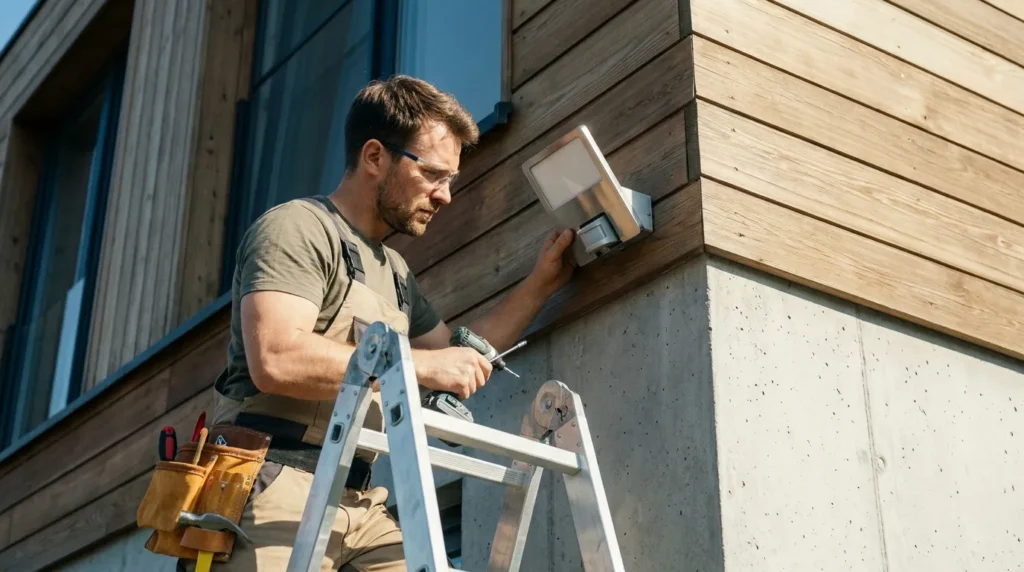
Where Should You Actually Mount a Porch Light?
Mount your main porch light around 9 feet off the ground. That’s high enough that it can’t be unscrewed or knocked loose by hand, and close enough to the door to actually light the lock and the doormat.
- Corner-mount when you can. A fixture placed at the edge of the porch roof covers two sides of the entryway instead of just one, so you often need fewer units total.
- Add a second light for recessed doors. If your front door sits inside an alcove, one fixture straight overhead leaves the handle and lock in their own shadow — the one spot that actually needs to be visible.
- Check the doormat test. Stand at your door at night and look down. If you can’t clearly see your own feet, the light isn’t angled or positioned right yet.
This kind of layered coverage pairs well with the door hardware upgrades in our guide on how to reinforce your front door, and with a wider look at burglar-proofing the rest of your yard beyond just the entryway.
What Angle Should a Porch Light Aim At Night?
Aim your porch light downward, at roughly 45 degrees toward the ground near your entry points, instead of straight out toward the street. DarkSky International recommends shielded, downward-directed fixtures specifically to cut glare — and that same angle is what actually lights up the ground where someone would be standing or crouched, instead of blinding your neighbors’ windows.
A light aimed outward mostly glares into passing headlights and does very little to reveal anyone near your foundation or window wells.
How Bright Should a Porch Light Be Without Blinding You?
Brighter isn’t automatically better here. One oversized floodlight creates a bright center and a hard-edged dark ring around it — and that ring is exactly where someone can stand without being seen from inside.
- For a covered porch or walkway, aim for roughly 100–300 lumens. Anything brighter tends to wash out the doorway and blind whoever’s standing on the steps, including you.
- For an open driveway or side yard, 700–800 lumens on a motion-activated fixture covers the distance without creating that same glare problem.
- Two or three smaller, evenly spaced lights almost always beat one giant unit, because your eyes stay adjusted to a consistent light level instead of snapping between bright and pitch-dark.
I made this exact mistake the first time around — I bought the single biggest floodlight I could find, mounted it dead center over the garage, and ended up with a yard that looked more like a stage spotlight than actual coverage. Splitting that same wattage across two smaller fixtures on either side fixed it within a weekend.
Steady vs. Motion-Activated: Which Porch Light Actually Works?
| Steady Porch Light | Motion-Activated Porch Light | |
|---|---|---|
| Deterrence style | Passive — visible but predictable after a few nights | Active — the sudden change signals “you’ve been seen” |
| Energy use | Runs all night, higher cost | Only draws power when triggered |
| Best for | House numbers, everyday walkway visibility | Entry points, side gates, driveways |
| Main downside | Becomes background noise fast | Can false-trigger on cats, wind, or passing cars |
Most homes end up better off running both at once: a dim, warm steady light near the house numbers for everyday visibility, and a brighter motion-activated fixture aimed at the actual entry point.
Can a Porch Light Connect to the Rest of Your Smart Home?
Yes — most current smart porch lights link to your Wi-Fi or a hub and can trigger a camera, a phone alert, or even a lock the moment someone steps close. A Ring Floodlight Cam Wired Plus (around $180) combines the light and the camera in one fixture, while something like the Eufy Security Solar Wall Light (around $35–40) works well on a side gate or driveway edge where running new wiring isn’t practical.
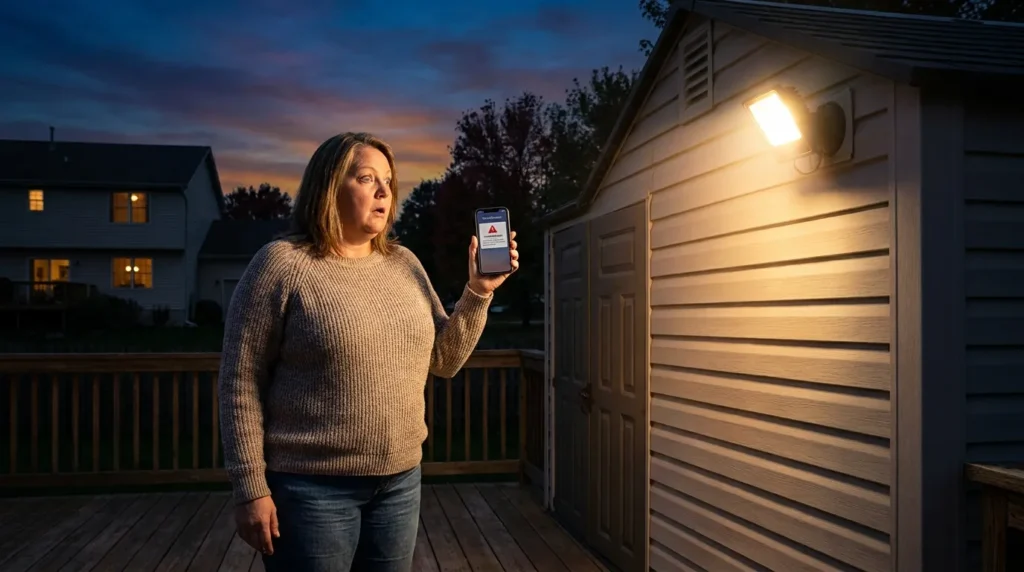
When a porch light is tied into a system like this, a trigger doesn’t just switch on the bulb — it also starts recording and pushes a notification to your phone, so you can check the live feed before deciding whether to do anything else. This kind of setup works best next to a properly secured Wi-Fi network and camera hub, and it’s worth double-checking your camera’s field of view too, since even a well-lit porch does little if the camera itself has a blind spot right where the light triggers.
If you want the deeper mechanics of how motion sensors themselves work — range, sensitivity, and why they misfire — that’s covered separately in our piece on whether motion sensor lights actually deter burglars.
Here’s a short walkthrough on mounting and aiming a porch light correctly, including the placement mistakes most people make.
What’s the Cheapest Way to Fix a Dark Porch This Weekend?
You don’t need an electrician or a full rewire to close most of the gaps covered above. A handful of low-cost fixes handle the worst blind spots in a single afternoon.
- Swap the bulb before you buy a new fixture. A warm-white LED rated around 3000K in your existing porch light often solves half the glare problem for under $10, with no new wiring involved.
- Add a battery-powered motion light to the worst blind spot first. Stick-on units cost roughly $15–25, need no wiring, and can be repositioned in minutes if the angle isn’t right the first time — this is the same approach covered in our guide to apartment security without drilling holes if you’re renting.
- Move — don’t just add — your existing fixture. If your current light sits directly over the door, sliding a second cheap unit to the side gate or the space behind the AC unit usually does more for coverage than a second light in the same spot.
- Test at night before you commit to a spot. Mount a light with painter’s tape first, wait for dark, and stand where a stranger would stand. It takes ten extra minutes and saves you from drilling a hole in the wrong place.
None of these fixes need a permit or a weekend course. They just need you to actually stand outside after dark once and look at your own porch the way a stranger would.
How Do You Keep a Porch Light Working as a Deterrent Long-Term?
A porch light only works as a deterrent if it stays unpredictable. Once a burglar can map out your schedule — same light, same time, every night — it stops being a warning and turns into a countdown clock.
Randomize your timing instead of locking it to one schedule. The Seattle Police Department’s home security guidelines recommend combining timers, photocells, and motion sensors rather than relying on a single fixed on/off time, precisely because a static pattern becomes obvious within a few days of watching. A photocell that reacts to actual dusk, paired with a motion sensor for sudden activity, gives you two layers instead of one predictable switch.
Build overlapping trigger zones for larger properties. One sensor near your side gate can be wired or app-linked to also flip on the porch light and a garage light at the same time. Someone stepping over a back fence at 11 p.m. suddenly has three lights reacting instead of one, which reads very differently than a single porch bulb clicking on.
Recalibrate for the season, not just the sensor. Daylight hours shift by more than an hour between summer and winter in most of the U.S., so a photocell set once in June often triggers too late by December. Check your dusk-to-dawn setting every few months, not just when a bulb burns out.
Weatherproof the wiring before it becomes a repair job. Exposed junctions left uncovered through a rainy season corrode fast, and a corroded connection is the most common reason a “smart” porch light quietly stops responding to motion. A $5 silicone weatherproof cap on each connection point outside adds years to a fixture’s working life.
Treat your porch light as one layer, not the whole plan. A motion-activated light paired with a visible camera and a solid deadbolt does more than any single piece alone — the light interrupts, the camera records, and the lock buys the extra seconds that make most opportunistic burglars move on to an easier target. If you haven’t compared lock types recently, our breakdown of smart locks versus deadbolts covers which pairing actually holds up.
Sync your “away mode” with your actual travel dates, not a generic vacation setting. Family Handyman’s guide on smart lighting schedules points out that burglars watch for patterns over several days, not just a single dark evening — so a randomized schedule that starts the day you leave and ends the day you’re back does more than a permanent “vacation mode” left running year-round. Running the schedule for a night or two while you’re still home lets you catch any timing issues before you actually need it working.
I started checking my own sensor settings every three months after one went a full winter firing five seconds too late to catch anything on camera. That one small habit — a quarterly five-minute check — has done more for me than any single piece of hardware I’ve bought.
A quick seasonal checklist, since this is the part most people skip:
- Wipe the sensor lens with a soft, dry cloth — dust and spider webs block the infrared path more often than people expect.
- Re-test the dusk-to-dawn trigger time after clocks change in spring and fall.
- Check any exposed wiring for cracking or water pooling near the connection points.
- Confirm your phone still gets notifications if the light is tied into an app — a firmware update can silently turn alerts off.
What Mistakes Quietly Cancel Out a Good Porch Light?
A lot of homeowners install the right fixture and still lose most of its value through a handful of small, easy-to-miss mistakes.
Setting the sensitivity dial and forgetting it exists. A sensor tuned for a windy October night trips constantly by summer, when tree branches move more and neighborhood cats wander through. Once a light fires too often, most people just stop noticing it — which defeats the entire point of motion activation.
Aiming the sensor at anything reflective. A pool, a parked car’s windshield, or even a shiny house number plaque can bounce heat and light back at the sensor and cause repeated false triggers. Each false trigger drains battery-powered units a little faster and trains you to tune the whole system out.
Leaving the “hidden paths” completely dark. Side gates, the gap behind an AC unit, and the strip along a shared fence line rarely get any coverage at all, even on homes with several porch lights already installed. These forgotten corners are exactly where someone moves once the main entry points are lit.
Skipping the test after a storm or a power outage. A fixture that lost power for six hours doesn’t always come back exactly where it left off — some units reset their sensitivity or schedule after an outage. Walk out and check it the next evening rather than assuming it’s fine.
Relying on the porch light as your only security measure. A motion-activated light significantly reduces the chance someone lingers near your door, but it doesn’t guarantee anything on its own. Pairing it with a doorbell camera and a secure lock makes much harder work for anyone testing your house.
Painting or coating over a sensor during a touch-up project. It sounds unlikely, but a fresh coat of trim paint that drifts onto a sensor’s lens can dull its infrared range by more than half without anyone noticing until the light stops reacting to anything but direct movement right in front of it.
Ignoring local ordinances on light trespass. A motion-activated floodlight aimed too high or too wide can spill directly into a neighbor’s bedroom window, and depending on where you live, that’s more than just an awkward conversation — some municipalities treat persistent light trespass as a code violation. Aiming down and checking the beam spread from your neighbor’s side of the fence avoids the whole issue.
None of these mistakes are dramatic on their own. Stacked together, though, they’re the reason you can have three working lights on your porch and still feel completely exposed in the dark.
Common Questions About Porch Lights and Burglars
Do porch lights stop burglars?
Not reliably by themselves. A motion-activated porch light paired with a visible camera performs noticeably better than a plain bulb left on all night.
Is it better to leave a porch light on all night?
Not really — a light on the exact same schedule every night becomes a predictable pattern rather than a deterrent. A timer with varied times, or motion detection, avoids that giveaway.
What color porch light is best for security?
Warm white around 3000K works best. It shows faces and details clearly without the harsh glare that colder, bluer bulbs tend to produce.
Can pets trigger a motion-sensor porch light?
Yes. Standard sensors pick up heat from cats, raccoons, and other animals. Look for “pet-immune” sensors or an adjustable detection height to cut down on false alarms.
Should porch lights stay on during a power outage?
Only if you’ve added battery or solar backup — a wired fixture with no backup power goes dark along with everything else, which is exactly when you’d want it working.
Do burglars avoid homes with visible cameras and lights?
A visible camera paired with a motion-activated light adds real friction. It forces someone to be seen and recorded at the same time, and that combination is enough to send most opportunistic burglars looking for an easier target.
Are motion-sensor porch lights worth it over a regular bulb?
For most homes, yes. The upfront cost difference is usually under $30, and the sudden-light effect does more deterrent work than a steady bulb ever will, especially at entry points and side gates.
Give Your Porch a Real Shot Tonight
You don’t need every fixture, sensor, and smart hub running perfectly to make a real difference here. One well-placed, well-aimed motion light beats three poorly angled ones every time.
My own front porch went from a spot I avoided looking at after dark to the one part of my house I actually feel good about. It took one weekend, a $20 sensor, and a lot of standing outside in my socks testing angles — and it was worth every minute of it.
Small, boring habits are what actually make this stick. Checking the lens for spider webs, resetting the timer after clocks change, and glancing at your camera app once a week matter more than any single expensive purchase.
Walk out tonight, stand where a stranger would stand, and fix the first thing that looks wrong. That’s the whole plan, and it costs nothing but ten minutes.
I’m just a homeowner who’s rewired more porch fixtures than I’d like to admit, not a licensed electrician. If you’re running new wiring rather than using a plug-in or solar unit, it’s worth having a local electrician or locksmith take a quick look to make sure everything’s up to code for your area.