I used to think a pretty yard was just about curb appeal. My hedges were tall and full. My porch had a nice shady corner where I liked to sit with my coffee. I was proud of it.
Then my neighbor got broken into.
The police officer who came by afterward walked past my house and stopped. He pointed at my hedges and said something I still think about: “That’s a great place for someone to hide while they try your window.” My stomach dropped. I had spent two summers growing that “privacy” without realizing I was also growing a hiding spot.
That one comment changed how I look at my own yard.
If you have ever felt safe just because your doors are locked and your alarm is set, I get it. I felt that way too. But your yard talks before your alarm ever gets a chance to.
What This Really Does to Your Peace of Mind
Here’s the hard part nobody tells you. A break-in doesn’t just cost you stuff. It costs you sleep.
People who have been through it often say the same things:
- They check the locks two or three times before bed, every single night.
- They flinch at small noises outside, even months later.
- Their kids ask to sleep with the lights on.
- They start avoiding their own backyard after dark.
- They feel guilty, like they should have “known better,” even though it was never their fault.
That last one hits hardest. You did not do anything wrong by wanting a nice yard. Most homeowners have no idea that a few overgrown bushes or a dark side gate can quietly turn their home into an easier target. This isn’t about blame. It’s about knowing what to look for so you can fix it before something happens, not after.
Your home should feel like the safest place on earth. If your yard is working against that without your knowledge, it is worth twenty minutes this weekend to walk around and look at it with new eyes.
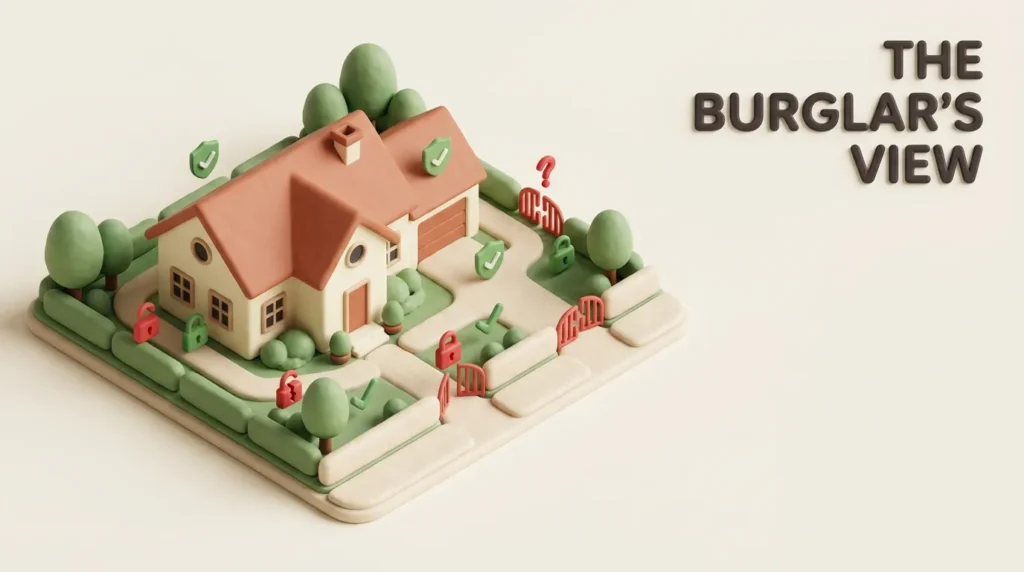
Reading Your Yard the Way a Burglar Would
Let’s go outside. Grab a notepad if you want, or just walk with me through this.
Most burglars are not professionals in movies with lockpicks and gadgets. According to crime prevention research from the International CPTED Association, a group that studies how environment design affects crime, most break-ins are opportunity-based. That means the burglar is not targeting you specifically. They are scanning the street for the house that looks easiest and quietest.
Your yard sends signals. Here’s how to read them.
Hiding Spots Near Windows and Doors
Any bush or shrub taller than three feet next to a window or door can hide a person almost completely. Once someone is behind it, they can work on a lock or a window for several minutes without anyone on the street noticing.
A simple fix: trim anything near ground-floor windows down to knee height. You lose a little privacy but you gain a clear sightline, and that trade is worth it.
This matters even more if you have young kids who play in the backyard. A yard with too many blind spots is not just a break-in risk. It’s harder for you to see your kids at play too.
Trees That Work Like Ladders
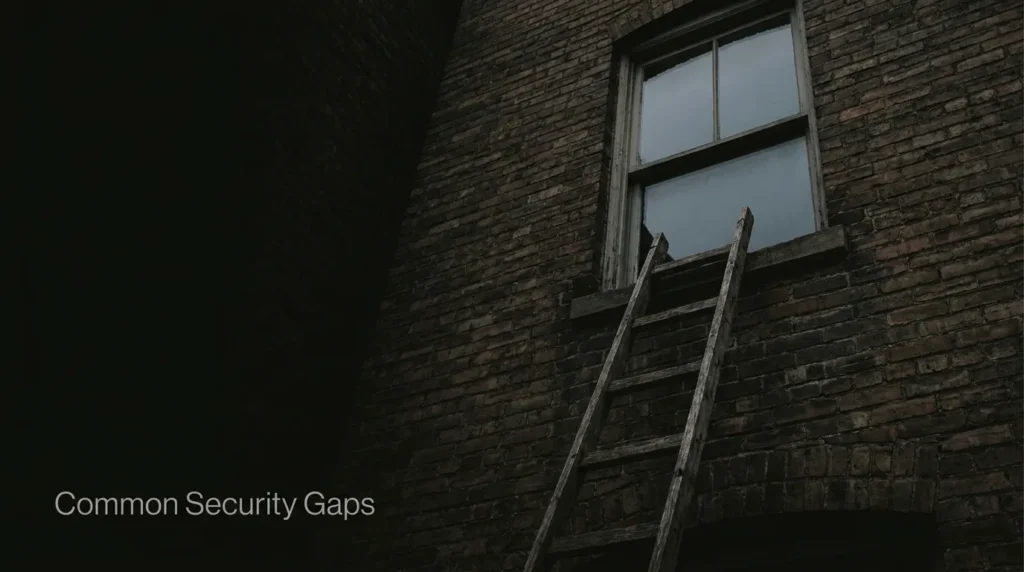
I never thought about this until a locksmith pointed it out to me. Tree limbs that reach close to a second-story window are basically a free ladder. Someone does not even need tools. They just need to climb.
What to do: keep branches trimmed back at least six feet from any upper-floor window. If you’re not confident doing this yourself, this is a good project to hand off to a professional, and it helps to know how to properly vet a contractor before letting anyone onto your property for tree work.
Quiet Ground and Dark Corners
Soft mulch and grass let someone walk right up to your window without a sound. Gravel, on the other hand, is loud. Research on crime deterrence by design, including guidance published through university extension programs on home landscaping, points to gravel paths near windows and entry points as a low-cost, high-impact fix.
My honest tip here: I put down a two-foot strip of gravel under every ground-floor window in my house. It cost less than a nice dinner out. I have stepped on it myself at night getting something from the shed, and yes, it is loud enough to wake the house.
Dark corners matter just as much. A motion sensor light costs very little and does two jobs at once. It startles anyone who shouldn’t be there, and it turns your porch light on for you when you’re coming home late with your hands full.
Here’s how yard lighting and modern security tech work together, explained simply:
Solid Fences vs. See-Through Fences
A tall, solid privacy fence feels safe. In reality, it can work against you. Once someone gets over it or through a side gate, that same fence now hides them from your neighbors too.
A fence with some visibility, like a picket style or a fence with gaps, still gives you privacy from the street but keeps sightlines open from your neighbors’ windows. That’s a trade worth thinking about.
Also, always lock side gates. It sounds obvious, but it’s one of the most common ways burglars reach a backyard unnoticed. This connects directly to a bigger point I always make in our family safety fundamentals guide: the small daily habits matter more than the big expensive systems.
An Unkempt Yard Sends a Signal Too
This one surprised me the most. A yard with tall grass, old newspapers on the porch, and dead leaves piling up doesn’t just look messy. It tells a stranger nobody is home, or nobody is paying attention.
Data collected by the Insurance Information Institute, which tracks burglary and property crime trends across the U.S., consistently shows that homes appearing unattended are more likely to be targeted than homes that look actively lived in.
A quick fix that costs nothing: ask a neighbor or family member to grab your mail and mow your lawn if you’re away for more than a few days. It’s a small favor that makes a real difference.
Smart Devices That Actually Help
Landscaping fixes go a long way, but pairing them with a few smart tools makes your yard even harder to target.
A smart door lock lets you check and lock your door from your phone, so you’re never wondering if you locked up before a trip. A pet camera does double duty. You can check on your dog during the day, and it also gives you a live view of your porch and yard if something feels off.
Neither of these needs to be expensive or complicated. Start with one, get used to it, then add the other later.
Bringing It All Together
None of these fixes require a full yard renovation. You can knock out the biggest ones, trimming bushes, adding gravel, and locking your gates, in a single weekend.
If you have kids at home, it’s also worth pairing these outdoor fixes with an indoor check. Our childproofing safety checklist and our guide on preparing kids for time home alone both connect well with this topic, since a safer yard also means a safer environment for your kids to play and answer the door confidently. Our piece on modern stranger danger habits is another good follow-up read if you want to build out a full family safety routine around your home.
Your yard is often the very first thing a stranger sees about your family. A little attention here goes a long way toward keeping the rest of your home, and the people inside it, safe.
Small Habits That Keep Your Yard Safe Long-Term
Fixing your yard once is a good start. Keeping it that way is what actually protects you.
Think of it like brushing your teeth. One good brushing session doesn’t matter if you stop for the next six months. Yard security works the same way.
Build a Five-Minute Sunday Habit
Pick one day a week, even just five minutes, to walk around your house. Look at your windows. Look at your gates. Look at your porch.
Ask yourself three quick questions:
- Can I see my front door clearly from the street?
- Is anything blocking my ground-floor windows right now?
- Are my outdoor lights actually working, or did a bulb burn out weeks ago?
I do this every Sunday morning with my coffee. It takes less time than scrolling through my phone, and it catches small problems before they turn into open invitations.
Rotate Your “Signs of Life”
An empty-looking house is a target. This matters most when you travel.
A timer on your porch light is a good start, but smart plugs take it further. You can set lights, and even a radio or TV, to turn on and off at different times so your house never looks like it’s on autopilot.
Here’s a scenario worth picturing: you’re on a beach vacation for a week. Your neighbor grabs your mail once. Your porch light comes on at dusk every night through a smart plug. From the street, your house looks exactly like a house where someone is home. That’s the goal.
Talk to Your Neighbors (Yes, Really)
This one sounds old-fashioned, but it works. Neighbors who know each other watch out for each other.
A quick text like “heading out of town Friday to Sunday, can you keep an eye on my place” takes ten seconds to send. It builds a small safety net that no camera or lock can fully replace on its own.
Layer Your Defenses Instead of Relying on One Fix
No single change makes your home bulletproof. Gravel paths, trimmed bushes, motion lights, a locked gate, a smart doorbell camera. Each one closes a gap on its own.
Put them together, and you make your home a much harder, slower, and riskier target. Most burglars want speed and quiet. Take those two things away, and you’ve already won most of the battle.
Where Good Intentions Quietly Backfire
I want to be honest here, because I made some of these mistakes myself before I learned better.
The first one is going overboard with lighting. You might think more light everywhere is always safer. But flooding your whole yard with bright light actually creates harsh shadows in the corners that don’t get covered. A few well-placed motion lights beat one giant floodlight that never turns off.
The second mistake is forgetting the side and back of the house. Most people spend all their energy on the front yard because that’s what guests see. Meanwhile, the side gate stays unlocked and the back window sits behind an overgrown shrub nobody has touched in years. Burglars know this. They almost always check the back before the front.
The third one hurts to admit. I used to leave my ladder leaning against the shed after doing yard work. I never once thought about it as a security risk. A ladder left outside is basically a gift for anyone trying to reach a second-story window. Now I keep mine locked inside the garage every single time, no exceptions.
A fourth common slip-up is posting vacation photos in real time. I know it’s tempting to share that beach sunset the moment you take it. But a public post telling the whole internet your house is empty for a week is a risk most people don’t think about until it’s too late. Save the photos for after you’re home.
And finally, treating this as a one-time project instead of an ongoing habit. You trim the bushes once, feel good about it, and then forget for two years. Yards grow. Bulbs burn out. Gates get left open by accident. Safety here isn’t a checkbox. It’s a routine.
None of these mistakes make you careless or a bad homeowner. They’re just easy to miss until someone points them out, which is exactly what I’m doing here for you now.
Common Questions About Yard Security and Burglary Prevention
Do burglars really avoid homes with cameras?
Yes, in most cases. A visible camera adds risk and delay for someone trying to break in, and most burglars want an easy, fast target. Even a fake camera can help, though a real one paired with a doorbell camera works far better.
What time of day are homes most at risk?
Believe it or not, daytime hours tend to see more break-ins than late night. Many burglars prefer midday, when houses are more likely to be empty because people are at work or school.
How tall should my bushes be near windows?
Keep anything near a ground-floor window trimmed to about knee height, roughly two to three feet. Anything taller starts to create a hiding spot instead of a nice view.
Does a barking dog actually help?
It genuinely does. Even the sound of a dog barking through a video doorbell speaker can make someone think twice and move on to an easier target.
Is gravel really effective, or is that just an old myth?
It’s more than a myth. Gravel underfoot is loud and hard to walk on quietly, which removes the element of surprise a burglar depends on near windows and doors.
Should I trim trees myself or hire someone?
Small branches near ground level are fine to handle yourself with basic tools. For anything near your roof or a second-story window, it’s safer and smarter to bring in a professional with the right equipment.
Your Weekend Action Plan
Here’s what I want you to take away from all of this.
You don’t need a huge budget or a full weekend to make your home noticeably safer. You need about an hour, a pair of trimming shears, and a walk around your own yard with fresh eyes.
Start with the windows closest to your doors. Trim what’s blocking them. Add a bag of gravel if your budget allows. Check that your gate actually locks, not just closes.
My honest closing thought: I used to think home security was all about the alarm system and the cameras inside. My own yard taught me that the real first line of defense starts outside, in the plants and lights most of us never think twice about. Fix what you can this weekend, and you’ll sleep a little easier tonight.
Disclaimer: This article is for general educational and informational purposes only and does not constitute professional security, legal, or landscaping advice. Every home and property is different, so please consult a licensed security professional, local law enforcement, or a certified landscaping contractor for guidance specific to your situation.
CTRL+F YouTube Search Line: [Here’s how yard lighting and modern]
YouTube Search Keywords to Find the Exact Video: motion sensor lights home security explained, how outdoor lighting deters burglars, smart lighting home security tips