Imagine you just landed after a long flight with your kids. Everyone is tired, hungry, and ready to get to the hotel.
You stand by the baggage carousel, waiting for your colorful suitcases to appear on the moving belt.
According to travel safety statistics compiled by Forbes, airport transit hubs remain prime targets for opportunistic baggage handlers and thieves.
Finally, you see your bag, but something looks wrong. The zipper is slightly open, or the lock is missing entirely.
You open it up and realize your expensive camera, jewelry, or even the kids’ favorite gadgets are gone.
The feeling of being violated in a public place is overwhelming and heartbreaking. It is not just about the money you lost.
It is the loss of memories and the sense of safety you had for your family trip.
This happens to thousands of travelers every single day across the globe, as documented in public reports on luggage theft trends.
You think the airport is a secure place with cameras everywhere, but thieves are smart and fast.
They know exactly where the blind spots are and how to open a bag in seconds.
This reality is a huge burden for parents who just want a stress-free vacation with their loved ones.
Maintaining security on the road is just as vital as practicing 5 essential tips for a securely life in your daily household routines.
The feeling of being violated in a public place is overwhelming and heartbreaking. It is not just about the money you lost—it is the loss of memories and the sense of safety you had for your family.
Why Most Families Fail to Keep Their Bags Safe
Many people believe they are doing enough to protect their stuff, but they often fall into common traps.
Here is why the standard approach usually fails to protect luggage from airport theft:
- Relying on cheap factory locks: Most suitcases come with a built-in lock that is very easy to pop open with a simple screwdriver or a pen.
- Trusting the “Zipper” blindly: Most people do not realize that a standard zipper can be opened with a ballpoint pen in three seconds and closed back up without leaving a trace.
- Using fancy, expensive-looking bags: High-end luggage screams “expensive items inside” to professional thieves who watch the carousels.
- Thinking “It won’t happen to me”: Many families skip basic security steps because they feel the airline or airport security will handle everything perfectly.
- Buying the wrong type of locks: Using non-TSA approved locks can lead to security agents breaking your bag open, which leaves it vulnerable for the rest of the journey.
Just like implementing modern stranger danger tips keeps your children safe from sketchy individuals in public, picking the right travel gear shields your property.
How Baggage Theft Destroys Your Peace of Mind
When you lose your items, it does more than just hurt your wallet. It creates a ripple effect of stress that can ruin the entire family atmosphere.
- Loss of Confidence: You start to feel anxious every time you check a bag, making future travels feel like a chore instead of a joy.
- Wasted Vacation Time: Instead of sitting by the pool, you spend your first two days filing police reports and calling insurance companies.
- Emotional Distress for Kids: Children can get very upset when their personal items or toys are stolen, leading to a negative association with flying.
- Financial Strain: Replacing stolen electronics or clothing on the spot is often much more expensive than buying them at home.
- Feeling Unprotected: It creates a sense that you cannot protect your family’s belongings, which is a very heavy feeling for any parent to carry.
We need to change how we think about luggage. It is not just a box for your clothes; it is a vault for your family’s comfort.
Understanding these risks is the first step toward building a defense that actually works.
You deserve to walk through an airport without looking over your shoulder or worrying about your checked bags.
Below, we will look at exactly how you can turn your suitcases into “hard targets” that thieves will want to avoid.
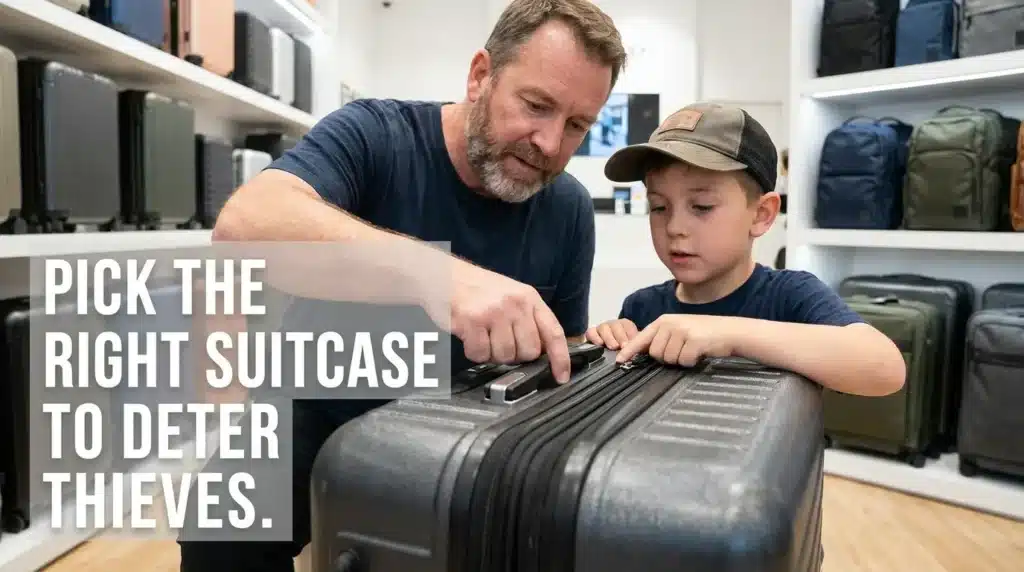
Pick the Right Suitcase to Deter Thieves
The first step in securing your gear starts before you even leave your house.
You need to choose a bag that makes a thief’s job difficult or impossible.
If a thief sees two bags and one looks hard to open, they will always go for the easier one. You want your bag to be the one they skip.
Hard-shell suitcases are generally much better than soft-sided fabric bags.
Fabric can be easily sliced with a sharp knife or a razor blade in a dark corner of the luggage handling area.
A solid polycarbonate shell provides a physical barrier that is much harder to bypass quickly.
Also, look for bags that do not use zippers at all. There are many “latch-system” suitcases available now.
These use heavy-duty clips instead of zippers, which completely removes the “pen-and-zipper” trick that thieves love to use.
If you must use a zippered bag, look for puncture-resistant zippers. These are double-layered and designed to resist being forced open by sharp objects.
Avoid bright, luxury branding. While it feels nice to have a designer bag, it acts as a magnet for people looking for high-value items like luxury watches or designer clothes.
When traveling with extended family, lifting heavy bags can cause physical strain, making it just as important to manage as following a preventing senior falls at home safety guide for elder care.
Mastering the Art of Secure Locking
Once you have a good bag, you need to lock it the right way. A lock is a deterrent, but only if it is the right kind.
Always use a TSA-approved lock. These locks allow airport security to open your bag with a master key if they need to inspect it.
If you use a regular lock, security will often clip it off.
Once that lock is gone, your bag travels the rest of the way completely unprotected.
When you buy a TSA lock, look for one with a steel cable instead of a rigid shackle. These are harder to snap off with pliers.
Another great tip is to lock your zippers to a fixed point on the bag if possible. Some bags have a built-in locking port for the zipper tabs.
This prevents the zippers from being moved around the track, which is a common way thieves hide the fact that they opened your bag.
Do not use the same code for every bag in your family.
If a thief happens to figure out one code, they shouldn’t be able to open all four of your suitcases.
Keep your codes written down in a safe place on your phone, but never keep a physical note of the code inside the bag itself.
Use Smart Technology for Real-Time Tracking
We live in a world where you can track almost anything with your phone. Why not do the same for your family’s luggage?
Small Bluetooth or GPS tracking tags are game-changers for family safety. You can hide a small tag inside the lining of each suitcase.
This does not stop someone from opening the bag, but it tells you exactly where the bag is at all times.
If your bag doesn’t come out on the carousel, you can check your phone.
You might see that it is still in the departure city or sitting in a different terminal.
Knowing the exact location of your bag gives you huge leverage when talking to airline staff.
It also helps if a thief tries to walk out of the airport with your bag.
Many of these trackers have an “anti-separation” alarm. If your bag moves a certain distance away from your phone, you get an instant notification.
This is perfect for when you are sitting in a terminal cafe and have your bags parked nearby. It gives you a digital safety net that wasn’t possible a few years ago.
Securing your vacation bags follows the same proactive logic as mapping out a child-proofing your home safety checklist to protect your toddlers from indoor hazards.
The Power of Visual Deterrents and Tamper Evidence
Thieves want to work in secret. They want to open a bag, take something, and close it so it looks like it was never touched.
You can stop this by making any tampering immediately obvious.
One of the best ways to do this is by using heavy-duty plastic wrapping services at the airport.
A bag wrapped in several layers of plastic is a nightmare for a thief. It takes too much time and effort to cut through, and they cannot hide the damage.
If you don’t want to pay for professional wrapping, you can use tamper-evident seals. These are special plastic ties with unique serial numbers.
You loop them through your zippers. If you land and see the seal is broken or replaced with a different number, you know right away that someone was inside.
This allows you to report the theft before you leave the airport.
Once you leave the building, it becomes much harder to prove the theft happened under the airline’s care.
You can also use bright, unique luggage straps.
These make your bag stand out to you, but they also add another layer of work for a thief.
A bag with two or three straps around it is simply not worth the hassle when there are hundreds of other unprotected bags nearby.
Be smart, be visible, and be prepared. Protecting your luggage is about making your bag the least attractive option in the room.
By following these practical steps, you are taking back control of your family’s travel experience. You are ensuring that the only surprises on your trip are the happy ones.
Below, we will look at how to pack your items internally to minimize loss and how to handle the situation if the worst happens.
Always remember that a little bit of preparation at home saves a lot of tears at the airport. Keep your family’s items safe and your mind at ease.
Travel is about exploring the world with the people you love. Do not let a thief take that joy away from you.
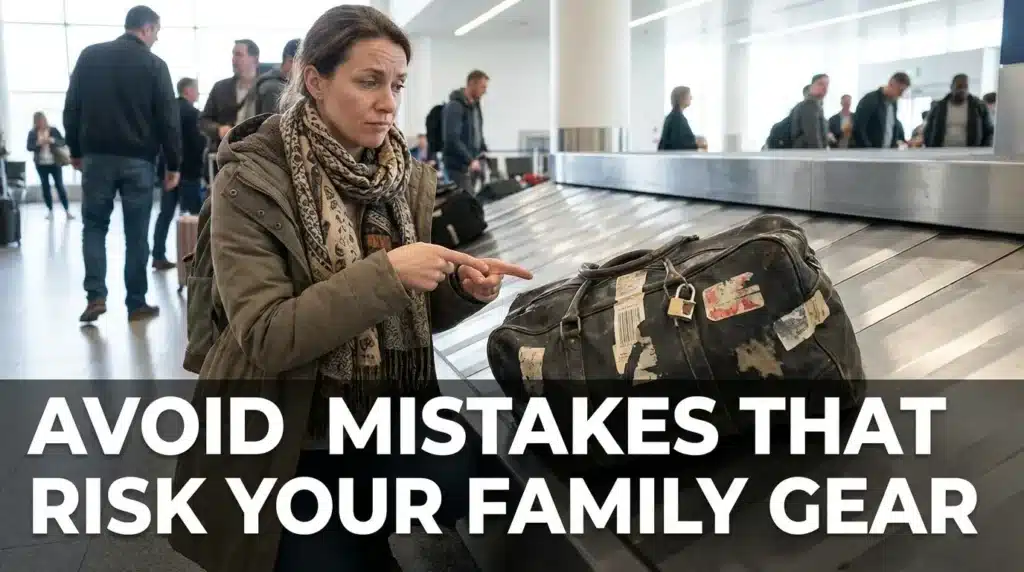
Hidden Tricks to Make Your Bags Untouchable
We have already talked about locks and trackers. Now, I want to share some pro-level secrets that most travelers never think about.
These steps add layers of safety that make your luggage a very difficult target for any thief.
When you use these methods, you are not just lucky; you are prepared.
One of the smartest things you can do is the “Internal Layering” method. Thieves usually have less than thirty seconds to dig through a bag.
They usually reach for the top layer or feel around the edges for small boxes. I suggest you place your least valuable items on the top and bottom.
Put your thickest clothes, like jeans or jackets, around the sides of the suitcase. This creates a protective wall for the items in the center.
If someone manages to unzip the bag slightly, all they will see and feel are old t-shirts or bulky sweaters. They won’t find your expensive shoes or backup gear quickly.
Another secret is using secondary fasteners. On top of your TSA lock, use a bright, heavy-duty zip tie to hold the zipper pulls together.
While a thief can cut a zip tie, it requires a tool and makes a loud “snap” sound. Most airport thieves want to be silent and fast.
Seeing a zip tie tells them that this owner is extra careful. It also acts as a visual signal for you at the carousel.
If that zip tie is missing when the bag comes out, you know someone has been inside.
You can then immediately alert airport police before you even touch the bag.
I also highly recommend taking a “Packing Video” before you close your bag at home.
Use your phone to record a quick sixty-second video of everything inside.
Show the brand of the bag, the lock you are using, and the items you have packed. This is your ultimate proof if you need to file an insurance claim.
Most people struggle to remember exactly what they packed after a long flight. Having this video on your phone gives you huge confidence when talking to airline agents.
To keep these results for the long term, you should make these steps a family habit.
Teach your kids to never leave the bags alone, even for a second, at the check-in desk.
Consistency is the key to safety. If you do this every single time you fly, it becomes second nature and your risk of loss drops to almost zero.
Huge Mistakes That Put Your Family’s Gear at Risk
Even the most careful parents can make simple mistakes that invite trouble. These errors might seem small, but they can lead to a total loss of your belongings.
If you want to keep your family safe, you must avoid these five common traps at all costs. Avoiding these will save you from a lot of stress and sadness.
1. Posting Bag Photos on Social Media Too Early
We all love to share our travel excitement online. However, posting a photo of your packed bags or your boarding pass is a huge mistake.
Thieves can see your name and your travel dates. Some can even use the barcode on your ticket to track your luggage through the airline system.
Wait until you are back home to share those photos. Don’t give anyone a digital map to your valuables while you are in the air.
2. Leaving Old Airline Tags on the Bag
Many people keep old stickers and tags on their bags as a sign of where they have been. This is very dangerous for your luggage safety.
These old barcodes can confuse the automated scanners at the airport. Your bag might end up on a plane to a different country by mistake.
A lost bag is much easier to steal than one that arrives on time. Always peel off every single old sticker before you go to the airport.
3. Packing High-Value Electronics in Checked Bags
This is perhaps the biggest mistake of all. Never, ever put laptops, tablets, or expensive cameras in your checked luggage.
Checked bags go through many hands and many dark corners. These items are the main targets for baggage handlers who might have bad intentions.
Keep all your electronics in your carry-on bag. If it is too heavy, rethink what you are bringing, but never let them out of your sight.
Just like learning child pool safety to prevent drowning keeps your children safe near open water on trips, avoiding high-value packing saves you from heavy heartbreak.
4. Buying Suitcases That Look Too Expensive
It is tempting to buy a bag that looks like a million dollars. But a flashy, gold-trimmed suitcase is a billboard for thieves.
It tells everyone that the person who owns this bag probably has expensive things inside. A plain, sturdy, and slightly worn-out bag is much safer.
You want your luggage to look boring and difficult to deal with.
Professional thieves go for the high-end brands because they want the best “reward” for their risk.
5. Walking Away Before Checking Your Bag
Once you drop your bag at the check-in counter, don’t just walk away instantly.
Wait those extra thirty seconds to see it move down the belt and through the curtain.
Sometimes the tag doesn’t stick properly, or the bag gets stuck right at the start.
If you are already gone, the bag might sit in a publicly accessible area for a long time.
By staying for a moment, you ensure the bag is officially in the “secure” zone of the airport. This small habit provides peace of mind for the rest of your day.
Before leaving your children unattended with any staff at an airport lounge or destination resort, it is smart to know how to vet a babysitter or local supervisor for complete safety.
Answers to Your Top Luggage Safety Questions
Is it better to use a hard-shell or a soft-sided suitcase?
For safety from theft, a hard-shell bag is almost always better. It cannot be easily cut with a knife, and most of them use clips instead of zippers. This makes it much harder for a thief to peek inside quickly.
Should I use a TSA lock or a regular padlock?
Always use a TSA-approved lock. If you use a regular lock, security officers will likely cut it off if they need to check your bag. This leaves your suitcase completely open for anyone to reach into for the rest of the trip.
Does wrapping my bag in plastic really help?
Yes, it is one of the best deterrents available. It takes a long time to remove, and it is impossible to put back perfectly. A thief will almost always choose an unwrapped bag over a wrapped one because they don’t want to leave evidence.
What should I do if I see my bag has been opened?
Do not leave the airport. Go straight to the airline’s baggage office and the airport police. Take photos of the damage and the bag immediately. If you walk out of the doors, the airline can claim the theft happened after you left.
Are GPS trackers like AirTags worth the money?
Absolutely. They are a very cheap way to have real-time info on your bag. While they don’t stop a thief, they tell you exactly where your bag is. This info is incredibly helpful when you are reporting a lost or stolen bag to the authorities.
Secure Your Bags and Enjoy Your Journey
Protecting your family’s luggage is not about being afraid; it is about being smart and proactive.
By taking a few extra minutes at home, you can prevent a huge disaster later.
We have looked at everything from choosing the right bag to using advanced layering tricks. These steps are simple, but they are extremely powerful when used together.
You now have the tools to turn your suitcases into secure vaults. No more worrying at the baggage carousel or wondering if your gifts made it through.
Start using these tips on your very next trip. Get the kids involved and make it a fun part of your travel routine.
When you know your things are safe, you can focus on what really matters—making beautiful memories with your family.
Safe travels are happy travels. Take these actions today and give your family the security and peace they deserve every time they fly.
Disclaimer: This guide is for informational purposes only. While these tips significantly reduce the risk of luggage theft, no method is 100% foolproof. Always check with your airline and local airport for their specific security rules and insurance policies. We are not responsible for any loss or damage that may occur during your travels. Keep your most valuable items and documents in your personal carry-on at all times.