I still remember the first time my son walked to the local park by himself. I spent the entire thirty minutes pacing around the kitchen, checking my phone every ten seconds just in case he called. It made me realize that my own fear wasn’t doing anything to help him stay safe; it was just making both of us a nervous wreck. I knew right then that I had to stop worrying and start giving him the actual tools he needed to handle the world without me.
You hand your teenager the car keys, or you watch them walk to the bus stop alone for the first time, and something in your chest tightens. This feeling is normal.
You know they are growing up. You also know the world does not always play fair. Somewhere between wanting to protect them and wanting them to grow into capable adults, most parents feel stuck.
That gap between “I want to keep them safe” and “I can’t be everywhere” is exactly where good safety education steps in.
Why Good Intentions Alone Don’t Protect Your Teen
Most parents try their best, but good intentions without a clear plan often fall short. Here’s what usually goes wrong:
- Vague warnings instead of clear rules. Saying “be careful out there” doesn’t teach a teen what to actually do in a scary moment.
- One conversation, then silence. Safety talks work best as an ongoing habit, not a single lecture delivered once and forgotten.
- Fear-based messaging that backfires. Teens who are only told “don’t do this or something bad will happen” often tune out instead of listening.
- Outdated advice. Rules that worked for landlines and playgrounds don’t cover today’s risks like location-sharing apps or online strangers.
According to the American Academy of Pediatrics, parents should focus on teaching bullying, online safety, and healthy relationship skills as core parts of a teen’s development, rather than relying on scattered warnings.
What’s Really at Stake for Your Teen’s Confidence
When safety isn’t taught clearly, teens don’t just face physical risk. Their mental confidence takes a hit too.
- A teen who has never practiced saying “no” to peer pressure often freezes when it matters most.
- Teens who don’t know how to read a risky situation may either become overly anxious or, just as dangerous, completely dismissive of real threats.
- Without a plan, even a minor incident — a scary rideshare, an aggressive stranger, an unsafe party — can shake a teen’s sense of control over their own life.
The goal isn’t to make your teen afraid of the world. It’s to make them capable inside it.
That distinction matters. A teen who understands personal safety rules for teens doesn’t walk around scared. They walk around prepared, which actually looks a lot like confidence from the outside.
This is where a structured approach helps. Instead of random advice dropped at random times, you can build a simple, repeatable framework your teen will actually remember and use. If you haven’t already, our full personal safety guide is a solid place to see how these core principles apply across every age and situation, not just for teens.
A Practical Framework for Teaching Teen Safety at Every Age
Teaching personal safety tips for teenagers works best when you break it into clear, doable steps rather than one overwhelming talk. Here are the three foundations every parent should cover first.
Step 1: Teach Situational Awareness, Not Paranoia
The single biggest safety skill a teen can build is simply paying attention to their surroundings.
Teaching your teen to pay attention doesn’t have to be scary or complicated. Watch this short guide to see a few simple ways they can stay aware of their surroundings without feeling like they are always in danger.
This means noticing exits in a new place, keeping headphones at a lower volume in public, and trusting that gut feeling when something seems off. It’s a habit, not a personality trait, so it has to be practiced.
Encourage your teen to look up from their phone when walking alone, especially at night or in unfamiliar areas. A useful trick: ask them to name three things around them every so often — it keeps their brain actively scanning instead of tuning out.
For a deeper breakdown of this exact skill, our guide on situational awareness for personal safety walks through real scenarios teens actually face, from parking lots to parties.
Step 2: Build Trust in Their Own Instincts
Teens are often taught to be polite above everything else. That instinct can work against them in unsafe moments.
Give your teen explicit permission to be “rude” if it means staying safe — hanging up on an uncomfortable call, walking away mid-conversation, or refusing to help a stranger who asks for directions in a car. Politeness should never outrank safety.
Practice this with simple role-play. Ask “what would you do if…” questions during car rides or dinner, and let them talk through the answer out loud. This builds muscle memory for real situations. Our piece on trusting your intuition for personal safety offers more scripts and examples you can use together.
Step 3: Create a Judgment-Free Emergency Plan
I once made a huge mistake by getting angry when my daughter called me for a ride from a party she wasn’t supposed to be at. Because I scolded her that night, she didn’t call me the next time she felt uncomfortable, which terrified me when I found out later. Now, we have a firm “safety first” rule: if she needs to get out of a bad spot, I will come get her with no questions asked and no lectures until the next day.
Every teen needs a clear, judgment-free way to reach you or get out of a bad situation, no questions asked in the moment.
This can be a code word they text you that means “come get me, no explanation needed.” It can also be a rule that they can always call for a ride home, even at 2 a.m., without punishment for whatever led to the situation.
Safety apps can support this plan without hovering over every move. A few reliable options are covered in our roundup of personal safety apps for staying connected with loved ones, which many families use for check-ins during commutes, night shifts, or solo outings.
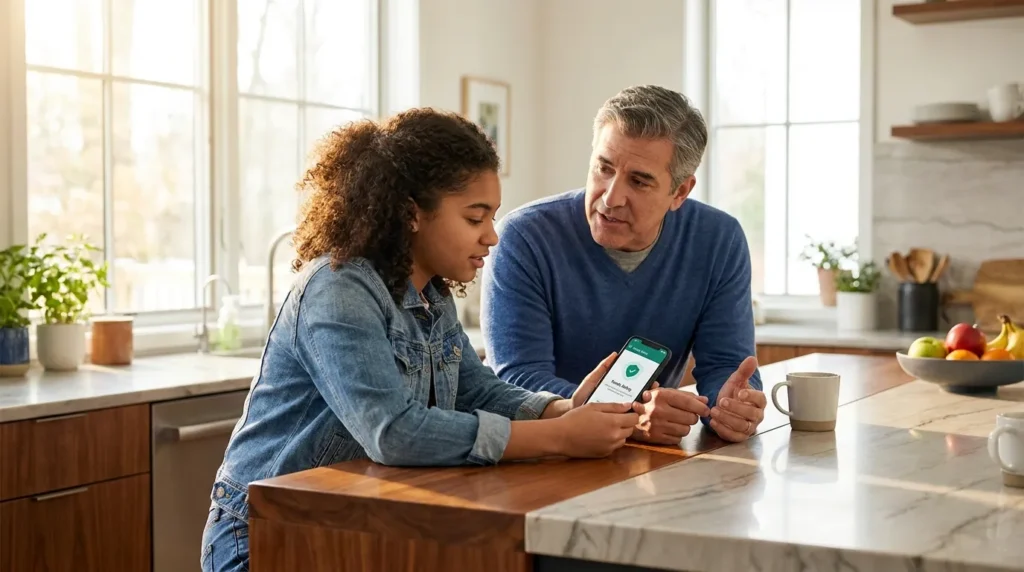
Talk to your teen about why you use tracking apps. Explain that these tools are a safety net for emergencies, not a way to spy on their private life. When they feel like you trust them, they are much more likely to keep the app turned on and follow the rules you’ve set.
A national survey by Pew Research Center found that most teens now carry smartphones and are online nearly constantly, which shapes how safety conversations need to happen today — meaning your plan has to account for both the physical world and the digital one from day one.
Digital Safety and Home-Alone Rules Every Teen Needs
Your teen’s safety plan isn’t complete until it covers the hours they spend online and the time they spend home without you. These two areas cause more quiet stress for parents than almost anything else.
Step 4: Set Clear Rules for Online and Social Media Safety
Most teens live a large part of their social life through a screen. That makes digital safety just as important as street safety.
Start with the basics: teens should never share their home address, school name, or daily schedule publicly on social media. Predators and scammers often piece together small details over time, not one big reveal.
Talk openly about “stranger danger” online too. It doesn’t look the same as it did offline — it might be a fake profile, a flattering DM, or someone pretending to be a peer. The FBI’s guidance on protecting children online notes that offenders often build trust slowly before asking a young person to meet in person or share private images.
Set a simple household rule: no meeting online contacts in person without a parent present, no exceptions, no matter how “normal” the person seems.
For teens who commute or travel through busy areas, digital habits connect to physical safety too. Our guide on staying safe in large crowds and public events covers how phone use and situational awareness overlap in real-world settings like concerts or transit hubs.
Step 5: Build a Home-Alone Safety Routine With Smart Tools
More teens are spending afternoons or evenings home alone than ever before. A clear routine makes this far less risky.
Teach your teen to never open the door for anyone they don’t recognize, even someone claiming to be a delivery driver or utility worker. A quick phone photo of the person through a peephole or camera, sent to you, takes seconds and adds real protection.
This is where smart home security genuinely earns its place. A smart door lock lets your teen lock up remotely if they forget, and it gives you a real-time log of who came and went. Paired with a basic door or window sensor, you get an alert the moment something opens that shouldn’t.
A teenager doesn’t need a security system built for a bank. They need simple tools that remove guesswork during the moments that matter most.
GPS location-sharing apps fill a similar gap outdoors. They aren’t about tracking your teen’s every move — they’re about knowing they arrived safely, especially on public transport or during a night shift commute. Our guide on public transport safety tips for commuters breaks down how to combine these tools with basic street awareness.
Reading Your Teen’s Environment Like a Trained Observer
Once the basics are in place, the real skill teens need is spotting trouble before it becomes a crisis. This is what separates a nervous teen from a prepared one.
Teach the “two-exit rule.” Whenever your teen enters an unfamiliar space — a party, a mall, a rideshare pickup spot — have them quickly identify two ways out. This single habit takes seconds but rewires how their brain scans a room.
At parties or social gatherings, teach your teen to never leave their drink unattended. If they set their glass down to go to the bathroom or dance, they should just get a fresh one when they return. It is a simple habit that protects them from the risk of drink spiking.
Practice the “delay tactic” for uncomfortable moments. If someone makes a teen uneasy, they don’t need a dramatic exit. A simple stall — checking a phone, pretending to text someone, walking toward a crowded area — buys time to think clearly and often ends the interaction on its own.
The teens who handle risky moments best aren’t the loudest or most aggressive. They’re the ones who paused, assessed, and chose a smart next move.
Turning Solo Trips Into Low-Risk Routines
Independence usually starts with small trips — walking to a friend’s house, taking public transit, or jogging in the neighborhood. These moments deserve their own mini-plan.
If your teen uses apps like Uber or Lyft, teach them the “check your ride” habit. They should always match the license plate and the driver’s photo before getting in. Make it a rule that they must share their live trip status with you as soon as the ride starts so you can see their progress in real-time.
Before your teen heads out alone, walk through three quick questions together: Where are you going? When will you be back? Who can you call if something feels wrong? This isn’t about control. It’s about giving them a mental script to fall back on under stress.
If your teen prefers running or cycling in the early morning or evening, the timing-specific advice in our guide on staying safe running or cycling at night is worth reviewing together.
Handling Confrontation Without Escalating It
Not every unsafe moment involves a stranger. Sometimes it’s peer pressure, an aggressive classmate, or an uncomfortable comment that crosses a line.
Teach your teen the difference between de-escalation and confrontation. A calm, firm “I’m not comfortable with this” often works better than arguing or trying to win a conflict. Walking away is not weakness — it’s control.
If the situation involves ongoing harassment, whether in person or at school, it helps for your teen to know their options ahead of time. Our resource on handling street harassment safely offers scripts and response strategies that apply well beyond just public spaces. For older teens who want a legal, age-appropriate layer of protection, our overview of legal self-defense tools for personal safety explains what’s actually allowed in most US states.
None of these advanced habits require your teen to become someone they’re not. They just add a beat of thinking time before reacting, which is often all it takes to stay safe.
Where Parents and Teens Go Wrong Without Meaning To
Even well-meaning families make mistakes when building a safety routine. Here are the ones we see most often, and why they matter.
- Treating safety as a one-time talk. A single conversation at age 13 won’t cover the situations a 16-year-old actually faces. Safety habits need refreshing as independence grows.
- Focusing only on strangers. Most real risks to teens involve people they already know — classmates, acquaintances, or online contacts posing as peers. Ignoring this leaves a major gap.
- Punishing honesty. If a teen gets in trouble every time they call for help, they’ll stop calling. The emergency plan only works if it’s judgment-free.
- Assuming apps replace conversation. Location-sharing tools and smart locks help, but they can’t teach judgment. Relying on tech alone leaves teens unprepared when the device isn’t available.
- Skipping digital boundaries. Many parents cover street safety in detail but barely mention social media risks, leaving teens exposed in the space where they spend the most time.
Left unaddressed, these gaps don’t just raise physical risk. They also chip away at trust between parents and teens, making kids less likely to speak up the next time something feels wrong. The National Center for Missing & Exploited Children notes that open, ongoing communication is one of the strongest protective factors for young people, far more effective than restrictive rules alone.
Frequently Asked Questions
What are the most important personal safety rules to teach a teenager?
Focus on three basics first: trusting their instincts, knowing how to reach you in any situation without fear of punishment, and staying aware of their surroundings instead of being absorbed in their phone.
What should I teach my teen about staying safe online and on social media?
Teach them to keep personal details like their address and schedule private, question flattering messages from strangers, and never meet an online contact alone without a parent knowing first.
How can I keep my teenage daughter safe when she’s out alone?
Practice situational awareness together, agree on a check-in system for outings, and make sure she knows it’s always okay to leave a situation early, even if it feels socially awkward.
What safety skills should a teen know before staying home alone?
They should know not to open the door for strangers, how to use a smart lock or security camera if you have one, and who to call immediately in an emergency.
How do smart home devices like door locks help protect teens at home?
Smart locks let teens secure the house remotely if they forget, give parents visibility into who enters, and remove the risk of a lost or copied physical key.
Small, Consistent Habits Build a Genuinely Safer Teen
None of this requires turning your home into a training camp. Small, repeated habits build real confidence far better than one big lecture ever could.
Start with one conversation this week. Pick a single habit from this guide — the two-exit rule, the judgment-free check-in call, or a simple online privacy rule — and practice it together.
Your teen doesn’t need to be fearless. They need to feel equipped, trusted, and ready to make good calls when you’re not standing next to them. That’s a goal you can start working toward today, one small conversation at a time. According to guidance from StopBullying.gov, teens who feel supported at home are significantly more likely to report problems early, which remains one of the most reliable ways to prevent small issues from becoming serious ones. If you want to build this awareness across your whole household, our roundup of essential tips for a secure life offers a good starting point for turning these individual habits into a consistent family routine.
You don’t have to be a perfect parent to raise a safe and confident child. Just start by talking about one small habit from this list today, like the two-exit rule or a secret code word. Watching your teen walk out the door with a solid plan in their head is the best peace of mind you can ever have as a parent.
Safety Disclaimer: This article is intended for general educational purposes only and does not replace professional guidance from law enforcement, licensed security consultants, child safety experts, or legal advisors. Safety needs vary by individual, household, and location. Readers should use their own judgment and consult qualified professionals or local authorities for advice specific to their situation.