Exercising at night often feels like the only option for many of us. You work all day, take care of the family, and finally, the sun goes down.
This is your time to hit the road and clear your mind.
However, the dark streets bring a lot of hidden risks. Every year, thousands of pedestrians and cyclists face serious road accidents simply because they were not visible.
According to NHTSA bicycle safety statistics, a significant percentage of cycling fatalities occur during low-light hours.
This is why understanding CDC pedestrian safety guidelines is so important for keeping yourself protected after dark.
The fear of oncoming cars, uneven paths, or personal safety can make your workout very stressful. Instead of feeling refreshed, you might feel anxious every time a car passes by.
This is a common struggle for night owls who love to stay active but want to get home safely.
Why Most People Fail to Stay Safe at Night
Many people think they are doing enough, but they often miss the most important parts of nighttime protection. Here is why mistakes happen on empty streets:
- Wrong Clothing Choices: Most runners think wearing a white shirt is enough. In reality, white looks grey or black in low light to a driver.
- Ignoring Traffic Rules: Some runners think the road belongs to them at night because there are fewer cars. This leads to dangerous habits like running in the middle of the street.
- Distraction Issues: Using loud headphones at night is a big mistake. It stops you from hearing approaching vehicles or people around you.
- Bad Route Planning: People often choose the same path they use during the day. They don’t realize that a safe park in the morning can be very dark and isolated at night.
The Mental Toll of Unsafe Night Workouts
If you don’t feel safe, you won’t enjoy your workout. The constant worry about “what if” situations can ruin your focus and progress.
You might find yourself looking over your shoulder more than focusing on your pace. This lack of peace of mind often leads people to quit their fitness journey entirely.
When you feel vulnerable, your confidence drops. You deserve to feel strong and secure, no matter what time you choose to exercise.
Taking small, smart steps can change this feeling of fear into a feeling of power.
“True athletic confidence isn’t just about pushing your physical limits. It is about knowing you have built an invisible shield of safety around your nightly routine.”
How to Make Yourself Visible to Everyone on the Road
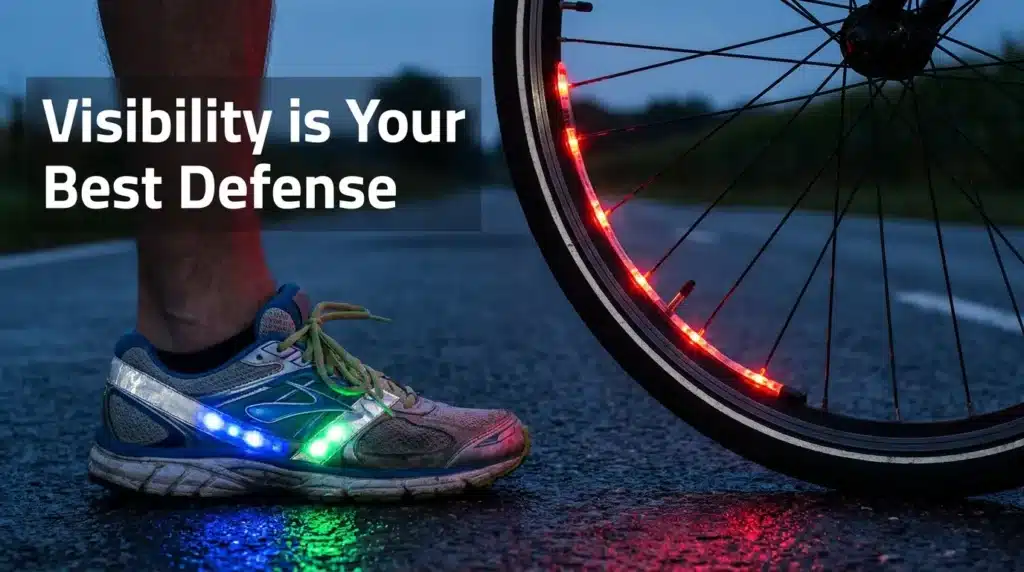
Visibility is your first line of defense. If a driver cannot see you, they cannot avoid you. You need to transform yourself into a moving light source.
Wear High-Visibility Gear
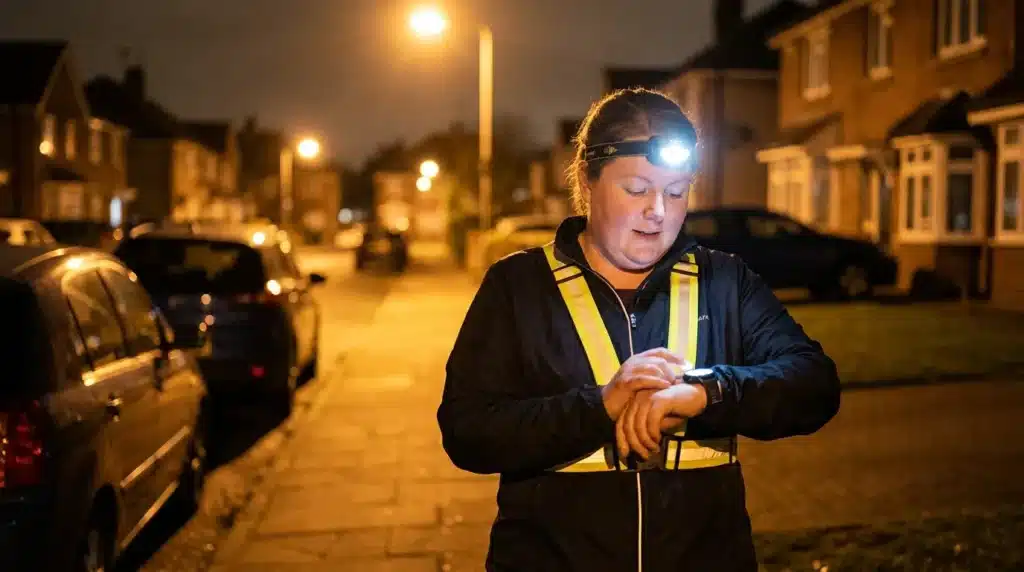
Don’t just rely on bright colors. You need reflective materials that bounce headlights back to the driver’s eyes.
Look for vests or jackets that have 360-degree reflectivity. This ensures you are seen from the front, back, and sides.
Small reflective strips on your shoes or ankles are also great because they move, which catches a driver’s attention faster.
Use Active Lighting Systems
Reflective gear only works if a car’s headlights hit it. You also need your own lights to guide your path.
For runners, a LED headlamp is a game-changer. It lights up the ground in front of you so you don’t trip over cracks.
For cyclists, a bright white front light and a blinking red back light are non-negotiable safety items. Always check your battery levels before heading out.
Choose the Right Light Settings
Most modern lights have a pulse or flash mode. Use these to stand out from the streetlights!
A flashing light is much easier for the human eye to notice than a steady one. It instantly signals to others that a moving person is on the road.
However, make sure your front light isn’t so bright that it blinds oncoming traffic. You want to be seen, not cause an accident.
Smart Route Selection for Night Safety
Where you run or cycle is just as important as what you wear. Nighttime changes the environment completely.
Stick to Well-Lit Paths
This sounds simple, but many people ignore it to find quiet trails. Always choose routes with consistent street lighting.
Shadows can hide potholes, black ice, or even people. Avoid shortcuts through dark alleys or unlit parks.
Staying in the light keeps you visible and is a core part of the safety tips for night shift workers who commute on foot.
Know Your Surroundings
Try to use routes that you have already explored during the day. You should know exactly where the sidewalks end and where traffic gets heavy.
If you must try a new path, do it when the sun is up first. This way, you won’t get lost in the dark or end up in a dangerous dead-end street.
Avoid High-Speed Roads
At night, drivers often drive faster and are less alert. Stay away from roads with high speed limits or narrow shoulders.
If there is a dedicated bike lane or a wide sidewalk, use it. The more physical distance you put between yourself and moving cars, the safer you will be.
The Importance of Using Your Senses
Your eyes and ears are your best safety tools. At night, you have to be extra sharp.
Put Away the Headphones
We all love listening to music or podcasts while we exercise, but at night, this can be very dangerous.
You must practice the core principles of situational awareness to hear and spot threats before they get close.
If you really want music, use bone-conduction headphones or keep the volume very low and use only one earbud.
Look Twice Before Crossing
Never assume a driver sees you, even if you are at a marked crosswalk. Wait for the car to stop completely or make eye contact with the driver.
In the dark, depth perception for drivers is much lower. Give them extra time to react to your presence.
Trust Your Instincts
If a certain street or a person makes you feel uneasy, turn around immediately. Your gut feeling is usually right.
It is always better to change your route than to take an unnecessary risk. Safety is always more important than finishing a specific mile or lap.
Practical Habits for Every Night Athlete
Adding a few small habits to your routine can make a huge difference in your overall safety.
Tell Someone Your Plan
Before you leave the house, let a friend or family member know your exact route and when you expect to be back.
You can use location-sharing features, but make sure to review the hidden settings to stop app tracking to keep your personal data private from third-party networks.
Carry Your Identification
Always have some form of ID with you. This could be a small card in your pocket or a wearable ID tag.
Include your name, an emergency contact number, and any important medical info. It is a small thing that provides a huge safety net in case of an emergency.
Keep Your Phone Charged
Your phone is your lifeline. Make sure it has enough battery to make an emergency call or use GPS.
Carry it in a secure pocket or an arm band. Don’t use it for scrolling while you are moving—keep your eyes on the road.
Understanding Traffic Flow at Night
Traffic behaves differently when the sun goes down. You must adapt your behavior to stay safe.
Run Against Traffic, Cycle With It
If you are running, always face the oncoming cars. This allows you to see them and move out of the way if they get too close.
If you are cycling, you are a vehicle. You must follow the same rules as cars and ride in the same direction as traffic. Always use hand signals so drivers know where you are going.
Be Predictable
Don’t make sudden turns or jumps into the street. Drivers cannot react as quickly in the dark.
Move in a straight line and signal your intentions early. The more predictable you are, the less likely you are to be involved in a collision.
Watch for Parked Cars
Sometimes the danger isn’t from moving cars, but from parked ones. Be careful of “dooring.”
This happens when someone opens a car door right as you are passing. Keep a safe distance from parked cars to give yourself room to react.
The Role of Technology in Safety
Technology has made exercising at night much safer than it used to be. You should use these tools to your advantage.
Safety Apps
There are apps designed specifically for runners and cyclists. Some have a panic button feature that alerts emergency contacts if you stop moving.
You can also use the best personal safety apps for families to allow real-time tracking so your loved ones can see your progress on a map.
Smart Wearables
Many fitness watches now have built-in safety features. They can detect a fall and automatically send your location to emergency services.
Investing in a good smartwatch can give you an extra layer of protection and peace of mind.
Rechargeable Lights
Old battery-powered lights often faded slowly, leaving you in the dark without realizing it. Modern USB-rechargeable lights stay bright until the very end.
They are also much cheaper to run in the long term. Make it a habit to plug them in as soon as you finish your workout.
Advanced Safety Strategies for Night Runners and Cyclists
Mastering Environmental Awareness and Gear Maintenance
Moving beyond basic visibility involves understanding how your environment changes as the night progresses. One major factor people often overlook is how the temperature drops after the sun disappears.
Even if it feels warm when you start, you can quickly lose body heat once you stop moving. This is why you should dress in layers using thin, moisture-wicking fabrics.
Another advanced tip is to pay close attention to the shadows. In the dark, depth perception is different, and shadows can hide potholes or slippery patches of oil.
If you see a dark spot on the road, assume it is an obstacle and move around it. Carrying a secondary, smaller backup light is also a smart move.
Building a Community-Based Safety Net
Exercising alone at night can be peaceful, but there is undeniable safety in numbers. Joining a local running or cycling group that meets in the evening is a great way to stay safe.
Drivers are much more likely to see a group of five or ten people with lights than a single person. If you cannot find a group, try to find a safety buddy.
This is someone you check in with via text message when you start and when you finish. Knowing someone is waiting for your “home safe” message adds a layer of security.
How to Maintain a Safe Routine for the Long Term
To keep getting great results from your night workouts, you need to turn safety into a habit. This starts with a pre-flight checklist.
Every evening, spend two minutes checking your gear. Are the reflectors clean? Are the lights bright? Is your phone battery above fifty percent?
Also, rotate your routes. While it is good to know your path, using the exact same street at the exact same time every night can make you a target for unwanted attention.
Change your start time by fifteen minutes or take a slightly different turn every few days. This keeps your routine unpredictable and fresh.
Common Errors That Put You at Risk
Many people make the mistake of assuming that if they can see a car, the driver can see them. This is a very dangerous thought.
Car headlights are aimed down at the road, not up at your chest. Unless you have reflective gear on your lower body, like your shoes, the driver might not notice you until it is too late.
Another big error is wearing dark colors under a reflective vest. If the vest slips or you take it off because you are hot, you suddenly become invisible. Always wear bright colors as your base layer.
A third mistake is ignoring the weather forecast. Rain or fog at night makes visibility almost zero for drivers. If the weather is bad, it is much smarter to take your workout indoors.
Finally, do not rely solely on your phone’s flashlight. It is not designed to be a safety light for exercise. The beam is too wide and will drain your phone battery, leaving you stranded.
Answers to Common Night Safety Questions
Is it better to use white or yellow lights for night exercise?
For your front light, a bright white light is best because it mimics daylight. For the back, always use a blinking red light. Drivers globally recognize red as a warning signal to slow down.
What should I do if a stray dog approaches me at night?
Stop running or cycling immediately. Do not scream or try to run away, as this can trigger the dog’s chase instinct. Stand still, keep your hands at your sides, and avoid direct eye contact. Slowly back away once the dog loses interest.
Are there specific apps that improve safety at night?
Yes, several apps allow for live location sharing and incident detection. Some even have features where you hold a button while you feel unsafe; if you let go and don’t enter a code, the app calls emergency services.
Can I wear black if I have a very bright headlamp?
It is not recommended. A headlamp only shows your position from the front. If a car comes from the side or back, they won’t see your black clothing. Always pair your lights with reflective materials.
How do I handle glare from oncoming car high-beams?
Do not look directly into the lights. Instead, look down and toward the right edge of the path or sidewalk. This helps you stay on track without being blinded by the bright glare.
Taking Charge of Your Nightly Fitness Journey
Exercising after the sun goes down is a wonderful way to clear your mind and stay fit. It offers a peace and quiet that you simply cannot find during the busy daylight hours.
By following these safety steps, you take away the worry and replace it with confidence. You don’t have to be afraid of the dark when you are the brightest thing on the road.
Every time you put on your reflective gear and check your lights, you are making a choice to protect your health and your life. Start small tonight.
Check your gear, pick a well-lit path, and tell a friend you are going out. You have the power to stay safe and strong, no matter when you choose to hit the road.
Disclaimer: The information provided in this article is for educational purposes only. Exercising at night carries inherent risks. Always follow local traffic laws and prioritize your personal safety. The author and the website are not responsible for any accidents or injuries that may occur while following these tips.