Working while the rest of the world sleeps is a brave choice. However, it comes with a set of challenges that daytime workers never have to think about.
Imagine walking to your car or a bus stop at 3:00 AM. The streets are empty, the shadows are long, and every small sound feels magnified. This is the daily reality for millions of healthcare workers, security guards, and factory staff.
For two years, I worked the 11 PM to 7 AM shift at a local clinic, and I still remember the cold sweat I felt every time I walked out to my car at 3 AM. I used to grip my keys so tightly my hands would hurt, constantly looking over my shoulder at every tiny shadow. It took me months of feeling terrified before I realized I couldn’t keep living in fear—I needed a real, practical plan to get home safely every night.
The feeling of being watched or the worry of a car following you is not just “paranoia.” It is a natural response to a higher-risk environment. According to psychological workplace assessments published by Forbes, chronic environmental stress can severely impact long-term productivity.
Many night shift workers feel a deep sense of isolation. When you commute in the dark, you are physically more vulnerable because there are fewer “eyes on the street.”
This lack of people means that if something goes wrong, help might not be nearby. For many, this leads to a constant state of low-level stress. You might find yourself walking faster, clutching your keys tightly, or constantly looking over your shoulder.
This stress doesn’t stay on the street; it follows you to work and even back home, making it hard to relax or sleep. To manage this state effectively, developing a strong mental framework through a situational awareness personal safety guide can be highly beneficial.
Why Typical Safety Advice Often Fails
Most people look for safety tips online but end up more confused or worried. This is because a lot of the information out there is not practical for someone working odd hours.
In behavioral risk analysis, a concept often discussed on Investopedia regarding risk mitigation, relying on generic models without personal customization usually leads to failure. Here is why common solutions don’t always work for late-night workers:
- Generic Advice: Most guides tell you to “avoid dark areas,” but your workplace parking lot or bus stop might only be in a dark area.
- Over-Reliance on Gadgets: People are told to buy expensive alarms or sprays, but they are never taught how to use them under pressure.
- Ignoring Fatigue: Many guides forget that a night shift worker is often exhausted, which slows down their reaction time significantly.
- Lack of Real-World Scenarios: Advice often sounds like it’s for a movie, not for a tired nurse trying to get home after a 12-hour shift.
- Victim Blaming: Some tips focus so much on what you should wear or do that they make you feel like any trouble is your fault.
How Commuting Stress Breaks Your Confidence
The constant worry about your nightly commute does more than just make you jumpy. It has a real impact on your mental health and professional life. Here is how it can hurt you:
- Sleep Quality Suffers: If you are “on edge” during your trip home, your brain stays in a state of high alert. This makes it very hard to fall into a deep, restful sleep during the day.
- Reduced Focus at Work: When a large part of your brain is worried about how you will get home safely, you have less mental energy for your actual job tasks.
- Social Isolation: You might start turning down extra shifts or career opportunities because you simply don’t want to deal with the commute at certain hours.
- Physical Tension: Carrying that level of stress leads to headaches, neck pain, and a weakened immune system over time.
- Loss of Freedom: You begin to feel like a prisoner of your schedule, unable to move through your city with the same ease as a daytime worker.
This struggle is real, but it doesn’t have to stay this way. Understanding the risks is the first step toward taking control. We are not just talking about “being lucky.”
We are talking about building a solid system that protects you. When you have a plan, that heavy feeling in your chest starts to lift.
You stop being a person who is “hoping for the best” and start being a person who is prepared for anything. This transition from fear to preparation is what restores your peace of mind and gives you back your confidence.
Building a 7-Step Bulletproof Plan for Your Nightly Commute
To change your experience, you need to change your approach. You cannot control the dark, and you cannot control who else is on the street. However, you can control your actions, your route, and your level of preparation. Let’s look at the 7 key steps of a professional-grade safety plan for night shift workers.
1. Optimize Your Commute Route
Most people take the same way to work every single day because it is the fastest. In the world of night shift safety, the fastest way is not always the best way. You need to think like a security expert when choosing your path.
Prioritize Light Over Distance: It is always better to walk an extra five minutes if it means staying on a street with bright, working streetlights. Darkness is a blanket for bad intent. By staying in the light, you make yourself a “hard target.” You can see what is ahead of you, and others can see you too.
Identify “Safe Havens”: As you commute, look for places that are open 24/7. This could be a petrol station, a late-night diner, or a hospital entrance. If you ever feel like someone is following you, you should already know exactly where to turn to find people and cameras. Never head toward your home or car if you feel unsafe; head toward a Safe Haven.
Vary Your Timing and Path: If possible, don’t be 100% predictable. If a person with bad intent is watching, they look for patterns. If you always walk the exact same sidewalk at exactly 11:02 PM, you are easy to track. Even small changes, like walking on the other side of the street or leaving five minutes earlier, can disrupt a stalker’s plan.
2. Manage Nighttime Fatigue
One of the biggest risks for night shift workers is their own body. Human beings are not naturally nocturnal. Between 2:00 AM and 5:00 AM, our bodies hit a “circadian low.” This means your reaction time is slower, your vision is less sharp, and your brain is “foggy.”
- The Danger of “Tunnel Vision”: When you are tired, your brain naturally starts to focus only on the ground in front of you. This is a survival mechanism to save energy, but it is dangerous for safety. You must consciously force yourself to look up and scan the horizon.
- Avoid the “Trance”: If you are driving home after a long night shift, you might experience “highway hypnosis.” This is when you drive for miles but don’t remember doing it. To stay safe, keep the air in your car cool and listen to engaging content like a podcast or upbeat music. If you feel yourself nodding off, stop. A ten-minute nap in a safe, well-lit parking lot is better than a crash.
- Hydration and Light Snacks: Being dehydrated makes fatigue much worse. Drink water before you start your commute. A small, healthy snack can also give your brain the glucose it needs to stay alert during the trip home. Remember, an alert mind is your best safety tool. If your brain is “off,” all the pepper spray in the world won’t help you.
Early on, I made the mistake of talking on the phone during my entire walk to my car, thinking it kept me safe. But after a close call where someone snuck up right behind me without me noticing, I realized my phone was actually distracting me. Now, I keep my phone tucked away, my head up, and one earbud out so I can actually hear what is happening around me.
3. Use Safety Tech Wisely
Technology can be a great friend to the night worker, but only if used correctly. Many people think that being on a phone call makes them safe. This is often a myth. If you are deep in a conversation, you are not paying attention to the person walking behind you.
Use “Check-In” Apps: Instead of talking on the phone, use apps that track your location and alert a friend when you arrive home. Features like “Emergency SOS” on modern smartphones allow you to call for help without even looking at the screen. Set these up before you leave work, not while you are walking.
Digital Footprint Awareness: Be careful about what you post on social media. If your profiles are public and you post “Heading to my night shift!” every night, you are telling the world exactly where you will be and when. Keep your work schedule private.
The Power of Sound: If you wear headphones, only keep one earbud in. You need your ears to detect “audio cues.” This could be the sound of a car engine idling, footsteps on gravel, or a door opening. Your ears often pick up danger before your eyes do, especially in the dark. By keeping one ear open to the world, you stay connected to your environment while still enjoying your music or podcast.
4. Practice Confident Body Language
When you are commuting at night, how you carry yourself matters more than you think. Criminals and predators often look for “easy” targets. This usually means someone who looks tired, distracted, or lost. Even if you are exhausted, you can “project” a different image.
Keep your head up and your shoulders back. Make brief eye contact with anyone you pass. This simple act tells them, “I see you, and I am not afraid.” It removes the element of surprise that most attackers rely on. Move with a clear purpose. Even if you aren’t sure where you are, walk like you know exactly where you are going.
Important Mindset Shift: Think of it as “active commuting.” You are not just a person moving from point A to point B. You are a person who is actively managing their space. This shift is powerful. It changes you from a potential victim into an observant, capable individual.
5. Stay Alert on Public Transit & Rideshares
When you work the night shift, your mode of transport changes the way you look at safety. If you take the bus or a train, the waiting period is often the most vulnerable time. You are standing still in a quiet place, which can make you feel like a target.
To stay safe, always wait in well-lit areas near other people if possible. Many train stations have “safety zones” marked with yellow lines or signs that are under high-quality camera watch. Stand right there. If you are at a bus stop, stay near the curb so you can see the bus coming from a distance.
Once the bus or train arrives, choose your seat wisely. Sit as close to the driver or the conductor as you can. This provides a layer of protection because the driver has a radio and can call for help instantly. If someone starts acting strange or makes you feel uncomfortable, don’t be afraid to move seats immediately.
If you prefer using rideshare apps like Uber or Lyft, safety begins before you even open the car door. Always wait inside your workplace until the driver is actually outside. Standing on the sidewalk with your phone out makes you distracted and vulnerable.
Before getting into any car, check the license plate and the driver’s face against the app. Ask the driver, “Who are you picking up?” Never say your own name first. This ensures you are getting into the right vehicle with the right person. Once inside, sit in the back seat on the opposite side of the driver to maintain space and visibility.
6. Secure Your Parking Lot & Vehicle
Want to see these safety moves in real action? Watch this quick video below to master parking lot safety hacks, then keep reading below to avoid the most common nighttime mistakes!
For those who drive their own cars, the transition from the building to the vehicle is a high-risk moment. Many people walk to their cars with their heads down, looking for their keys in their bags. This is a mistake that leaves you open to a surprise approach.
Have your keys in your hand before you leave the building. You can even hold one key between your fingers as a simple tool for self-protection. As you walk, keep your eyes scanning the area under and around your car. If you see someone hanging around your vehicle, turn back and ask a security guard to walk with you.
Once you reach your car, get inside and lock the doors immediately. Do not sit there and check your phone or organize your bag. The car is only safe when it is moving or locked with the engine running. Many people make the mistake of sitting in a parked car for ten minutes, which gives someone plenty of time to approach the window.
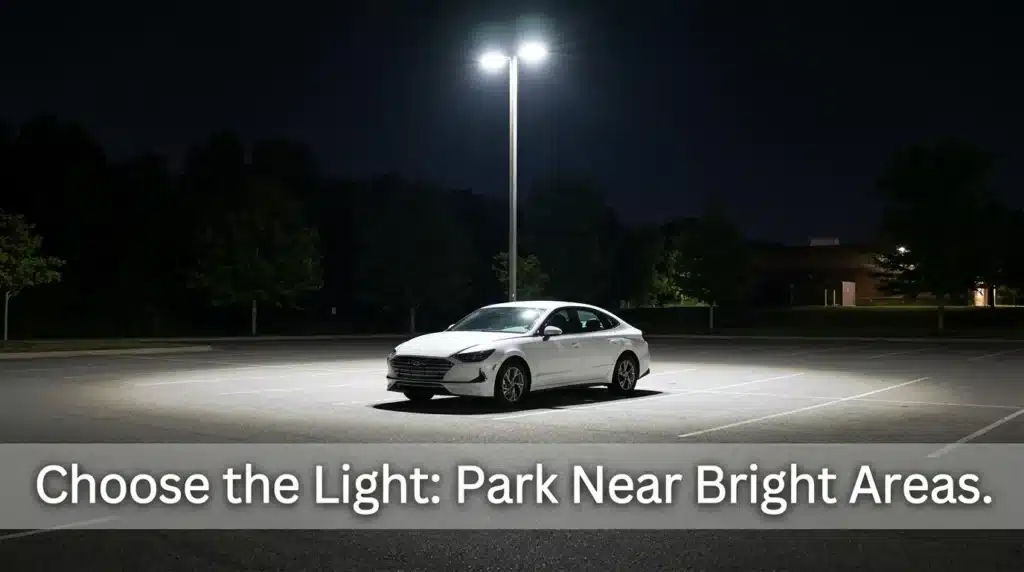
If you have to walk a long distance in a dark parking lot, try to park under a streetlight. Even if it means walking a few extra steps, the light is your best friend. A well-lit car is much less likely to be targeted by someone looking for a quiet spot.
Make it a habit to check your back seat before you get in. Use a small, bright flashlight to quickly peek through the window. It takes only two seconds but can prevent a nightmare scenario. These small habits might seem extra, but they build a wall of security around your daily life.
7. Avoid Dangerous Nighttime Mistakes
Even the most careful people can fall into traps if they aren’t careful. Here are the 5 most dangerous nighttime mistakes you must avoid:
- Being Too Predictable: If you leave the exact same door at the exact same minute and walk the exact same path, you are easy to watch. Try to change your exit door or your walking path slightly every few days to keep your routine random.
- Falling for the “I’m Almost Home” Syndrome: This happens when you get within a block of your house and you relax completely. You might take your keys out or start looking at your phone because you feel safe. Many incidents happen right at the front door because the person stopped paying attention. Stay alert until you are inside and the door is locked behind you. Just as you would proactively prevent identity theft on public Wi-Fi exposure while out, don’t let down your digital or physical guard at your doorstep.
- Ignoring Your Car’s Maintenance: A flat tire or an empty gas tank is a minor problem during the day, but it is a massive danger at 2:00 AM. Keep your car well-maintained and never let your fuel drop below a quarter tank. Being stranded on a dark highway is a situation you want to avoid at all costs.
- Over-Politeness with Strangers: If a stranger asks you for the time or directions at night, you don’t have to stop. You can keep walking and say, “I’m in a hurry, sorry!” Your safety is more important than being a “nice person” to a stranger in a dark place. Trust your gut; if a request feels like a trick to make you stop, it probably is.
- Carrying Unpracticed Self-Defense Tools: Relying on a tool you haven’t practiced with is a false sense of security. If you carry pepper spray but have never tested how it sprays, you might hurt yourself more than an attacker. If you choose to carry a tool, learn how to use it properly. Otherwise, your best tools are your eyes, your ears, and your ability to run away.
Long-Term Habits for a Secure Lifestyle
Staying safe isn’t something you do once; it is a way of living. To keep these results for a long time, you must stay consistent. It is easy to get “lazy” after a few weeks of no trouble. You might think, “Nothing has happened yet, so I can relax.”
This is exactly when risks increase. Think of safety like a seatbelt. You don’t wear it because you expect to crash today; you wear it just in case. Treat your nightly awareness with the same respect.
Encourage your coworkers to follow these rules too. If you all leave the building at the same time, walk in a group. There is true safety in numbers. A group of three or four people is almost never targeted compared to a single person walking alone.
Review your route every few months. Sometimes streetlights burn out, or construction creates new dark alleys. By staying flexible and updated, you ensure that your safety plan never gets old or outdated. Just as you routinely evaluate a social media privacy settings guide to protect your digital accounts, reviewing physical routes keeps your daily travel secure.
Frequently Asked Questions About Night Shift Commuting
Is it better to walk fast or slow when I’m alone at night?
You should walk at a steady, purposeful pace. Don’t run, as that shows fear, but don’t dawdle either. Walking with a clear direction shows that you are focused and aware of where you are going.
Should I carry my bag on my shoulder or across my body?
It is usually better to carry a bag across your body or wear a backpack. This keeps your hands free to move and makes it harder for someone to grab the bag and run. However, if someone does grab it, let it go. Your life is worth more than your phone or wallet.
What should I do if my car breaks down at night?
Stay inside the car with the doors locked. Call for professional help immediately. If a stranger stops to help, talk to them through a cracked window and tell them you have already called for assistance.
How can I stay awake if I feel like I’m falling asleep at the wheel?
The only real cure for sleepiness is sleep. If you are too tired to drive, don’t risk it. Find a well-lit, safe area like a 24-hour gas station and take a 20-minute power nap before continuing.
Is it safe to use a bicycle for a night shift commute?
Yes, but you must have very bright front and back lights. Wear reflective gear so cars can see you. Stick to main roads and avoid taking shortcuts through dark parks or narrow bike paths that have no exits.
Taking Control of Your Nightly Journey
Your job is important, but your safety is the top priority. Moving through the night doesn’t have to be a source of constant fear. By using these advanced tips, you turn the darkness from a threat into just another part of your day.
You have the power to protect yourself. Every time you check your back seat, choose a bright route, or stay off your phone, you are winning. You are showing that you value yourself and your well-being. Keeping your personal defense strong mirrors how you protect home wifi network zones—it requires consistent enforcement.
Stay proud of the work you do during those late hours. It takes a special kind of person to handle the night shift. Now, use that same strength to keep yourself secure. Start tonight by making one small change to your routine.
Maybe you will park closer to the light or keep one earbud out. These tiny actions add up to a very safe life. You deserve to feel confident every time you step out of your door. Keep your head high, stay aware, and know that you are ready for whatever the night brings.
Taking back your peace of mind doesn’t happen all at once, but you don’t have to change your whole routine overnight. Start by picking just one simple habit tonight, like parking under a bright streetlight or holding your keys in hand before you walk outside. You work hard during the quiet hours of the night, and you deserve to get home feeling safe, calm, and proud every single day.
Disclaimer: This content is for informational purposes only. Personal safety is a complex issue and these tips do not guarantee safety. Always prioritize your intuition and follow the advice of local security professionals or law enforcement in your specific area.