The Day a Stranger’s “Bump” Cost Me My Wallet
I still remember the exact spot on the metro platform where it happened.
I was squeezed between a dozen people, my backpack pressed against my chest, and I felt someone bump into my shoulder. I mumbled “sorry” like a good tourist and kept moving.
It wasn’t until I sat down twenty minutes later that I reached for my wallet and felt nothing but an empty pocket.
My stomach dropped. My cards, my cash, even a small photo I kept in there — gone.
I spent the next two hours canceling cards from a payphone, feeling stupid and exposed in a city I didn’t know well.
That one “bump” taught me more about crowd safety than any travel blog ever had.
The Quiet Anxiety Pickpockets Leave Behind
Losing your wallet or phone in a crowd isn’t just about the money. It changes how you feel for the rest of the trip.
You start looking over your shoulder at every station. You hold your bag a little tighter every time someone walks close to you. A trip that was supposed to feel fun starts to feel like a test you’re afraid to fail.
Here’s what most people don’t talk about:
- The panic of realizing your ID and cards are gone in a country where you don’t speak the language
- The awkward, embarrassing feeling of asking hotel staff or police for help when you feel like it was “your fault”
- The hours lost calling banks, canceling cards, and replacing documents instead of enjoying your trip
- The lingering distrust — even friendly strangers start to feel like threats
This isn’t about being paranoid. It’s about understanding that pickpockets rely on distraction and crowd density far more than skill, and once you know their playbook, you take away most of their advantage.
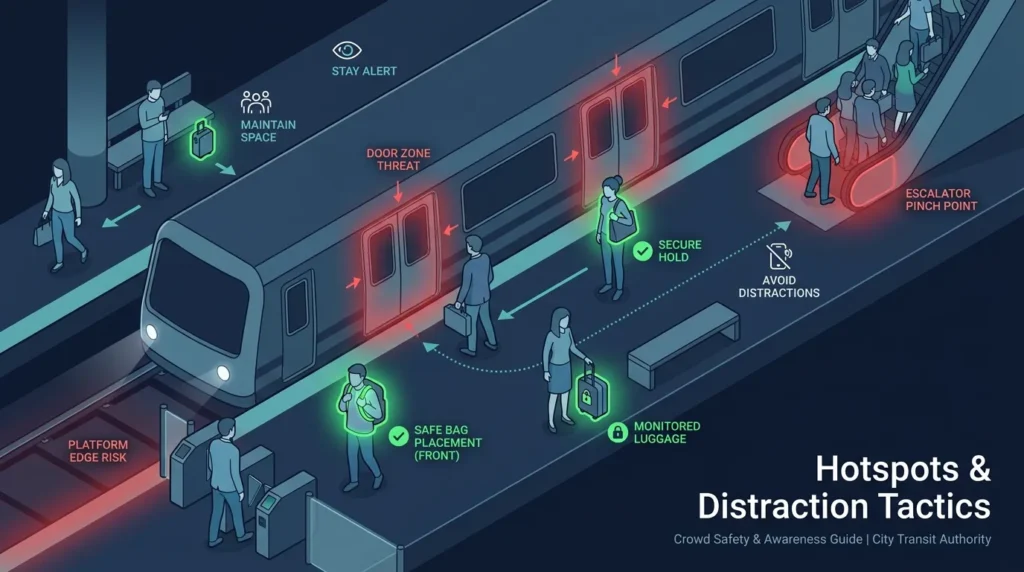
Where Pickpockets Actually Work (and Why Crowds Make It Easy)
Pickpockets don’t pick random victims. They read body language the same way a salesperson reads a room.
They look for three things: distraction, loose valuables, and confusion. Crowded places — train platforms, markets, festivals, tourist landmarks — give them all three at once.
Learn to Spot the “Set-Up” Before It Happens
Most pickpocket thefts follow a pattern, and once you see it, you can’t unsee it.
A common method is the “sandwich technique.” One person slows down or stops right in front of you. Another person closes in from behind. You’re briefly boxed in, and that’s the exact moment your pocket or bag gets opened.
Another version uses a fake distraction — someone drops something, asks for directions, or points at a “stain” on your shirt. While you’re looking down or reacting, a second person is already at your bag.
Watch for these warning signs in a crowd:
- Someone standing unusually close when there’s clearly space elsewhere
- A person who makes sudden, deliberate physical contact and then apologizes
- Groups that seem to “surround” you near doors, stairs, or ticket machines
- Anyone holding a jacket, map, or newspaper oddly close to your bag
I want to be honest about something I got wrong early on. I used to think a busy tourist area was automatically safer because of all the police and cameras around. It’s actually the opposite — heavy foot traffic is exactly what pickpocket teams look for, because nobody remembers one specific bump in a crowd of hundreds.
Watch This Before Your Next Trip
This short video breaks down exactly how pickpocket teams scout and target tourists in real crowds, and it’s worth watching before you pack your bags:
How You Carry Your Bag Matters More Than the Bag Itself
The single biggest mistake I see travelers make isn’t a cheap bag. It’s where they carry it.
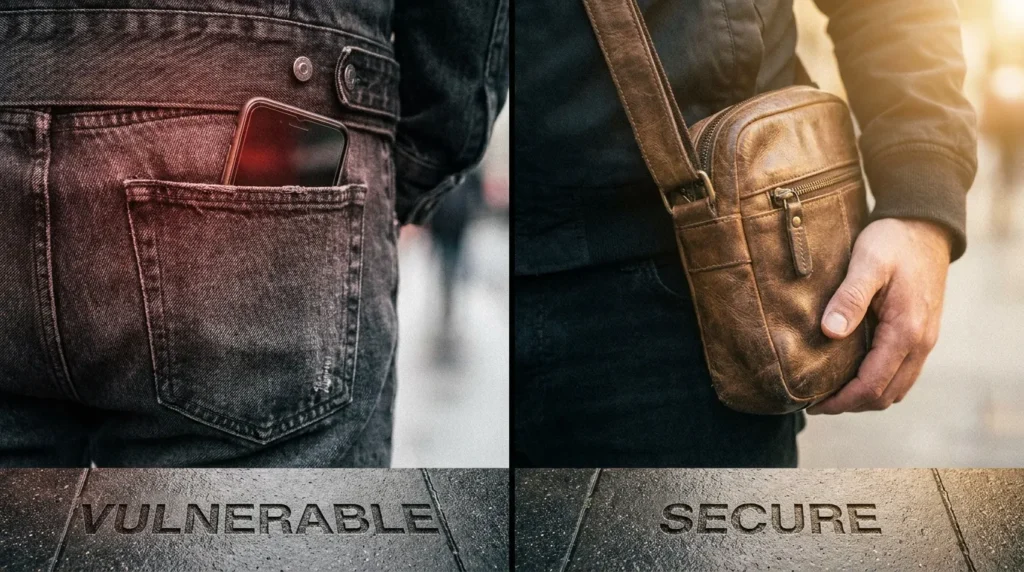
Back pockets, outer coat pockets, and open tote bags are the easiest targets in any crowd. A thief needs less than two seconds of unguarded access.
Simple fixes that actually work:
- Wear crossbody bags in front of your body, not on your back or side
- Keep zippers facing your body, not the crowd
- Use front pants pockets for phones and cash, never back pockets
- If you’re wearing a backpack in a packed space, swing it to your front
If you also tend to stand out visually in tourist spots, it helps to look into simple ways to blend in and avoid looking like an easy target, since pickpockets often scan for visual cues just as much as bag placement.
Myth vs. Reality: Anti-Theft Bags
| Myth | Reality |
|---|---|
| “Anti-theft bags make you 100% safe” | They slow thieves down, they don’t stop determined ones |
| “Only backpacks get targeted” | Crossbody bags and purses are targeted just as often |
| “Pickpockets only work alone” | Many operate in teams of two or three |
Keep Your “Real” Valuables Out of Reach Entirely
Here’s a habit that changed everything for me after that metro incident.
I stopped carrying my passport and all my cards in one place. I now split things up — a small amount of daily cash and one card stays with me, and everything else stays locked in my hotel or accommodation.
This one change means that even in a worst-case scenario, I’m not losing everything at once.
Practical ways to reduce your risk before you even leave your room:
- Use a hotel safe or a lockable bag for your passport and spare cards
- Carry only the cash you’ll need for that day
- Keep a digital copy of your ID and passport saved securely, separate from the physical ones
- Consider a hidden money pouch under clothing for backup cash
For longer trips, it’s also worth reviewing a full international travel security protocol so you’re not making these decisions on the fly while jet-lagged and distracted.
A quick note on documentation: according to the U.S. Department of State’s guidance for travelers, keeping copies of your travel documents separate from the originals is one of the simplest ways to recover faster if something goes wrong.
Stay Aware Without Being Anxious
There’s a difference between being alert and being paranoid, and it took me a while to find that balance.
Small habits that keep you sharp in crowded areas:
- Keep your phone in a front pocket, not held loosely in your hand
- Avoid using headphones in both ears while walking through busy stations
- Glance around when someone gets unusually close instead of ignoring it
- Trust that “off” feeling — most people who felt something was wrong were right
I used to feel silly checking my bag every few minutes in a crowd. Now I see it as no different than checking a mirror while driving. It’s just part of moving through the world safely.
If you’re traveling with family, this awareness matters even more, since kids and older relatives are often distracted by their surroundings. A quick read through family-focused travel safety habits can help you build routines the whole group follows automatically.
The Habits That Keep You Safe Long After You Get Home
Staying alert on one trip is easy. The real skill is making it automatic, so you don’t have to think about it every single time you step into a crowd.
I used to treat safety like a checklist I ran through once at the airport. Now it’s just part of how I move through any busy place, at home or abroad.
Here’s what actually makes these habits stick for the long run:
Build a “pocket routine” before you leave your hotel or house each day. Touch your phone, wallet, and keys in that exact order every single time. Your hand will notice instantly if one of them feels off later.
Rotate what you carry based on the crowd size, not the destination. A quiet museum on a Tuesday morning doesn’t need the same setup as a packed night market or a holiday parade.
Pro Tip: I once got lazy on a “safe” afternoon in a small town square and left my phone in my back pocket out of habit. Nothing happened that day, but it reminded me that pickpockets don’t care if the city feels charming or small. The habit has to be constant, not situational.
Talk to your travel companions about a simple signal. If one of you notices someone standing too close or acting strange, a quick word or look lets the group tighten up without causing a scene.
Use technology as a backup, not your main defense. Apple AirTags, Tile trackers, or built-in phone tracking apps won’t stop a theft, but they can help you recover a bag faster or prove your location to local authorities. According to Europol’s guidance on organized property crime, reporting theft quickly with accurate details significantly improves recovery chances, even in cities where pickpocketing is common.
Keep a small “loss kit” mentally ready: your bank’s international phone number, a photo of your passport saved in an encrypted note app, and your embassy’s contact info. This takes ten minutes to set up and can save you hours of panic later.
If you travel often, it’s worth treating this the same way you’d treat general hotel room security habits — something you do automatically, not something you remember only after a scare.
Don’t skip the “boring” prep. Photocopy your cards. Screenshot your itinerary. Tell one person back home your rough daily plan. None of this feels exciting, but it’s exactly what makes recovery fast if something does go wrong.
The Costly Mistakes That Make Pickpockets’ Jobs Easier
I want to be real with you about something. Most people who get pickpocketed weren’t careless in some dramatic way.
They made small, forgivable mistakes that felt harmless in the moment.
Wearing your bag on your back in a packed space is one of the biggest ones. You genuinely cannot feel someone unzip a bag that’s out of your sightline, no matter how “aware” you think you are.
Keeping your phone in your hand while walking through a crowd feels convenient, but it’s basically an invitation. A distracted grip is easy to bump loose, and phones are one of the most targeted items because they’re worth so much on resale.
Another one that surprised me: trusting a “helpful stranger” too quickly. Someone offering unsolicited help with your bag, your map, or your ticket machine can be completely genuine. But it’s also a classic distraction setup, and there’s no harm in politely saying “I’ve got it” and stepping back a little.
Leaving your wallet or phone on a café table is so common it barely registers as risky anymore. It takes less than two seconds for someone to walk by and take it while you’re mid-conversation.
People also underestimate how much a stressed, distracted body language gives away. If you look lost, tired, or overwhelmed, you’re easier to approach and easier to distract. That doesn’t mean you have to fake confidence you don’t feel. It just means slowing down, finding a quiet spot to check your map, and not making big decisions while standing in the middle of a rushing crowd.
The cost of these mistakes isn’t only financial. You lose time, you lose peace of mind, and sometimes you lose trust in people who had nothing to do with what happened. That’s the part that lingers the longest.
If you’re navigating unfamiliar transport systems on top of crowd safety, pairing this with a look at ride-sharing safety versus local taxis can help you avoid stacking multiple risks on the same day.
Common Questions About Staying Safe From Pickpockets
What should I do immediately if I get pickpocketed?
Stay calm and check what’s actually missing before you panic about everything. Report it to local police for a written report, then call your bank right away to freeze your cards.
Do money belts really work?
Yes, especially for backup cash and your passport, since they’re hidden from view entirely. Just don’t dig into them in public, or you’ll show everyone exactly where your valuables are.
Are certain cities more dangerous for pickpocketing than others?
Some tourist-heavy cities do see more reported cases simply because of crowd density and foot traffic. But the core risk factors, distraction and loose valuables, are the same everywhere in the world.
Can pickpockets target you even if you’re not carrying much cash?
Absolutely, since phones, cards, and passports are often worth more to them than cash. A stolen phone alone can be resold or used for further scams.
Is it safe to keep my passport with me all day while sightseeing?
Generally, no, unless you legally need it on you for a specific reason that day. A photocopy or digital scan usually covers your needs while the original stays locked up safely.
Should I fight back if I catch someone in the act?
No, your safety matters more than your belongings in that moment. Make noise, alert people nearby, and let local authorities handle the physical response.
Your Crowd Stays the Same, You Don’t Have To Be an Easy Target
Here’s what I want you to take from all of this. Crowds themselves aren’t dangerous. It’s the small, unguarded moments inside them that create the opening.
Every habit we’ve talked about, wearing your bag right, staying aware without being anxious, splitting up your valuables, takes almost no extra effort once it becomes routine.
I still travel through packed stations and markets all the time. The difference now is that I move through them without that tight, anxious feeling in my chest, because I know my routine is doing the work for me.
Start small tomorrow. Pick just one habit from this guide and build it into your day before you even think about the rest.
You don’t need to be perfect at this. You just need to be a little harder to catch off guard than the person standing next to you.
Disclaimer: This article is intended for general informational purposes only and does not constitute professional security, legal, or travel advice. Personal safety situations vary by location, circumstance, and individual risk factors. Always follow local laws, official travel advisories, and the guidance of local authorities when traveling.