The Afternoon I Actually Measured My Cat Flap
My cat has always come and gone through her flap without me giving it much thought. Then a neighbor’s house got broken into, and the police told her the likely point of entry was her own cat flap.
That conversation sent me outside with a tape measure. I checked the distance between my flap and my back door handle, and it was closer than I expected.
I hadn’t looked at that flap critically in the four years I’d owned it. That night, I found myself checking the back door before bed for the first time since we moved in.
Cats need their independence, and most owners aren’t willing to give that up just to lock down a door. But a standard flap was never built with break-ins in mind, and once you notice that, it’s hard to unsee.
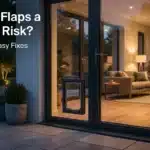
Are Cat Flaps a Security Risk? 5 Hidden Vulnerabilities (And Fixes)
Understanding exactly how a cat flap creates an entry point is the first step toward closing that gap without taking away your cat’s freedom.
Once you know what intruders actually look for, fixing it becomes a fairly quick and affordable project.
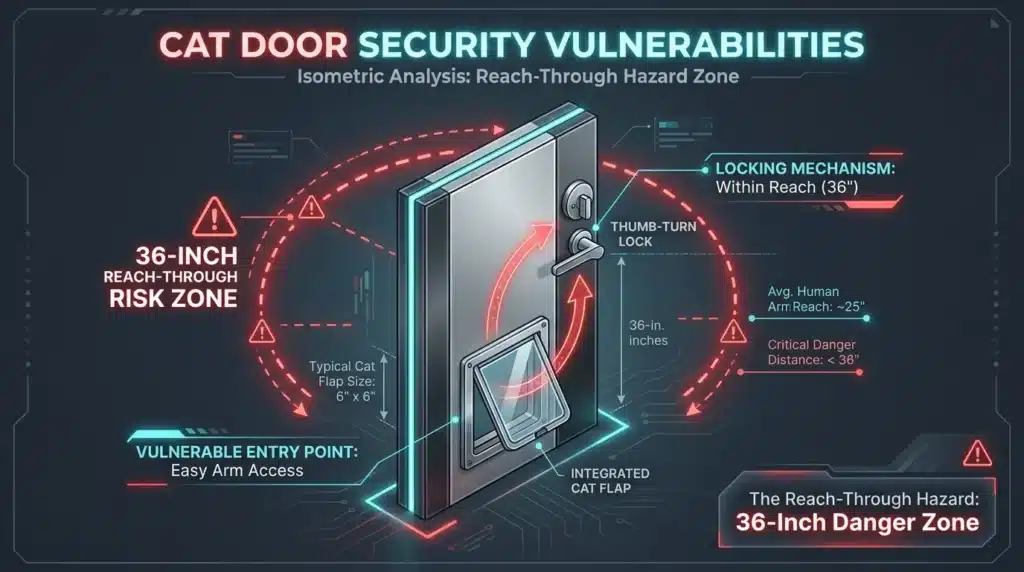
The Reach-Through Hazard: Lever and Deadbolt Placement
Most cat flaps sit low on a door, which puts them closer to floor-level hardware than people usually realize.
Intruders look for flaps installed within 36 inches of a door handle or a thumb-turn deadbolt.
A hand or a thin tool pushed through the flap can reach up and flip a manual lock in seconds, since cat flaps rarely have anything blocking that reach besides a soft rubber or plastic seal.
If your deadbolt uses a simple thumb-turn on the inside, this is the exact weak point a burglar is trained to look for.
This risk goes up if your cat flap sits on a side or rear door that is hidden from street view.
You have two options here: move the flap further from the lock, or swap the lock itself for one that a reach-and-turn motion can’t defeat.
You can read our guide on how to reinforce your front door to see how stronger strike plates and physical barriers help protect handles near any kind of pet opening.
Cat Flap Risk Assessment
| Vulnerability | Primary Hazard Level |
|---|---|
| Reach-Through Access | High (If within 36 inches of thumb-turn lock) |
| Unlocked Flap Panel | High (Leaves the door open 24/7) |
| Standard Plastic Flap | Medium (Easy to pry, cut, or force open) |
| Microchip RFID Flap | Low (Stays mechanically locked at all times) |
Why a Cat’s Smaller Flap Isn’t Automatically Safer
It’s tempting to assume a cat flap is inherently less risky than a dog door simply because the opening is smaller. That’s only half true.
A smaller flap does rule out an adult crawling through it. But it does nothing to stop a hand or a thin tool from slipping in and finding a lock — that gap needs very little room.
Cats also tend to want their flap installed lower and closer to the ground than a dog door would be, which frequently puts it closer to floor-mounted hardware or low door handles.
If your home has an apartment or rental setup with limited modification options, this low placement is worth checking carefully, since landlords often installed the cheapest flap available without thinking about lock proximity.
Microchip RFID Flaps vs Standard Vinyl Flaps
A standard cat flap usually relies on a lightweight magnetic strip to hold the flap shut against wind and drafts.
That magnet offers almost no resistance against something being pushed through from the outside.
Anyone can push a screwdriver or thin pry bar straight through a standard vinyl cat flap without much noise or effort.
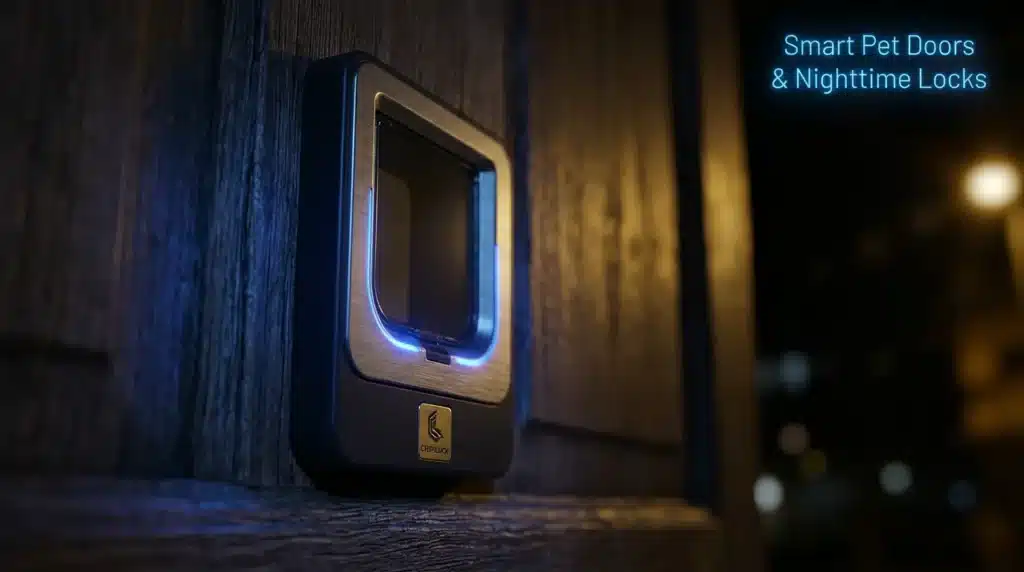
Microchip cat flaps solve this by staying mechanically locked at all times, only releasing when your cat’s registered microchip or collar tag is detected within a few inches of the sensor.
Many models also include a four-way lock setting, letting you choose in-only, out-only, fully locked, or open access depending on the time of day.
That four-way flexibility is one of the biggest differences from most dog doors, and it gives you a level of control a simple flexible flap never will.
Watch this quick walkthrough on how microchip cat flaps compare to standard flaps for security:
Comparison Matrix: Evaluating Cat Flap Options
Picking the right flap comes down to balancing your cat’s needs, your budget, and how much physical security you actually want at that opening.
| Cat Flap Style | Security Level | Average Cost | Physical Barrier Strength | Best Suited For |
|---|---|---|---|---|
| Standard Vinyl Flap | Very Low | $15 – $50 | Weak (Flexible Plastic) | Indoor doors only |
| Slide-In Panel Cover | High | $40 – $90 | Strong (Rigid Panel) | Nighttime lockup |
| Microchip RFID Flap | Very High | $80 – $200 | Very Strong (4-Way Locking) | External doors |
| Wall-Mounted Tunnel | High | $150 – $350 | High (Dual Sealed Flaps) | Hidden side walls |
DIY Reinforcements: Quick Hacks for Existing Flaps
You don’t need to replace the whole door to noticeably improve your setup.
A slide-in cover panel, even a basic one, adds a physical barrier that a soft flap simply doesn’t have on its own.
Swapping short factory screws for longer, thicker ones anchors your flap frame into the actual door studs instead of just the thin surface panel.
If your flap sits near a lock, a secondary slide bolt mounted higher up gives you a lock a reach-through hand can’t get anywhere near.
Outdoor lighting near the flap is another low-cost deterrent worth adding. Our breakdown on do motion sensor lights deter burglars explains where to angle it for the best coverage.
Pro Tip: I started closing my slide-in cover the same moment I put my cat’s food bowl down at night. Tying it to a routine I already do daily meant I stopped forgetting it within the first week.
Critical Safety Checklist for Nighttime and Vacations
A short nightly routine keeps your cat flap from becoming the weak point in an otherwise secure home.
- Slide in a rigid cover panel before turning off the house lights for the night.
- Confirm the four-way lock setting is switched to locked if you have a microchip flap.
- Check that outdoor lighting near the flap is working and unobstructed.
- Trim any bushes or planters near the flap that could hide someone crouching down.
- Walk your yard perimeter using our guide to burglar proof your yard before leaving on a trip.
If you’re prepping the house for a longer renovation project where doors and access points change temporarily, it’s worth reviewing our tips on securing your home during a renovation, since contractors and open work areas can create extra opportunities around a cat flap that isn’t normally a concern.
Long-Term Habits That Actually Keep a Cat Flap Secure
Fixing the hardware once is only half the job. Keeping it working for you months later takes a bit of routine.
Build the Check Into Something You Already Do
Trying to remember “lock the cat flap” as a standalone task rarely works long-term.
Attach it to something automatic, like turning off the porch light or your last check of the house before bed. If the flap check rides along with a habit you already have, it actually sticks.
Watch the Frame, Not Just the Flap
Cat flap frames take a beating from repeated pushing, weather, and years of use. A loose or warped frame can weaken the surrounding door material, even if the flap itself still closes fine.
If you notice the frame flexing when you press on it, that’s a bigger issue than the flap, and it deserves attention before anything else.
Pair It With Broader Perimeter Awareness
A cat flap is rarely the only vulnerable point on a property. If you’re also dealing with a driveway, side gate, or exterior access that feels exposed, our guide on cheap DIY driveway security gate ideas covers low-cost ways to close off approach routes before someone even gets close to your back door.
And if your cat flap happens to be near a bedroom or a room you’d rather keep sealed off at night regardless of what’s happening at the back of the house, it’s worth looking at how to secure a bedroom door from the inside as an added layer.
Where Well-Meaning Cat Owners Go Wrong
Assuming small automatically means safe. Size only solves the crawling-through problem, not the reach-through one covered above. Treating a small opening as a non-issue is one of the most common mistakes.
Leaving the flap unlocked around the clock out of habit. Many standard flaps have no lock at all, and even microchip versions are sometimes left on a permanently unlocked setting for convenience. That convenience comes at the cost of leaving the door effectively open all day and night.
Ignoring the frame once the flap itself looks fine. People focus entirely on the flap and forget the surrounding cutout weakens the door material over time, especially on older wooden doors.
Skipping the reach-through test. Getting down and physically checking how far you can reach through your own flap toward the lock feels unnecessary, but it’s the fastest way to know your actual exposure instead of guessing.
Common Mistakes and Fixes
| Common Mistake | Real-World Risk Level | Simple Solution |
|---|---|---|
| Flap Near Thumb-Turn Lock | High (Easy arm reach) | Move flap or upgrade to key-operated deadbolt |
| Flap Left Permanently Unlocked | High (Door effectively open 24/7) | Use timed or four-way lock settings |
| Weakened Door Frame Around Cutout | Medium (Structural soft point) | Reinforce frame or replace affected panel |
| No Nighttime Cover Routine | Medium (Relies on flap alone) | Add a slide-in panel and tie it to a nightly habit |
Common Questions About Cat Flap Security
Are cat flaps a security risk?
Cat flaps can create a real security risk, mainly through the reach-through problem near nearby locks rather than someone actually crawling through the opening. The risk is very manageable once you address flap placement, locking, and the strength of the surrounding frame.
Can someone break in through a cat flap?
It’s uncommon for an adult to physically fit through a standard cat flap, but a person can still reach an arm or a tool through it to reach a nearby lock or handle. That’s the more realistic risk to plan around.
Can a cat flap be locked?
Most modern cat flaps include at least a basic manual lock, and microchip models typically offer a four-way setting: in-only, out-only, fully locked, or open access. Using the lock setting consistently is one of the simplest security upgrades available.
Is it safe to have a cat flap on a door near my bedroom?
It can be, as long as the flap is properly locked at night and positioned well away from any nearby door or window locks. If the flap sits close to a bedroom, pairing it with a secondary lock on the bedroom door itself adds an extra layer of peace of mind.
How do I stop other animals from coming in through my cat flap?
Standard magnet-only flaps let any similarly sized animal push through, including other cats, raccoons, or opossums. A microchip RFID flap solves this directly, since the lock only releases for your cat’s registered chip or collar tag.
One Tape Measure, Twenty Minutes, Done
A cat flap doesn’t force a choice between your cat’s freedom and your home’s security. Placement, locking, and the frame around it are the three things that actually matter, and none of them take long to fix.
Check where your flap sits relative to your nearest lock — that one detail tells you more about your real risk than anything else here.
I used to think of my cat flap as background noise, just a fixture on the door. Now it’s something I actually check.
If your household also has a dog, the same reach-through and locking issues apply on a larger scale. Our guide on are dog flaps a security risk walks through the same fixes sized for a bigger opening.
A quick heads-up before you go: I’m just a fellow cat owner sharing what worked for my own back door, not a locksmith or security professional. If you’re dealing with an older door or an unusual layout, it’s worth having a local locksmith take a look to make sure everything lines up with your specific setup.