What Does It Actually Mean to Feel Safe?
My hands used to hover over my phone every time I heard a strange sound outside my window. I’d lie there at 2 AM, running through every possible scenario, unable to fall back asleep. It wasn’t one big event that triggered this—it was years of small worries piling up until they became a constant hum in the background of my life.
I started locking my doors twice. Checking my bank app every morning before coffee. Flinching at notifications from unknown numbers. None of it made me feel safer. It just made me more tired.
A securely life comes down to five connected habits: reinforcing your home’s entry points, protecting your digital identity with strong authentication, staying alert in public spaces, building a family emergency plan, and taking basic precautions while traveling. None of these require expensive gear—just consistency and the right starting point.
Most people spend money on the wrong fix. A better lock. A pricier antivirus. A fancier camera. None of it holds up, because real security isn’t a purchase — it’s a system, and almost nobody ever gets shown how the five pieces connect.
That gap is exactly what leaves so many of us stuck in a low-grade state of worry that never fully lifts. You check the locks, but you still can’t shake the feeling that something’s missing. You update your password, but you’re not sure if that’s actually enough. This isn’t paranoia. It’s the natural result of trying to solve a system-level problem with scattered, one-off fixes.
Why the Weight of Feeling Unprotected Runs Deeper Than You Think
Living without a clear safety plan costs more than peace of mind. It reshapes your daily routine in small ways you barely notice — until you stop and add them up.
You spend mental energy at work replaying whether you locked the back door. You hesitate before letting your kids walk to a friend’s house alone. You avoid checking your bank statements because you’re afraid of what you might find. Over time, this low-level vigilance becomes exhausting in a way that’s hard to name but impossible to ignore.
The people who feel most at ease aren’t the ones with the most expensive security systems. They’re the ones who’ve built simple, repeatable habits across every part of their life—physical, digital, and personal. That’s the difference between reacting to fear and actually living with confidence.
The Real Numbers Behind Why a System Matters
| Safety Category | Key Statistic |
|---|---|
| Home Security | Homes without visible security systems are roughly 300% more likely to be targeted by burglars |
| Digital Safety | Over 90% of data breaches trace back to phishing scams or weak, reused passwords |
| Personal Safety | Roughly 70% of street-level incidents can be avoided through basic situational awareness |
| Family Safety | Households with a practiced emergency plan cut panic and injury risk by up to 85% |
| Travel Safety | About 1 in 4 travelers report facing a security or identity risk while using public Wi-Fi |
Source: FBI Uniform Crime Reporting, cybersecurity industry breach reports, and public safety studies.
These numbers point to the same conclusion: prevention is dramatically cheaper—in money, time, and stress—than recovery. A basic understanding of digital risk exposure, as outlined by CISA’s consumer cybersecurity guidance, shows that most breaches start with something small and preventable.
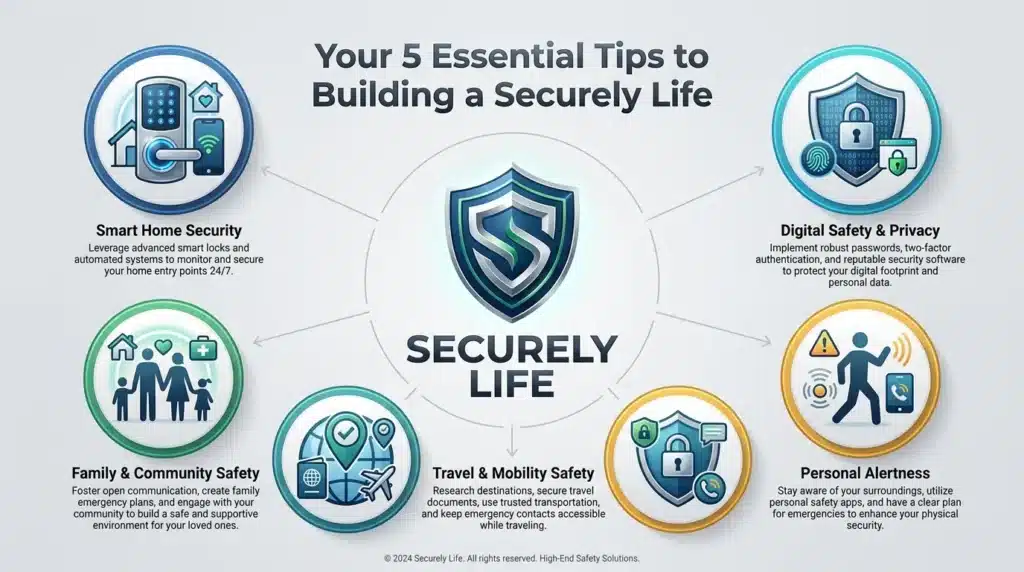
The Securely Life Checklist: 5 Core Habits
Building a securely life doesn’t require overhauling your daily routine overnight. It’s about stacking five practical, everyday habits—starting with the physical boundaries of your home.
Tip 1: How Do You Strengthen Home Security Without Overspending?
Reinforcing your home starts with your weakest entry point, not your most expensive gadget. Most break-ins happen through a front door or ground-floor window because those are the fastest, quietest ways in.
Check your strike plates first. A standard lock is only as strong as the wood holding it in place. Swap the short screws that came with your door hardware for 3-inch screws that reach into the wall stud behind the frame—this single change makes forced entry significantly harder, even for an experienced intruder.
Lighting matters just as much as hardware. Install motion-sensor lights at a height of at least 8 feet, positioned so they can’t easily be reached or unscrewed. A sudden light isn’t just a deterrent—it signals that someone inside is paying attention.
Quick wins that cost nothing:
- Keep the garage door closed even when you’re home
- Trim bushes and shrubs near windows down to under 3 feet
- Make sure your house number is visible from the street for emergency responders
- Say hello to your neighbors—informal watch networks catch what cameras miss
I learned the hard way that a $200 camera means nothing if the door frame behind it is soft enough to kick in. Fixing the frame cost me about $15 in hardware and twenty minutes with a drill.
For a full walkthrough of entry-point weaknesses, our guide on reinforcing your front door against forced entry breaks down exactly which points fail first.
💡 Want to dive deeper into protecting your property? Explore our full library of guides in the Home Security hub.
Tip 2: What Actually Protects Your Digital Identity?
Digital safety starts with a simple truth: reused passwords are the single biggest reason accounts get compromised. If one site leaks your password, every account using that same password is now exposed.
Do this today:
- Use a password manager to generate unique, 16+ character passphrases for every account
- Turn on Two-Factor Authentication (2FA) for your email, banking apps, and social profiles—this blocks access even if your password leaks
- Request a secondary PIN from your mobile carrier to prevent SIM-swapping attacks
- Avoid public charging ports; carry a small USB data blocker or stick to your own wall outlet
Phishing attempts are also getting harder to spot. If a message claims to be your bank but the sender’s email address has a strange domain or a spelling error, that’s your signal to stop and verify—never click first.
After dealing with a near-miss phishing text myself (it looked exactly like my delivery service), I started checking every “urgent” message against the company’s official app instead of clicking links directly. That one habit alone has caught three fake messages in the past year.
Watch this quick breakdown of how phishing scams are built to fool even careful people:
💡 Secure your data and stay ahead of new threats—browse our full Digital Safety section for the latest breakdowns.
Tip 3: How Do You Build Real Situational Awareness?
Personal safety isn’t about carrying tools—it’s about noticing your surroundings before something goes wrong. Security professionals call this situational awareness, and it’s a skill you can build in a few weeks of consistent practice.
Keep your head up in public spaces, especially parking lots and transit stations. People looking down at their phones are the easiest targets simply because they’re the last to notice anything happening around them.
Trust your gut. If a street feels too quiet, or someone’s behavior makes you uneasy, change direction immediately. That instinct is your brain processing small warning signs faster than conscious thought can.
Practical habits that build confidence:
- Keep a small flashlight or personal alarm within easy reach
- Match a ride-share driver’s license plate to the app before getting in
- Walk with purpose—confidence itself reduces the odds of being targeted
💡 Equip yourself with more tactics for navigating public spaces—visit our Personal Safety hub.
Tip 4: What Makes a Family Emergency Plan Actually Work?
A family safety plan only works if everyone—including young kids—can follow it without panicking. Start with a fire escape plan that maps two exit routes from every room, and pick a fixed outdoor meeting spot, like a specific tree or a neighbor’s porch.
Teach children their full name, your name, and your home address, and turn it into a memory game rather than a scary lecture. Set up a family “safe word” that only trusted people know, so kids can verify anyone claiming to pick them up on your behalf.
Keep a basic emergency kit stocked with water, non-perishable food, a flashlight, and first-aid supplies—and check it every six months, since batteries and expiration dates don’t wait for a crisis to remind you.
Once I started running a two-minute fire drill with my own family every few months, the difference in how calmly everyone responded during an actual power outage last winter surprised me.
💡 Keep the people who matter most protected—explore our full Family Safety resource library.
Tip 5: How Do You Stay Safe While Traveling?
Travel strips away your home-field advantage, which is exactly why small precautions matter more on the road than at home.
Before you leave, save digital copies of your passport and key documents in an encrypted cloud folder. Split your cash across your wallet, a bag, and a hidden pouch, so a single loss doesn’t wipe out your trip.
On the ground:
- Always engage the hotel room deadbolt and security latch immediately
- Never leave luggage unattended, even for a minute in a lobby
- Use a VPN on public Wi-Fi at airports and cafes to block data snooping
- Share your live location with someone back home during unfamiliar trips
💡 Whether you’re traveling domestically or abroad, dive deeper in our Travel Safety masterclasses.
The Advanced Layer: Making Your Safety System Actually Stick
Setting up a smart camera takes ten minutes. Remembering to change its default password? That’s where most people fail — not because the habit is hard, but because nothing reminds them to keep doing it once the setup phase is over.
Smart tech works best when it’s boring and predictable. Smart cameras and video doorbells let you check who’s at your door from anywhere, which pairs directly with the family safety habits covered earlier. But the moment you set one up, change the default username and password immediately—factory settings are public knowledge, and a compromised camera becomes a bigger risk than not having one at all.
Smart plugs are an underrated trick here too. Set lights to turn on and off at slightly randomized times when you’re away. It’s a small detail, but it’s the kind of signal that makes a house look occupied without you doing anything at all.
A few maintenance habits worth putting on a calendar:
- Replace smoke detector and smart lock batteries every 6 months, before they die
- Install software updates on routers and cameras as soon as they’re available—these patches often close the exact holes hackers rely on
- Add a battery backup for your router so cameras and alerts stay active during a power cut
I used to treat these updates the same way I treated the “check engine” light—something to deal with eventually. Then a firmware bug in an old router left my home network exposed for nearly two weeks before I noticed. That one gap cost me more cleanup time than every update I’d skipped combined.
Training your reaction, not just your setup. Tools only matter if you know how to use them under pressure. Walk through a mental “what if” scenario occasionally: Where’s the nearest exit? Who do you call first? Families who rehearse this calmly, without making it feel like a scary drill, respond faster and with far less panic when something actually happens.
The Mistakes That Quietly Undo Everything Else
A locked front door and a strong password won’t save you from these five mistakes — because none of them come from carelessness. They come from small blind spots that feel harmless in the moment.
Oversharing your life in real time. Posting vacation photos while you’re still away, or tagging your exact location at a new gadget purchase, hands over information that used to take real effort to gather. Check your privacy settings on every platform you use—if your profile is public, your daily routine is essentially on display.
Hiding a spare key where everyone already looks. Under the mat, inside a fake rock, above the doorframe—burglars know every one of these spots because they’re the same five spots everyone uses. A smart lock with a keypad or a spare key left with a trusted neighbor closes this gap for good.
Letting software updates pile up. That “remind me later” button feels harmless, but most updates exist specifically to patch a vulnerability hackers are already using. Skipping updates doesn’t just delay a fix—it keeps a known door open.
Having exactly one way to handle an emergency. A digital lock with no backup key, a single exit route, one form of communication—single points of failure are the quiet cause of most panic during a real crisis. A workable plan always has a second option built in.
Relaxing your guard the moment you’re on vacation. Crowded train stations, unattended bags, trusting a stranger’s directions too quickly—travel safety failures rarely come from danger, they come from people being more relaxed than the situation actually calls for.
No safety habit here guarantees you’ll never face a problem—layered precautions significantly reduce your risk, but nothing makes you completely immune to bad luck or a determined criminal. The goal is stacking the odds heavily in your favor, not chasing an impossible guarantee.
Common Questions About Living a Secure Life
Is home security expensive to set up?
No, most of the highest-impact fixes cost very little. Reinforcing strike plates with 3-inch screws, trimming window-side bushes, and keeping your garage door closed are all free or under $20, and they address the entry points burglars actually use most.
What’s the fastest way to protect my identity online?
The fastest fix is turning on Two-Factor Authentication on your email and banking apps today, since this alone blocks most account takeovers even if a password leaks. Pairing it with a password manager closes the rest of the gap within a weekend.
Do I need to carry a weapon for personal safety?
Not usually—situational awareness prevents far more incidents than any tool you could carry. If you do carry something like pepper spray, proper training matters more than the tool itself, since an untrained response can backfire in a real confrontation.
How do I talk to kids about safety without scaring them?
Frame it the same way you’d explain wearing a bike helmet—a normal precaution, not a warning about danger. Turning your family’s escape plan into a quick, low-pressure game helps kids remember it without associating it with fear.
Is public Wi-Fi actually risky while traveling?
Yes, open networks at airports and cafes make it easier for someone nearby to intercept your data. A VPN encrypts your connection in seconds and removes most of that risk, so it’s worth turning on before you check anything financial.
Your Next Move Starts With One Small Step
You don’t need to overhaul your entire life this weekend. Pick one thing—maybe it’s finally turning on 2FA, or swapping those short screws on your front door—and start there. Once that habit feels automatic, move to the next piece.
I’ve found that safety stops feeling like a chore the moment it becomes routine instead of a reaction to fear. That shift doesn’t happen overnight, but it happens faster than you’d expect once the first habit sticks.
Just a heads-up from someone who’s pieced this system together over time: I’m not a licensed security consultant, so for anything involving your specific home layout or a serious ongoing threat, it’s worth getting a local locksmith or security professional to take a look. What works broadly doesn’t always account for the details of your exact situation.